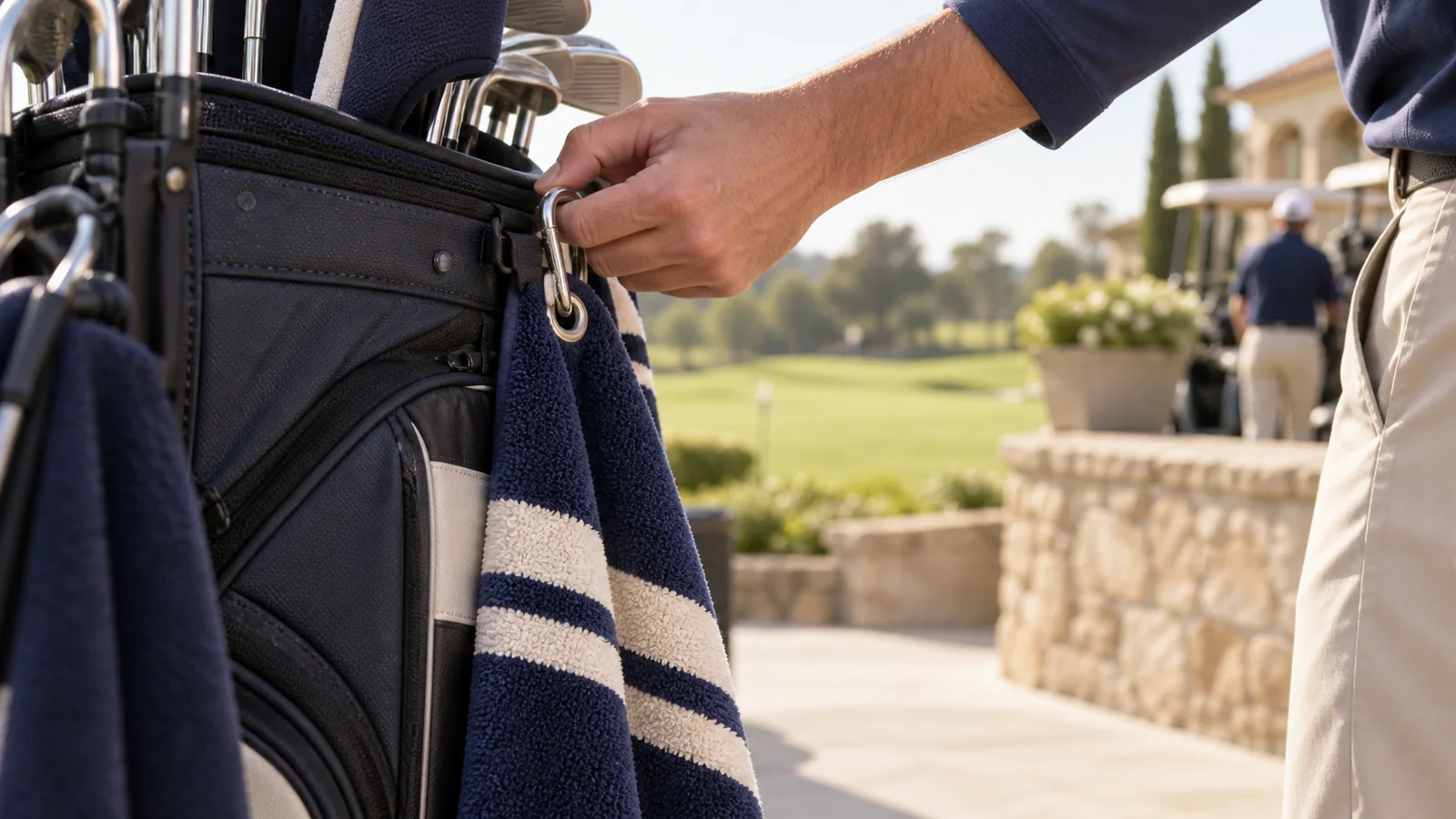
For custom golf towels wholesale, define the user, towel job, material, finished size, fold, attachment, logo method, color, washing route, packaging, event date, and delivery destination before requesting prices. Approve a physical decorated sample with the intended clip, grommet, magnet, label, and pack-out. The purchase order should identify test methods, acceptance limits, artwork version, approved sample, inspection level, and reorder references rather than relying on a digital mockup alone.
This guide is for golf clubs, resorts, pro shops, tournament organizers, promotional distributors, corporate-event teams, retailers, and importers. A caddy towel sold in a pro shop has a different job from a compact tri-fold giveaway or a wet-and-dry towel carried by a player. Comparing quotes without naming that job produces misleading price differences.
There is no universal best golf-towel size, GSM, fabric, attachment, minimum order, wash life, or lead time. The correct specification depends on the end use, branding area, laundry plan, pack-out, shipping method, and event deadline. Loft Weave builds custom towel programs around a written brief and sample approval rather than a generic product label.
Define the golf program before choosing the towel
Start with the buyer and the moment of use. A member towel may hang on a golf bag for an entire season. A tournament towel may be packed with tees, a scorecard holder, or sponsor merchandise and used once before it enters a home laundry. A resort may issue towels through a cart fleet and collect them for centralized washing. A pro shop may need retail-ready labeling and consistent restock colors.
Write down the use case, expected order quantity, number of artwork versions, target delivery date, destination, distribution method, and whether the towel is sold, gifted, or controlled as club inventory. These decisions affect artwork approvals, packaging, labeling, carton marks, sampling, and freight. They also determine whether the project fits a proven private-label towel route or needs more extensive OEM development.
Separate the cleaning job from the marketing job. Golfers may use one area for a damp wipe and another for drying, but a supplier should not promise that a fold automatically keeps those zones separate. Ask for a sample, try the intended fold and attachment on the real bag, and observe how the towel behaves when wet, dusty, and repeatedly handled.
Choose a towel format that works on the bag or cart
Common program formats include a compact bag towel, a tri-fold towel, a larger caddy towel, and a square towel attached by a clip or magnet. Those names are not controlled specifications. Two factories can use the same name for products with different finished dimensions, fabric mass, fold positions, hardware, and logo areas.
| Format to investigate | Operational fit | Specification questions | Sample check |
|---|---|---|---|
| Compact bag towel | Tournament gift, member bag, promotional kit | Finished size, corner attachment, usable logo field, packaging | Does it hang clear of wheels and remain easy to reach? |
| Tri-fold towel | Defined hanging width with a larger opened surface | Fold direction, fold retention, center grommet, decoration across panels | Does the logo read while folded and after laundering? |
| Caddy towel | Large working surface for player or caddie | Finished size, carrying method, wet/dry use plan, edge construction | Is the weight manageable when wet and does it drag? |
| Cart or magnetic towel | Cart fleet, rail, or metal attachment point | Magnet assembly, pull requirement, enclosure, laundering instructions | Does the approved assembly stay attached in the intended position? |
Use physical dimensions in millimeters or inches, state the measurement method, and identify the product state. A 40 cm by 60 cm label may describe the intended finished towel, a pre-wash sample, or a nominal catalogue size. The order should say which one. The towel GSM guide explains why size and mass must be reviewed together.
Select material and weave from evidence, not product nicknames
Cotton terry, cotton waffle, cotton-rich blends, and synthetic microfiber constructions can all appear in golf-towel programs. Each route changes hand, surface structure, decoration compatibility, drying behavior, lint behavior, wash response, and price. A fiber label by itself does not prove cleaning performance or absorbency.
For a cotton terry towel, inspect pile coverage, loop stability, ground construction, hems, border, and the area around the attachment. A waffle structure should be evaluated for the actual yarn and cell geometry rather than assumed to be faster drying because of its name. If the offer uses microfiber, require the generic fiber names and percentages, then test the exact construction. The cotton terminology guide helps separate fiber origin, preparation, spinning, and marketing language.
ASTM D5433-24 is a performance specification for towel products intended for institutional and household use. It recognizes purchaser and supplier agreement as a basis for purchasing requirements. A golf program may sit outside parts of that stated end-use scope, so a buyer should confirm method applicability with a qualified textile laboratory and write the agreed properties into the purchase specification.
Set finished size, GSM, fold, and logo area on one drawing
Put the finished length, width, hem depth, border width, attachment position, fold lines, and decoration field on an actual-size or dimensioned drawing. State whether dimensions apply before washing, after a defined process, or at another agreed state. Set separate criteria for averages and individual pieces when that distinction matters.
ASTM D3776/D3776M-20(2025) offers four options for measuring fabric mass per unit area. Ask the laboratory or supplier which option, specimen type, conditioning, and reporting basis produced the quoted value. A cut towel includes hems, borders, hardware reinforcement, and moisture conditions that may not match a small fabric swatch.
An arithmetic check can identify a quote that needs explanation. A towel measuring 40 cm by 60 cm has a rectangular area of 0.24 m2. At 400 g/m2, the simple calculated fabric mass is 96 g before hardware, decoration, seam, moisture, and method effects. These figures illustrate the calculation; they are not a recommended golf-towel size or GSM.
Show the logo field after folding. A centered embroidery on an open towel can disappear inside a tri-fold. A large print may cross a hem or grommet reinforcement. A woven border may need clear space around letters. The drawing should settle those issues before a machine sample is made.
Specify the grommet, clip, loop, or magnet as part of the product
An attachment changes the towel's load path and laundering risk. Record hardware material, finish, color, dimensions, opening method, attachment orientation, and reinforcement. For a grommet, specify inside and outside diameter, washer or backing arrangement, distance from finished edges, and the reinforced textile area. For a sewn loop, define tape or fabric, dimensions, seam type, and pull direction.
Test the complete assembly
Inspect the towel with its final hardware attached. Apply a buyer-approved pull or repeated-use procedure in the intended direction and record the load or cycle count if a numeric claim is required. Look for fabric tearing, grommet rotation, seam opening, finish damage, and sharp edges. Do not copy a hardware rating from an unrelated component and apply it to the assembled towel.
Define magnet use and care
A magnetic towel needs a named attachment surface and a controlled assembly. Ask how the magnet is enclosed, whether it is removed before washing, and what care statement follows from that design. Evaluate holding performance on the intended cart rail or bag accessory under the buyer's own use conditions. Avoid universal claims that one magnet will stay attached on every cart, bag, or course.
Check metal finish after moisture exposure
Golf towels are handled wet and may contact soil, cleaning products, sunscreen, or fertilizer residue. Agree on a corrosion or appearance check that reflects the program. Inspect staining of nearby fabric as well as the hardware itself. If the supplier proposes a standardized method, obtain the method number, specimen preparation, duration, and acceptance limit before quoting the result.
Choose a logo method that fits the towel construction
Embroidery suits compact marks and controlled thread colors, but density, backing, topping, placement, and reverse finish must be approved. The custom embroidered towel guide covers those controls. A heavy stitch field can stiffen a small towel, bury fine detail in pile, or pull a light waffle structure out of shape.
Jacquard construction can carry a larger tonal or contrasting woven identity. It connects the artwork to yarn planning, pile direction, finishing, and order scale. The custom jacquard towel guide explains face, reverse, repeat, and woven artwork approval.
Print and transfer methods can support fine graphics or full-surface designs when they suit the fiber and surface. Ask for the exact process, pretreatment, print side, cure route, hand, wash method, and effect on the working surface. A digital mockup cannot demonstrate color, penetration, edge definition, hand, or durability.
Create a file-control table with the original logo, supplier production artwork, thread or color references, actual-size placement sheet, approval date, and approver. The same logo can require different simplification on terry, waffle, embroidery, woven border, and print constructions.
Build a sample path that ends with a signed physical towel
A practical route may include an available quality sample, material and color references, digital artwork proof, decorated development sample, corrected sample, and pre-production sample with final hardware and packaging. Simple repeat orders may combine stages. A new towel, attachment, artwork, or pack-out usually needs more evidence.
The towel sample testing checklist gives a broader signoff process. For a golf towel, add a bag or cart fit check, folded-logo check, hardware use check, and the intended presentation test. Photograph the approved sample on the actual attachment point and retain one sealed sample with buyer and supplier.
Record measured dimensions and mass before and after the agreed wash procedure. Note shade, surface hand, pile or cell definition, loose threads, hardware movement, puckering, print change, embroidery distortion, and package condition. A supplier photo can supplement this record but should not replace the retained physical standard.
Test washing, color transfer, dimensions, and working performance
Write the wash and dry procedure before testing. ISO 6330:2021 specifies domestic washing and drying procedures for textile testing, including reference machines, detergents, ballast, and several drying routes. A complete test identifies the chosen procedure. A club laundry may use different chemistry and equipment, so the buyer should reproduce its actual process or select another applicable method with a laboratory.
ISO 5077:2007 addresses dimensional change after an appropriate washing and drying procedure. Record the preparation, marking, measurement, wash, dry, conditioning, and calculation details. A percentage without the associated method and direction cannot resolve whether a folded logo field or attachment position remains acceptable.
ISO 105-X12:2016 covers resistance of textile color to rubbing and staining other materials, with dry and wet rubbing options. This matters when a dark towel is handled wet near gloves, apparel, bags, or light-colored towels. Set the required rating and test face instead of promising that no shade will ever transfer.
ASTM D4772-26 addresses surface water absorption of terry fabrics. Confirm the latest scope and apply it only to an appropriate terry construction. A result from a terry sample should not be presented as proof for a waffle, microfiber, or finished product outside the method's scope.
Use measured and appearance criteria together
A towel can pass a mass or dimensional limit and still show unacceptable logo puckering, grommet rotation, edge wave, print cracking, shade change, or loose loops. Pair numeric requirements with a signed sample and defect photographs. State the lighting and normal viewing distance for color and appearance review.
Control fiber labels, origin marking, care information, and logo rights
The U.S. Federal Trade Commission's Textile Fiber Rule requires covered textile products to disclose generic fiber names and percentages by weight, the responsible manufacturer or marketer identity, and country of processing or manufacture. The FTC guide Threading Your Way Through the Labeling Requirements explains disclosure, label placement, imported-product treatment, and recordkeeping.
Confirm the exact legal treatment of the proposed golf towel, packaging, and sales channel with qualified U.S. counsel or a compliance adviser. Care information should match the textile, decoration, and attachment. If hardware must be removed before washing, the instruction needs to be clear and consistent with the physical design.
The buyer should own or have permission to use the club crest, sponsor mark, tournament name, and other artwork. The United States Patent and Trademark Office explains that a trademark can be a word, phrase, symbol, design, or combination that identifies source. Keep written artwork authorization and define who owns the production file and leftover decorated goods.
Compare MOQ, price, sampling, and delivery on the same assumptions
MOQ may apply per towel construction, size, body color, artwork, decoration process, or packaging version. Ask the supplier to state the unit that controls the minimum. The wholesale towel MOQ guide shows how color and SKU fragmentation affect a custom order.
Compare unit price together with sampling charges, artwork or digitizing, hardware, labels, packaging, inspection, inland transport, export documents, freight, duties, and destination charges. The wholesale towel pricing guide provides a cost-per-dozen worksheet for comparing offers on the same basis.
Build the schedule backward from the in-hand date, not the event date. Include artwork review, sample production, courier time, corrections, bulk production, inspection, export clearance, freight, customs, and delivery buffer. Do not accept a production lead time as if it were a delivered date.
Write a golf towel RFQ that factories can quote consistently
| RFQ field | What to state | Evidence to request |
|---|---|---|
| Program and destination | Club, pro shop, tournament, resort, quantity, SKUs, delivery address, in-hand date | Production and shipping timeline with assumptions |
| Base towel | Fiber content, yarn, weave, pile or cell structure, finished size, mass basis, color, hems, border | Available quality sample and construction sheet |
| Attachment | Grommet, clip, loop, magnet, dimensions, material, finish, position, reinforcement | Component record and assembled-sample test |
| Branding | Artwork version, method, colors, dimensions, placement, face/reverse, folded appearance | Actual-size proof and decorated physical sample |
| Testing | Wash/dry route, dimensions, mass, rubbing, absorbency where applicable, hardware and appearance limits | Named methods, reports, sample count, results |
| Labels and packaging | Fiber/origin/responsible-party label, care, barcode, insert, bag, carton marks | Artwork files and complete pack-out sample |
| Commercial terms | MOQ basis, unit and setup price, sampling, Incoterm, currency, payment, inspection, freight | Itemized quote and validity period |
Send the same RFQ to every shortlisted supplier. Use the supplier selection checklist to compare evidence, communication, sample discipline, and corrective-action process. The certifications guide helps verify certificate scope rather than treating a logo on a presentation as proof.
Inspect the towel, logo, attachment, and pack-out as one unit
Write the inspection plan before production. Define lot, sample size, critical, major, and minor defects, measurement method, acceptance limits, and the authority to approve a concession. Inspect random packed pieces rather than only presentation samples selected by the factory.
Check finished dimensions, mass on the agreed basis, shade, weave or pile, hems, loose loops, stains, decoration placement, artwork clarity, thread or print color, grommet position, reinforcement, clip operation, magnet assembly, labels, barcodes, folding, individual packs, assortment, carton quantity, and carton marks. Confirm that the inspected units match the signed pre-production sample.
If the goods will enter the United States, align the product record with the import plan described in the Pakistan to USA towel import guide. Classification, origin marking, invoice description, valuation, and importer responsibility need their own review.
Protect repeat orders with a controlled reference pack
Retain the signed towel, actual-size artwork, production file, thread or print references, towel construction, yarn and color records, attachment supplier and finish, label file, packaging standard, carton marks, inspection report, and approved deviation record. Give the pack a revision number and approval date.
For every reorder, ask the factory to disclose changes in yarn source, dye route, machine, finishing, hardware, decoration, packaging, and subcontractors. A reorder that uses a new body color, clip, embroidery file, or wash instruction is not identical merely because the purchase-order title is unchanged.
Compare the reorder sample with the retained standard under the same conditions. Review critical measurements and the folded appearance before bulk release. This creates a stronger record than relying on an old product photograph or color name.
Custom golf towel buyer checklist
- End use, buyer group, distribution route, destination, and in-hand date are written.
- Finished size, fold, textile construction, fiber content, mass basis, color, hems, and border are specified.
- Attachment material, dimensions, position, reinforcement, use test, and care route are approved.
- Actual-size artwork shows logo method, colors, placement, folds, seams, hardware, face, and reverse.
- Physical decorated sample passes wash, dimensional, color-transfer, hardware, and appearance checks.
- Label, origin, responsible-party identity, care information, barcode, packaging, and carton marks are approved.
- MOQ basis, itemized price, sampling, Incoterm, freight, inspection, and delivery assumptions are comparable.
- Inspection plan and defect definitions are agreed before production.
- Signed sample and revision-controlled reference pack are retained for reorders.
Frequently asked questions
What material is best for custom golf towels?
No single material is best for every program. Cotton terry, cotton waffle, blends, and microfiber constructions behave differently in hand, cleaning, drying, decoration, washing, and price. Define the job, test the exact construction, and approve a decorated sample instead of choosing from the fiber name alone.
What size should a wholesale golf towel be?
Choose size by attachment point, hanging length, folding method, working area, logo visibility, wet weight, packaging, and user preference. Put finished dimensions and fold lines on the artwork drawing, then test the sample on the actual bag or cart. Catalogue names such as tri-fold or caddy towel are not dimensions.
Should a golf towel use embroidery, jacquard, or printing?
Embroidery works for compact stitched marks, jacquard integrates a broader design into the weave, and printing can support fine or full-surface graphics on a compatible base. Compare artwork detail, towel surface, hand, reverse appearance, wash evidence, order scale, and price before approving the method.
How should a grommet or clip be tested?
Test the complete assembled towel in the intended pull direction and use position. Agree on a documented load or repeated-use procedure when a numeric claim is needed. Inspect reinforcement, fabric tearing, grommet rotation, clip operation, sharp edges, metal finish, and staining after moisture and laundering exposure.
What should buyers send for a golf towel quote?
Send quantity by SKU, finished size, construction, fiber content, target mass basis, color, attachment, artwork, logo method, packaging, label market, test requirements, inspection plan, destination, Incoterm, and in-hand date. Ask suppliers to separate setup, sampling, towel, decoration, hardware, packaging, inspection, and freight costs.
Primary sources used
- ASTM D5433-24, Standard Performance Specification for Towel Products for Institutional and Household Use
- ASTM D3776/D3776M-20(2025), Mass Per Unit Area of Fabric
- ASTM D4772-26, Surface Water Absorption of Terry Fabrics
- ISO 6330:2021, Domestic Washing and Drying Procedures for Textile Testing
- ISO 5077:2007, Dimensional Change in Washing and Drying
- ISO 105-X12:2016, Colour Fastness to Rubbing
- Federal Trade Commission, Textile Fiber Rule
- Federal Trade Commission, Threading Your Way Through Textile Labeling Requirements
- United States Patent and Trademark Office, What is a trademark?