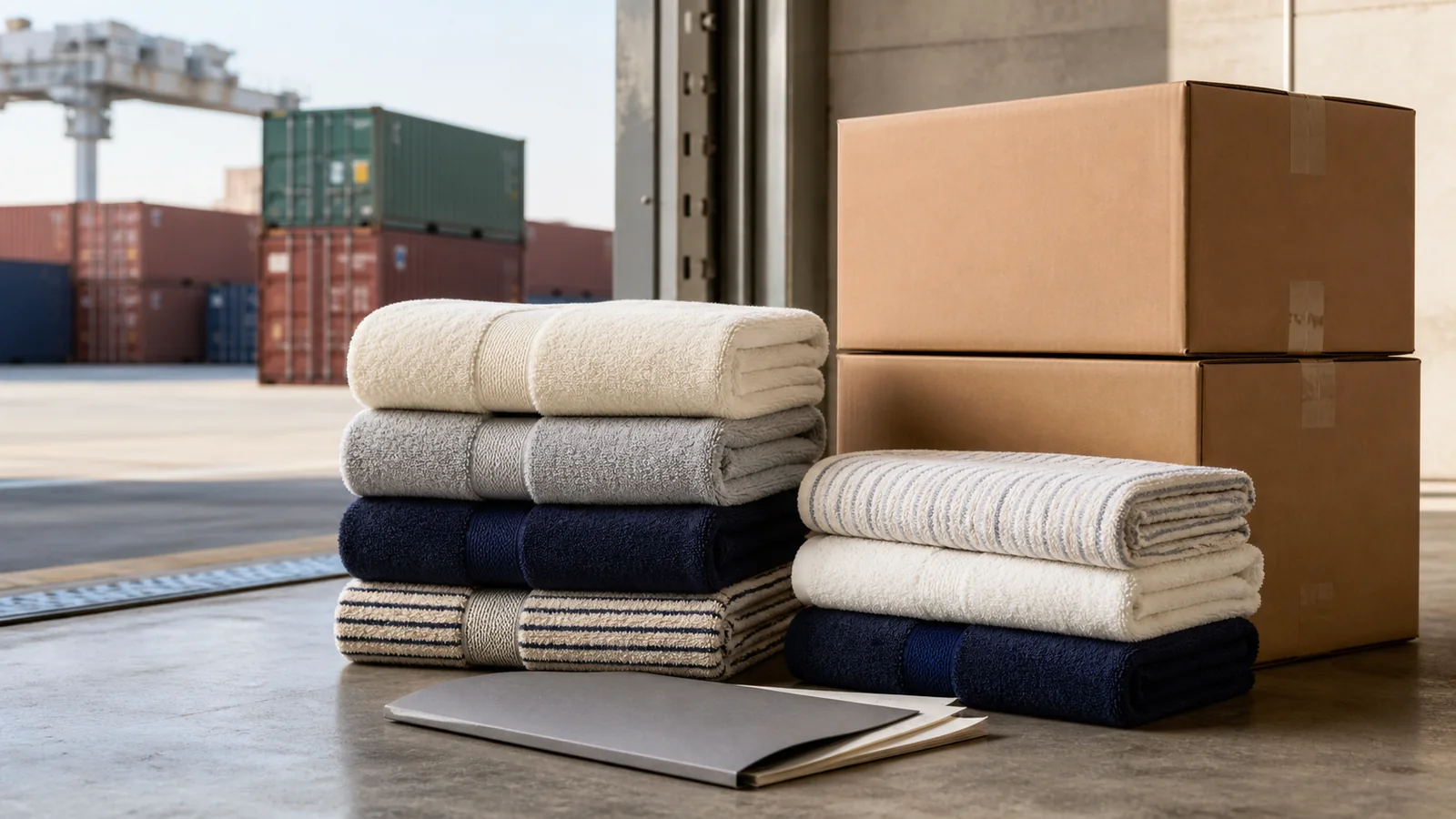
To import towels from Pakistan to the USA, the U.S. buyer should appoint the importer of record, confirm the exact HTSUS classification, register an importer number, arrange a customs bond when required, prepare labels and shipping records, file ocean security data on time, and budget duties plus port and entry fees. For ordinary cotton terry bath towels, HTSUS 6302.60.00 is a common starting point, but the importer remains responsible for the classification and should verify it before pricing or shipment.
This guide is for hospitality buyers, distributors, private-label brands, and procurement teams buying commercial quantities. It is an operational planning resource, not legal advice. A licensed customs broker can file the entry, but U.S. Customs and Border Protection (CBP) says the importer is still ultimately responsible for compliance.
Decide who will be the importer of record
The importer of record is the party responsible for presenting accurate entry information, classifying and valuing the goods with reasonable care, paying duties, and meeting other applicable U.S. requirements. A U.S. buyer commonly fills this role. The purchase contract and Incoterm should identify commercial responsibilities, yet the logistics term alone does not erase the legal duties attached to the importer named on the customs entry.
CBP uses an importer number to identify that party. For a U.S. business, this is usually its Employer Identification Number. A sole proprietor may use a Social Security Number, and a party without either may request a Customs Assigned Importer Number through CBP Form 5106. Put the chosen importer name, address, and number on the broker's setup documents early; fixing entity data after the shipment is booked can delay filing.
A customs broker is not legally required for every import, according to CBP, but commercial ocean entries combine classification, valuation, a bond, Importer Security Filing, entry transmission, and government messaging. For a first towel order, a broker experienced with textiles is usually worth engaging before the purchase order is final. Ask the broker to review the product specification rather than classify from a vague invoice line such as "100% cotton towels."
Bond and entry planning
CBP says a customs bond is required for commercial imports valued above $2,500 and for certain goods subject to other-agency requirements. A single-transaction bond may suit an occasional shipment; regular importers often compare a continuous bond. The broker or surety should set the bond based on the entry profile and current duty exposure, including additional tariffs.
Do not assume a low-value sample follows the same process as a commercial container. A development sample may arrive by courier and clear differently, while a production lot will typically require a formal entry. Keep sample approval, commercial shipment, and customs-value records distinct.
Classify the towel from construction and use
The U.S. International Trade Commission's current Harmonized Tariff Schedule lists heading 6302 for bed linen, table linen, toilet linen, and kitchen linen. Subheading 6302.60.00 covers toilet and kitchen linen made of cotton terry toweling or similar terry fabric. Its statistical lines distinguish dish towels from other towels and use different textile category reporting.
That heading often fits woven cotton terry bath towels, hand towels, washcloths, and some kitchen towels. It does not cover every item sold with the word "towel." Microfiber cleaning cloths, bar mops, knit articles, coated products, beach articles with unusual construction, or towels supplied as part of a set can produce different classifications. Fiber content, fabric construction, dimensions, use, and packaging all matter.
Send the broker a classification packet with the composition by weight, whether the fabric is woven or knit, terry construction, pile and ground fibers, dimensions, weight, intended use, photographs, label artwork, sample, and product literature. If the classification affects a large program or remains uncertain, CBP's Binding Ruling Program can provide a pre-entry decision. CBP cautions that a classification ruling is binding while duty rates can change.
| Product detail | Why customs needs it | Evidence to keep |
|---|---|---|
| Fiber percentages by weight | Separates cotton, man-made fiber, blends, and component claims | Mill declaration, lab report, approved label |
| Woven, knit, terry, pile, or non-pile construction | Directs the heading and subheading analysis | Technical sheet, close photographs, physical sample |
| Intended use and dimensions | Distinguishes bath, dish, cleaning, and other made-up textile articles | Purchase specification and catalog description |
| Pile, ground, border, and decoration | Supports both classification and truthful fiber labeling | Component map, bill of materials, embroidery details |
| Packaging or retail set | May affect the entry description and classification analysis | Pack-out diagram, carton list, retail artwork |
Calculate current towel import duty and entry fees
For HTSUS 6302.60.00, the current general Column 1 rate is 9.1% ad valorem. Pakistan does not appear among the special-rate countries shown for this line. On July 23, 2026, the Office of the U.S. Trade Representative announced a 10% Section 301 tariff on most products of Pakistan. The Federal Register notice makes the additional duty applicable to covered goods entered for consumption, or withdrawn from warehouse for consumption, on or after 12:01 a.m. Eastern time on July 24, 2026, subject to stated exceptions and a narrow in-transit rule.
For a cotton terry towel correctly entered under 6302.60.00 and not covered by an exception, the planning arithmetic on August 5 is 9.1% general duty plus 10% additional duty, or 19.1% of customs value. Confirm the applicable Chapter 99 number with the broker; the USTR implementation identifies 9903.05.62 for covered products of Pakistan. A different towel classification, origin result, exemption, entry date, or later tariff change can change the answer.
Dated rate example: A $40,000 customs value multiplied by 19.1% produces $7,640 in estimated duties. This example does not include the Merchandise Processing Fee, Harbor Maintenance Fee, brokerage, bond, exams, storage, freight, insurance, drayage, or inland delivery. It is not a customs quote.
CBP's fiscal-year 2026 Merchandise Processing Fee for formal entries is 0.3464% of imported value, excluding duty, freight, and insurance, with a minimum of $33.58 and a maximum of $651.50. Ocean cargo unloaded at a covered U.S. port is also generally subject to a Harbor Maintenance Fee of 0.125% of commercial cargo value. Air freight does not incur that harbor fee.
Customs value usually begins with the price paid or payable for merchandise sold for export to the United States. CBP explains that transaction value may require additions for packing costs paid by the buyer, selling commissions, assists, certain royalties or license fees, and specified resale proceeds when they are not already included. Tooling, custom packaging artwork, molds, or components supplied by the buyer can become assists. Give those facts to the broker instead of using the invoice subtotal automatically.
Approve textile labels before bulk production
The Federal Trade Commission says most textile products need labels disclosing fiber content, country of origin, and the identity of the manufacturer, importer, or another dealer. A U.S. firm may use its FTC Registered Identification Number instead of its business name, but an RN is optional and is not issued to businesses outside the United States.
For an imported cotton towel made in Pakistan, the label should accurately state the fiber content and country, for example "100% Cotton" and "Made in Pakistan," together with the responsible company name or valid RN. The FTC requires the country of origin on the front of the label. Required disclosures must be legible, conspicuous, readily accessible, and in English. The label must stay securely attached until delivery to the consumer, though the FTC does not require the textile disclosures themselves to be permanently attached.
Terry towels need special care when pile and ground use different fibers. FTC guidance says a label cannot describe only the loops if that would misstate the whole product. When loops are cotton and the ground is polyester, the whole-product percentages or an accurate sectional disclosure must reflect both components. Named claims such as Pima or Egyptian cotton also need truthful percentages and a clear statement of whether the claim covers the loops or the full towel.
The FTC Care Labeling Rule cited for apparel does not generally make care instructions mandatory for household towels. Buyers may still add durable wash instructions because hotels, laundries, retailers, and consumers use them. Any instruction or performance claim should be accurate for the approved construction, dye, decoration, and finish.
Country-of-origin marking and online listings
CBP separately requires foreign-origin articles to be marked in a conspicuous place as legibly, indelibly, and permanently as the nature of the article permits, unless an exception applies. Textile origin can become complicated when fabric formation and finishing occur in different countries. A towel woven, dyed, cut, and sewn in Pakistan is usually straightforward, but mixed-country production should be reviewed under the textile origin rules rather than guessed from the shipping country.
FTC guidance also covers mail-order and internet advertising. Product descriptions offered online should disclose whether the product was made in the United States, imported, or both, and the statement must agree with the physical label. Keep website copy, packaging artwork, purchase specifications, and customs origin data aligned.
Build one consistent shipping document set
CBP requires a commercial invoice, or acceptable substitute, before release. The invoice should give an adequate product description, quantities, values, the appropriate eight-digit HTSUS subheading, and the invoicing party's name and address. A practical towel shipment file also includes the packing list, ocean bill of lading or air waybill, purchase order, label approval, origin support, broker instructions, bond details, and any test or compliance records required by the buyer.
Every document should tell the same story. The seller and buyer names, importer number, manufacturer, country of origin, quantities, carton counts, weights, values, product descriptions, HTSUS data, Incoterm, and ports must agree. Generic or conflicting descriptions raise avoidable questions. Use a line such as "woven cotton terry bath towels, 100% cotton, made in Pakistan" with size, quantity, unit price, and agreed classification rather than "textiles" or "samples."
Ocean shipments need Importer Security Filing
For vessel cargo, Importer Security Filing is commonly called ISF 10+2. CBP says eight importer data elements, including seller, buyer, importer number, consignee, manufacturer, ship-to party, country of origin, and commodity HTSUS number, are due no later than 24 hours before cargo is loaded on the U.S.-bound vessel. Container stuffing location and consolidator data are due as early as possible and no later than 24 hours before arrival.
An inaccurate, incomplete, or late filing can lead to liquidated damages of $5,000 per violation. Put the ISF deadline in the purchase order and booking checklist. The supplier, forwarder, consolidator, broker, and buyer should know who sends each data element and who confirms CBP acceptance before lading.
If solid-wood pallets, crates, or dunnage are used, the U.S. Department of Agriculture's Animal and Plant Health Inspection Service requires regulated wood packaging material to be pest-free, debarked, treated, and marked under ISPM 15. Ask the exporter for clear photographs of compliant marks before container loading. Processed-wood packaging such as plywood or particleboard may fall outside the regulated category, but mixed materials should be checked.
Trace cotton and production for forced-labor compliance
Section 307 of the Tariff Act prohibits merchandise mined, produced, or manufactured wholly or in part with forced labor. CBP tells importers to exercise reasonable care over their supply chains and understand where and how goods are produced. An invoice stating Pakistan as origin does not answer where the cotton was grown, spun, woven, dyed, or finished.
Request a supply-chain map for the production lot: cotton origin, gin where available, spinner, yarn supplier, weaving mill, dyeing and finishing facility, cut-and-sew or hemming location, and exporter. Keep purchase orders, invoices, transport records, transaction certificates where relevant, payroll or social-audit support, and production records that connect the shipment to those entities. Review current CBP Withhold Release Orders and Findings, while remembering that absence from a public list is not proof of a clean supply chain.
Supplier certifications can help organize evidence, but each claim has a scope. OEKO-TEX product testing, GOTS chain-of-custody records, social-audit reports, and management-system certificates answer different questions. The towel certification guide shows how to match a document to the facility, product, date, and shipment.
Use a landed-cost worksheet before approving the order
A factory price is only one line in a U.S. import decision. Compare suppliers on a common Incoterm and customs-value basis. Then add ocean or air freight, insurance, general duty, additional duty, MPF, HMF for ocean cargo, bond, broker, destination handling, drayage, storage allowance, inspection, testing, inland delivery, and financing cost. Keep sales tax, warehouse handling, and retail fulfillment separate when they occur after import.
| Landed-cost line | Input | Buyer check |
|---|---|---|
| Customs value | Invoice price plus any required additions | Confirm assists, packing, royalties, and currency conversion |
| General duty | Current HTSUS rate for the exact product | Verify classification and entry date |
| Additional duty | Current Chapter 99 action for origin | Verify 9903.05.62 reporting and any exception |
| Government fees | MPF and, for relevant ocean entries, HMF | Use current minimums, maximums, and fee rules |
| Logistics and clearance | Freight, insurance, broker, bond, terminal, drayage | Separate quoted, estimated, and contingency amounts |
| Unit landed cost | Total landed cost divided by saleable units | Allow for defects, samples, replacements, and testing |
Normalize towel specifications before comparing unit cost. GSM, dimensions, fiber mix, yarn, dyeing, borders, embroidery, labels, packaging, quantity, and test requirements can change the factory price and freight density. Use the wholesale towel pricing guide beside the MOQ planning guide so tariff math is not masking a different towel construction.
Pre-shipment checklist for towels from Pakistan
Release-to-ship file
- Name the importer of record and confirm the importer number, broker power of attorney, and customs bond.
- Approve the final product description, composition, construction, dimensions, intended use, HTSUS classification, and Chapter 99 reporting.
- Recheck the live duty rate and exemptions using the intended entry date.
- Approve the fiber, country-of-origin, company or RN, optional care, and retail-pack labels against the production sample.
- Match the commercial invoice, packing list, purchase order, bill of lading instructions, manufacturer, values, weights, quantities, origin, and Incoterm.
- Assign every ISF data element and obtain acceptance before the vessel-lading deadline.
- Review forced-labor traceability for the cotton, yarn, fabric, wet processing, finishing, and sewing supply chain.
- Verify ISPM 15 treatment marks when regulated solid-wood packaging is used.
- Complete sample, wash, colorfastness, absorbency, dimensional-change, workmanship, packaging, and pre-shipment inspection approvals.
- Freeze the landed-cost worksheet and keep a contingency for exams, storage, demurrage, or classification questions.
A reliable import process begins before the deposit. Put classification evidence, labels, documentation, test requirements, and filing responsibilities into the purchase order. The supplier vetting checklist helps confirm whether the production partner can provide the records needed for the entry and the finished product.
Frequently asked questions
What is the U.S. HTS code for cotton terry bath towels?
HTSUS 6302.60.00 is a common classification for toilet and kitchen linen made of cotton terry toweling or similar terry fabric. Statistical suffixes distinguish dish towels and other towels. Construction, fiber content, use, and packaging can change classification, so the importer should verify the exact product with a broker or request a CBP ruling.
How much duty applies to towels imported from Pakistan?
As of August 5, 2026, HTSUS 6302.60.00 shows a 9.1% general rate, and covered Pakistan-origin goods carry an additional 10% Section 301 duty effective July 24, 2026. That gives a nominal 19.1% example before fees for non-exempt cotton terry towels. Confirm the live HTSUS, classification, entry date, and exceptions.
Does a U.S. towel importer need a customs broker?
CBP does not legally require every importer to hire a broker, but the importer remains responsible for compliance. Commercial towel entries often involve classification, valuation, a bond, ISF, entry filing, and additional tariffs. A licensed broker with textile experience can file on the importer's behalf and review the shipment before booking.
What labels are required on imported towels?
Most towels need accurate fiber content, country of origin, and the manufacturer, importer, or another dealer's business name or valid RN. The origin should be on the front of the label, and required disclosures must be legible, conspicuous, accessible, and in English. Care instructions are useful but are not generally mandatory for household towels under the FTC apparel rule.
When is ISF due for an ocean towel shipment?
CBP requires eight ISF importer data elements no later than 24 hours before the cargo is laden on the U.S.-bound vessel. Container stuffing location and consolidator data are due as early as possible and no later than 24 hours before arrival. Late, inaccurate, or incomplete filings can trigger $5,000 in liquidated damages per violation.
Approve the customs file with the towel specification
Importing towels from Pakistan to the USA is manageable when product and entry data are built together. A precise towel specification supports classification, labeling, valuation, inspection, and landed-cost planning. A vague specification leaves the broker and buyer to solve those questions after money has moved or cargo is waiting.
When the towel type, fiber composition, dimensions, GSM, quantity, branding, packaging, destination, and delivery window are ready, request wholesale pricing and import planning inputs. Loft Weave can prepare the product and supplier information your customs broker needs; the importer and broker should make the final entry decisions.
Primary authorities
- U.S. International Trade Commission: Harmonized Tariff Schedule
- Office of the U.S. Trade Representative: July 23, 2026 Section 301 action
- USTR Federal Register notice and HTSUS implementation annexes
- U.S. Customs and Border Protection: Importing into the United States
- CBP: Importer Security Filing timing and data
- CBP: Commercial invoice requirements
- CBP: Fiscal-year 2026 Merchandise Processing Fee
- Federal Trade Commission: Textile and Wool Acts labeling guide
- Federal Trade Commission: Calling It Cotton
- CBP: Forced labor compliance and supply-chain due diligence
- USDA APHIS: ISPM 15 wood packaging requirements