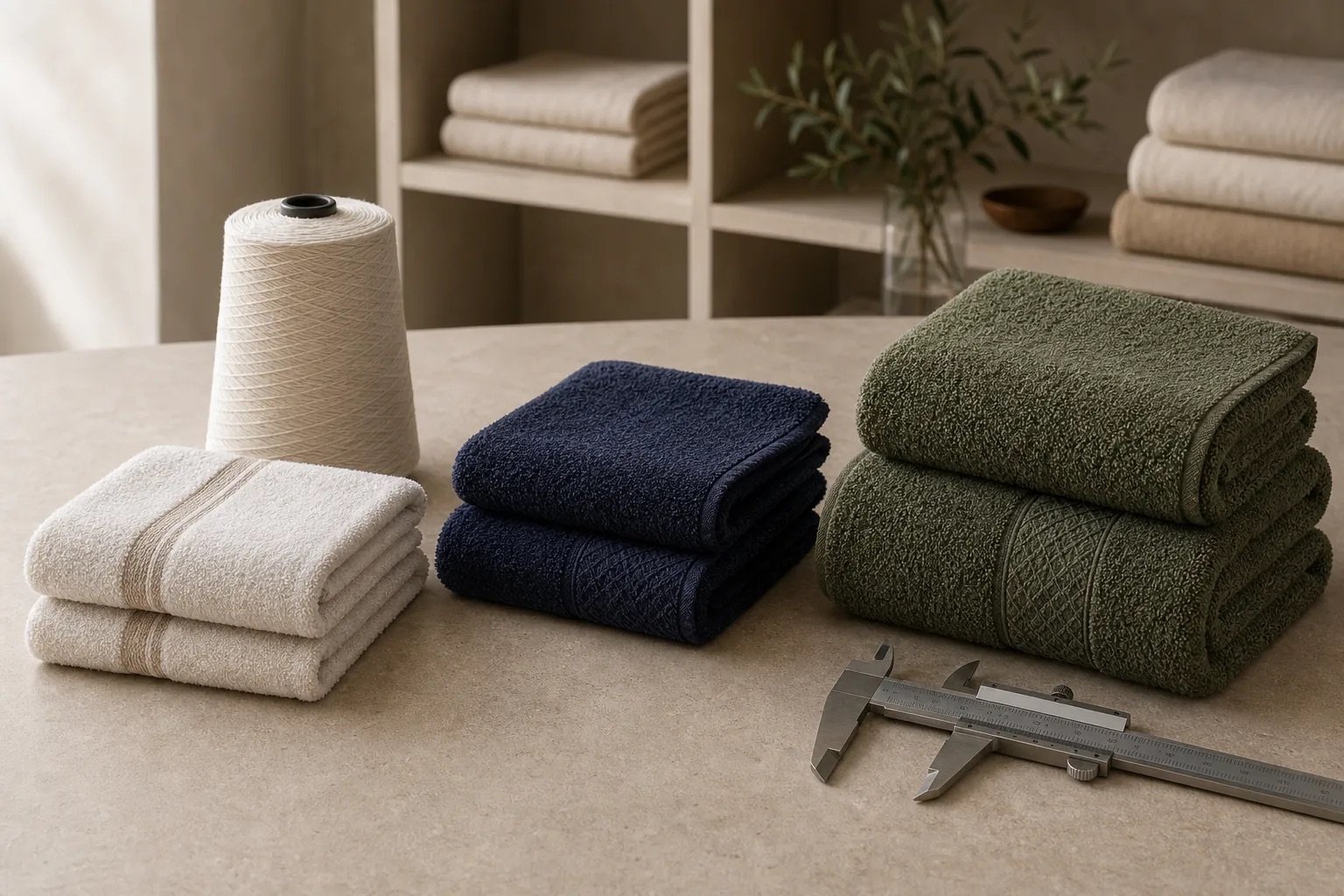
GSM is one of the first numbers on a commercial towel specification, but it is not a complete quality score. It measures fabric mass per square metre. For bulk buyers, the useful question is not “What is the highest GSM?” It is “Which GSM range delivers the right hand-feel, drying time, laundry throughput, and cost for this application?”
This towel GSM guide gives procurement teams a practical starting point for hotels, gyms, spas, salons, and pool operations. Use the ranges below to shortlist constructions, then confirm the decision with production samples and a controlled laundry trial.
Key takeaways
- GSM means grams per square metre: the mass of the fabric over a defined area.
- Higher GSM usually adds material and perceived plushness, but can also increase drying time, storage volume, and freight weight.
- Towels with the same GSM may perform differently because of yarn, pile, weave, finishing, dimensions, and border construction.
- Specify an acceptable GSM tolerance and test samples from the intended production construction—not only a showroom sample.
What GSM Means in Towels
GSM stands for grams per square metre. It expresses fabric mass per unit area, not thickness, absorbency, softness, or durability by itself. ASTM International’s current D3776/D3776M standard covers methods for measuring fabric mass per unit area. The related ISO 3801 standard, confirmed as current in 2023, addresses mass per unit length and mass per unit area for woven fabrics.
A simple calculation illustrates the idea:
If a conditioned 10 cm × 10 cm swatch has an area of 0.01 m² and weighs 5 grams, the calculated fabric mass is 500 GSM. In formal testing, the sampling method, conditioning, sample location, and whether the result represents one swatch or a commercial lot all matter. ASTM notes that a small-swatch result applies to that sample and not necessarily to the entire lot.
That distinction is important for bulk purchasing: a perfect approval swatch does not prove that every towel in a shipment will remain within the agreed range.
Recommended Towel GSM Ranges by Use Case
There is no universal standard assigning one GSM to every hotel, gym, or spa. The table below is a practical buying framework rather than a compliance rule. Your laundry process, replacement cycle, dimensions, yarn construction, and guest experience target should determine the final specification.
| Recommended starting range | Common commercial applications | Primary buying consideration |
|---|---|---|
| 300–400 GSM | Fitness centres, pool operations, high-turnover hand towels | Faster handling and drying, compact storage, lower unit weight |
| 400–500 GSM | Standard hotel programmes, salon and operational towels | Balanced hand-feel, laundering efficiency, and acquisition cost |
| 500–600 GSM | Upscale guestrooms, spa treatment towels, premium bath programmes | Fuller hand-feel without automatically moving to the heaviest construction |
| 600–700 GSM | Luxury suites, boutique hospitality, selected low-turnover guest-facing uses | Maximum plushness where longer drying and greater storage volume are acceptable |
Gym and fitness towels: 300–400 GSM
For high-rotation fitness programmes, a lighter towel is often the operationally stronger choice. A 300–400 GSM starting range can reduce the amount of textile mass moving through each wash and dry cycle while keeping storage and collection bins manageable.
Do not choose on GSM alone. Test whether the towel remains absorbent, dimensionally stable, and comfortable after repeated laundering. Review our gym towel options when comparing quick-turn constructions and sizes.
Hotel towels: 400–600 GSM for most programmes
Many commercial hotel specifications begin between 400 and 600 GSM. The lower end supports efficient, high-volume programmes; the upper end adds a more substantial guest-facing hand-feel. Luxury properties may evaluate 600–700 GSM for selected bath towels, but heavier is not automatically better if it creates laundry bottlenecks.
Build the programme by item rather than forcing one GSM across every size. A bath towel, hand towel, washcloth, and bath mat perform different jobs. Compare the available hotel towel specifications by item, construction, and service level.
Spa and salon towels: 400–600 GSM
Spas often want a softer, fuller presentation, while salons may prioritise rapid turnover and process compatibility. A 400–600 GSM range gives buyers room to balance both. Chemical resistance, colourfastness, dye selection, and care instructions must be specified separately; GSM alone does not make a towel bleach-safe.
For treatment rooms and salon operations, review spa and salon towel options and request samples in the actual colour and construction under consideration.
Pool and resort towels: choose around the operating model
Pool towels illustrate why use case matters more than prestige. A resort may prefer a larger striped towel for presentation, while a high-turnover pool operation may benefit from a more moderate weight. Consider towel dimensions, wet pickup weight, return rates, drying capacity, and storage—not only dry GSM.
Why Two Towels With the Same GSM Can Perform Differently
Two towels can both be labelled 500 GSM and still feel and perform noticeably differently. GSM tells you how much fabric mass is present across an area; it does not explain how that mass is built.
Compare these variables alongside GSM:
- Fibre content: cotton type, blends, and any performance fibres.
- Yarn construction: yarn count, twist level, combing, and consistency.
- Pile design: loop height, loop density, and pile-to-ground relationship.
- Base weave and borders: ground stability, decorative bands, and hem construction.
- Dimensions and finished weight: the complete towel size and mass, not only the GSM number.
- Finishing: processes that affect initial hand-feel, absorbency, shrinkage, or colour.
- Laundry performance: dimensional change, colourfastness, seam integrity, drying behaviour, and appearance after repeated cycles.
A denser-looking towel is not automatically the most durable, and a softer showroom sample is not automatically the best commercial choice. The strongest purchasing decision combines the GSM target with measurable construction and performance requirements.
How to Verify a Supplier’s GSM Claim
1. Put the target and tolerance in writing
Do not specify only “500 GSM.” Agree on the target, permitted tolerance, measurement method, finished dimensions, and whether testing occurs before or after washing. The appropriate tolerance should be mutually agreed for the construction and confirmed in the purchase specification.
2. Approve a production-representative sample
Request a sample made with the intended yarn, pile, borders, colour, and finishing. A generic white showroom towel can help with early comparisons, but it should not become the production benchmark for a different construction.
3. Record finished size and finished towel weight
GSM and dimensions work together. Record the finished width, length, and whole-towel mass so the receiving team has more than one useful checkpoint.
4. Run a controlled laundry trial
Wash samples using the temperatures, chemistry, drying method, and handling conditions expected in service. Compare dry time, shrinkage, hand-feel, absorbency, colour, hems, and visible wear after a defined number of cycles.
5. Define batch and receiving checks
Ask where samples will be drawn from during production and what happens when results fall outside the agreed specification. ASTM distinguishes between full-piece, full-width, small-swatch, and narrow-fabric approaches; for commercial shipments, the sampling plan must represent more than one favourable swatch.
Commercial Towel Specification Checklist
Use this checklist when requesting samples or quotations:
- Application and service environment
- Item and finished dimensions
- Target GSM and agreed tolerance
- Fibre content and yarn construction
- Pile, border, hem, and colour requirements
- Finished towel weight
- Performance and laundry checks
- Laundry method and trial-cycle count
- Branding, labels, and packaging
- Volume, MOQ, lead time, and destination
- Production sampling plan
- Pre-shipment verification plan
Frequently Asked Questions
What is a good GSM for bath towels?
For many commercial bath towel programmes, 400–600 GSM is a useful starting range. Standard hotels often favour the operational balance in the lower to middle part of that range, while upscale properties may test heavier options. The right answer depends on laundry capacity, desired hand-feel, dimensions, construction, and replacement strategy.
Is a higher GSM towel always better quality?
No. Higher GSM means more fabric mass per square metre, not guaranteed softness, absorbency, durability, or consistency. Yarn quality, pile construction, ground weave, finishing, hems, dimensions, and laundry performance can make two towels with the same GSM behave very differently.
What GSM is best for gym towels?
Many gym programmes begin around 300–400 GSM because lighter constructions can support rapid turnover, compact storage, and efficient handling. Buyers should still test absorbency, dimensional stability, comfort, and appearance after repeated laundering before approving a production specification.
What GSM is best for hotel towels?
Most hotel programmes can begin by comparing 400–600 GSM constructions. Properties seeking a more luxurious bath-towel presentation may also evaluate 600–700 GSM, provided the laundry operation can accommodate the additional textile mass, drying time, and storage volume.
How can a buyer check towel GSM?
A laboratory can measure mass per unit area using a recognised method such as ASTM D3776/D3776M. For supplier control, put the target, tolerance, sampling plan, conditioning, and test timing in writing. A small swatch can confirm that sample, but it may not represent an entire production lot.
Choose the Weight Around the Operation
The best towel GSM is the one that supports the full operating requirement: guest or member experience, laundry throughput, storage, freight, replacement cycle, and cost. Use GSM to narrow the field, then use production-representative samples and written performance checks to make the final decision.
Sources
- ASTM International. ASTM D3776/D3776M — Standard Test Methods for Mass Per Unit Area (Weight) of Fabric. Accessed July 20, 2026.
- International Organization for Standardization. ISO 3801:1977 — Textiles — Woven fabrics — Determination of mass per unit length and mass per unit area. Confirmed 2023; accessed July 20, 2026.