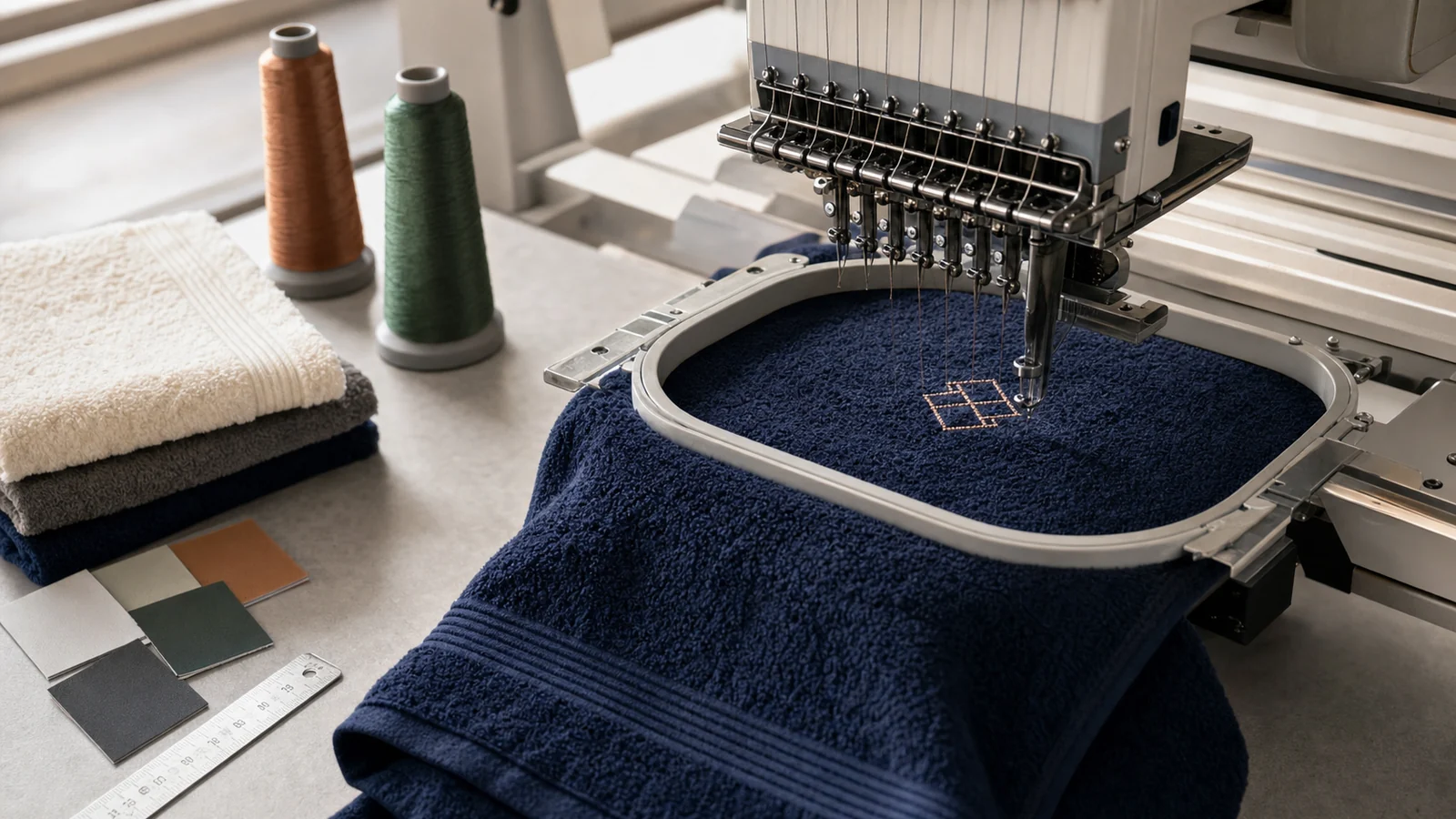
To order custom embroidered towels wholesale, define the base towel first, then approve a stitch-ready logo on that exact construction. The purchase brief should state finished size, GSM, fiber content, color, logo dimensions and placement, thread colors, backing or topping, sample approval, wash-test method, quantity by SKU, packaging, labeling, delivery terms, and the remedy for work outside tolerance.
A clean logo file is only the starting point. Terry pile moves under the needle, small lettering can close up, a design that looks balanced on a bath towel can crowd a hand towel, and thread that performs in ordinary washing may need separate review for a hotel or healthcare laundry program. Buyers get a more reliable result when the branded sample, not a screen mockup, becomes the production reference.
This guide is for hotel groups, gyms, spas, salons, distributors, corporate programs, and private-label brands buying logo towels in commercial quantities. It explains what belongs in the brief and the quote without inventing a universal minimum, price, or turnaround. Those figures depend on the towel, artwork, number of color and size combinations, production route, testing, packing, and delivery schedule.
Embroidery, woven borders, and jacquard logos solve different problems
Embroidery adds thread to a finished or partly finished towel. It is useful when the buyer wants a raised mark, several thread colors, or a branding step that can be applied after the base towel has been produced. The logo still needs a stitch file, suitable hooping, and an approval on the chosen towel.
A woven border can repeat a name or simple device in a flatter decorative band. A jacquard logo is built into the woven structure across a larger area. These routes change loom planning and usually connect the branding more closely to the towel's original production. Screen printing, digital printing, or heat-applied decoration may suit some promotional uses, but the finish, hand, absorbency, and laundering expectations need separate assessment.
| Branding route | Best considered when | Approval questions |
|---|---|---|
| Embroidery | A raised logo, multiple thread colors, personalization, or branding after towel production is required. | Stitch file, stitch types, density, underlay, thread, stabilizer, hooping, placement, reverse-side finish, and wash result. |
| Woven border | The mark can be simplified into a flatter border treatment and the order supports coordinated weaving. | Border width, readable repeat, yarn colors, distortion after finishing, reverse appearance, and size scaling. |
| Jacquard logo | A larger tonal or contrasting woven design is part of the towel construction. | Weave artwork, contrast, pile direction, dimensions, edge definition, shrinkage, and loom repeat. |
| Print or transfer | A graphic effect or campaign use matters more than a stitched or woven hand. | Ink or film compatibility, absorbency impact, cracking or fading, wash process, restricted substances, and hand feel. |
The choice should follow the product brief. A spa may prefer a small tonal embroidery that does not dominate a soft neutral towel. A gym may favor a compact mark positioned away from the main wiping surface. A promotional towel with full-color artwork may need a printing route. Loft Weave's private label vs. OEM towel comparison helps separate post-production branding from a buyer-developed towel construction.
Specify the base towel before the logo
Logo development is easier when the supplier knows the towel's finished dimensions, target GSM, fiber composition, pile height, border construction, color, finish, and intended laundering. Embroidery that sits cleanly on a dense border can behave differently on deep terry loops. A heavy design can stiffen a light towel. A large filled area can also change drape, drying, and the feel against skin.
Do not treat GSM as a complete quality grade. It states mass per unit area, not pile stability, absorbency, softness, shrinkage, or durability. If the towel changes after the logo is approved, the buyer should ask whether a new sample is needed. The towel GSM guide covers the relationship between weight, dimensions, and commercial use.
Color also needs a physical reference and an approval method. Thread and towel use different materials and surface structures, so a screen match is not a production standard. Decide whether the goal is a tonal effect, a visible contrast, or the closest available thread shade to a controlled brand color. Record the supplier's thread reference and the approved towel shade together.
A vector logo still needs embroidery digitizing
Send editable vector artwork when available, plus a PDF reference and the brand-color values used by the design team. Confirm that the file is the approved logo version and identify any elements that may be removed or simplified at small size. Thin gaps, tiny counters, gradients, fine outlines, and compact legal marks can fail when translated into thread.
Digitizing converts artwork into machine-readable stitch data. Tajima Group's DG software documentation lists separate controls for stitch types, stitch angle, underlay, anchor points, size, and fabric properties. That is useful evidence that digitizing involves construction decisions, not a direct image export. Ask the supplier which file version, design dimensions, color sequence, and machine format were used for the sample.
A reliable approval sheet should show the logo's finished width and height, placement measurements, thread references, the stitch-file version, and the towel SKU. It may also record stitch count for quote control, but count alone does not prove quality. Direction, density, underlay, tie-ins, trims, tension, topping, backing, and the way the pile is controlled affect the result.
Small lettering deserves a physical check
Letter height that works in print may not remain legible in embroidery. Curves can fill, corners can round, and closely spaced letters can merge. Avoid approving small text from a magnified digital preview. Review it at actual size on the chosen towel, from the distance at which a guest or customer will see it.
Measure logo size and placement from finished edges
Words such as "corner" and "centered above the border" leave room for interpretation. State the finished logo width and height, then give horizontal and vertical distances from named finished edges or seams. Add an orientation image that makes the towel's top, face, and fold direction unambiguous.
Placement can need adjustment across bath towels, hand towels, washcloths, bath sheets, and gym towels. A single distance from the edge may look correct on one size and cramped on another. If the program includes several sizes, approve a placement rule or an individual measurement for each. Also confirm how the towel will be folded or presented, because a technically correct logo can disappear inside the fold.
What to mark on the placement sheet
- Finished towel size and SKU
- Towel face and orientation
- Logo width and height
- Distance from the nearest side edge
- Distance from the hem or woven border
- Permitted placement tolerance
- Thread colors and stitching sequence
- Folding and pack-out orientation
Approve the sample after washing, not only before it
The production sample should use the actual towel construction, color, thread, stabilizer, finishing, and intended placement. Review the front and reverse for puckering, distortion, pile showing through, loose tails, hard edges, skipped areas, trapped topping, staining, and damage to the towel. Measure the logo and placement against the approval sheet.
Then test the complete article under a defined wash and dry procedure. ISO 6330:2021 specifies domestic washing and drying procedures for textile testing, including different reference machine types and six drying procedures. ISO 105-C06:2010 covers colorfastness to domestic and commercial laundering, while warning that hospital and industrial articles can face special procedures that are more severe. A buyer using tunnel washing, high alkalinity, chlorine, peroxide, or elevated drying temperatures should give the actual laundry program to the supplier and testing laboratory.
Do not assume every embroidery thread has the same limits. For example, Madeira publishes product-specific technical data that states composition, washing conditions, and colorfastness ratings for a named thread. The useful purchasing lesson is to obtain data for the selected thread and shade, then verify performance on the finished towel. A generic promise that the embroidery is "washable" does not define temperature, chemistry, cycle count, drying, or the acceptance threshold.
| Sample check | Before laundering | After the agreed cycles |
|---|---|---|
| Logo appearance | Edges, fill, small text, thread coverage, pile control | Color change, abrasion, loose stitches, distortion, loss of definition |
| Towel around logo | Puckering, stiffness, hoop marks, broken loops | Shrinkage mismatch, rippling, tears, hard backing edges |
| Placement | Measured from finished edges or border | Position and alignment after towel dimensional change |
| Color interaction | Thread-to-towel match or contrast | Bleeding, staining, fading, and shade change |
| Reverse side | Backing, tails, knots, comfort, and cleanliness | Backing breakdown, exposed thread, roughness, and trapped debris |
MOQ, pricing, and lead time need a common scope
There is no defensible universal minimum for custom logo towels. A supplier may set the minimum by base towel, logo, thread-color combination, towel color, size-color SKU, carton, or total program. Ask for a quantity matrix. The wholesale towel MOQ guide provides a worksheet for separating those scopes.
Keep the quote in three parts: base towel, one-time development, and recurring branding. One-time work can include artwork review, digitizing, sample setup, and a physical approval piece. Recurring embroidery cost can change with design size, stitch construction, color changes, hooping, backing or topping, trimming, inspection, and packing. A quote that blends every charge into one number makes reorder forecasting harder.
Lead time should identify the stages that start only after buyer approval: base-towel production or allocation, shade approval, digitizing, strike-off or sewn sample, bulk embroidery, inspection, packing, and shipment. State how quickly approvals are due and what happens if artwork or color changes. A delivery promise should name the shipping term, destination, and assumptions instead of giving a number of days without a start point.
For a clean commercial comparison, ask each supplier to quote the same towel, logo dimensions, color sequence, quantity by SKU, packaging, test requirement, delivery basis, and approval schedule. The wholesale towel pricing guide shows how to separate product cost from development and landed cost.
Embroidery does not replace textile labels or brand permission
The Federal Trade Commission's textile guidance specifically lists towels and washcloths among covered products. Most covered textile products sold to consumers need fiber content, country of origin, and the identity of the manufacturer or another responsible business. The embroidered logo is a brand treatment; it does not substitute for required product information.
Confirm the exact company name or Registered Identification Number used on the label, the fiber statement supported by the whole towel, country-of-origin wording, label placement, package presentation, and records. The FTC notes that textile records supporting required label information generally need to be kept for three years. Requirements can change by market and distribution route, so the buyer should have final consumer-facing artwork reviewed for the destination.
Only submit artwork the buyer is authorized to use. The U.S. Patent and Trademark Office explains that a trademark can be a word, phrase, symbol, or design that identifies the source of goods or services, and that the registration symbol may be used only with a registered mark for the listed goods or services. A supplier should receive written approval of the final logo and confirmation that the buyer controls or has permission for the artwork.
If restricted-substance certification is required, include embroidery thread, stabilizer, topping, labels, and other added components in the scope discussion. OEKO-TEX describes STANDARD 100 as a system for testing textile products and accessory materials for harmful substances. A certificate should connect to the relevant article, components, certificate number, and validity rather than appearing as an unsupported logo on a quote. Loft Weave's certification and quality page explains how to review scope and evidence.
Custom embroidered towel purchase-order checklist
- Base towel: use, finished dimensions, GSM and tolerance, fiber content, construction, color, finish, and laundry program
- Artwork: approved vector file, PDF reference, brand colors, logo version, and written authorization
- Digitizing: stitch-file version, finished dimensions, stitch construction, thread sequence, and ownership or reuse terms
- Materials: thread manufacturer and reference, selected shade, needle and stabilizer approach, topping, and backing removal
- Placement: towel face, orientation, edge measurements, border relationship, tolerance, and folding presentation
- Samples: pre-production piece on each relevant towel type, approval date, sealed reference, and changes requiring reapproval
- Testing: named wash and dry procedure, actual commercial-laundry conditions where relevant, number of cycles, and acceptance criteria
- Quantity: pieces by size, towel color, logo, thread combination, pack, and carton
- Commercial terms: base-towel price, setup charges, recurring branding cost, sample cost, delivery basis, lead time, payment, and quote validity
- Quality control: inspection level, measurement method, sampling point, defect categories, documentation, and remedy
- Labels and packing: fiber and origin labels, responsible identity, care information, bag or band, barcode data, case pack, and carton marks
- Reorder file: approved sample, stitch file, thread references, towel specification, test results, artwork version, and change-control record
The final production reference should be difficult to misunderstand. A supplier should be able to compare a bulk piece with the approved sample and written tolerances without guessing what the buyer meant.
Frequently asked questions
What file format should I send for towel embroidery?
Send editable vector artwork when available, plus a PDF reference and approved color values. The supplier still needs to convert the design into stitch-ready embroidery data for the selected towel, dimensions, thread, and machine.
What is the minimum order for custom embroidered towels wholesale?
There is no universal minimum. Ask whether the MOQ applies to the total program, base towel, logo, towel color, size-color SKU, thread combination, or package. Request a written quantity matrix before comparing suppliers.
Can the same logo file be used on every towel size?
The source artwork may be shared, but each finished logo size and placement needs review. Small lettering, stitch density, border width, and fold presentation can require a different digitized version or placement measurement.
How should embroidered hotel towels be wash tested?
Test the finished towel, thread, stabilizer, and finish under a written procedure that reflects the intended laundry. State machine type, chemistry, temperature, drying, cycle count, and acceptance criteria; industrial or hospital processes may exceed domestic test conditions.
What should be approved before bulk embroidery starts?
Approve the base towel, physical sewn sample, logo dimensions, placement, thread shades, stitch-file version, reverse-side finish, wash result, labels, packaging, inspection criteria, and the remedy for production outside tolerance.
Build the quote around one approved branded towel
The most useful custom-towel quote begins with a complete specification and ends with a physical reference. When the towel, logo, materials, placement, test procedure, quantity, labels, packing, and delivery terms are fixed, the buyer can evaluate cost and timing without leaving the difficult decisions until production.
Use Loft Weave's custom towel pricing request to share the towel type, size, GSM, colors, logo artwork, quantity by SKU, packaging, destination, laundry conditions, and required date. The response should identify assumptions, approval steps, MOQ scope, and charges that would change if the artwork or product brief changes.
Primary sources
- Federal Trade Commission: Threading Your Way Through the Labeling Requirements Under the Textile and Wool Acts
- International Organization for Standardization: ISO 6330:2021, Domestic washing and drying procedures for textile testing
- International Organization for Standardization: ISO 105-C06:2010, Colour fastness to domestic and commercial laundering
- Tajima Group: DG embroidery digitizing software and stitch-data controls
- United States Patent and Trademark Office: What is a trademark?
- OEKO-TEX: STANDARD 100 product and accessory-material testing
- Madeira: Technical overview of professional embroidery threads