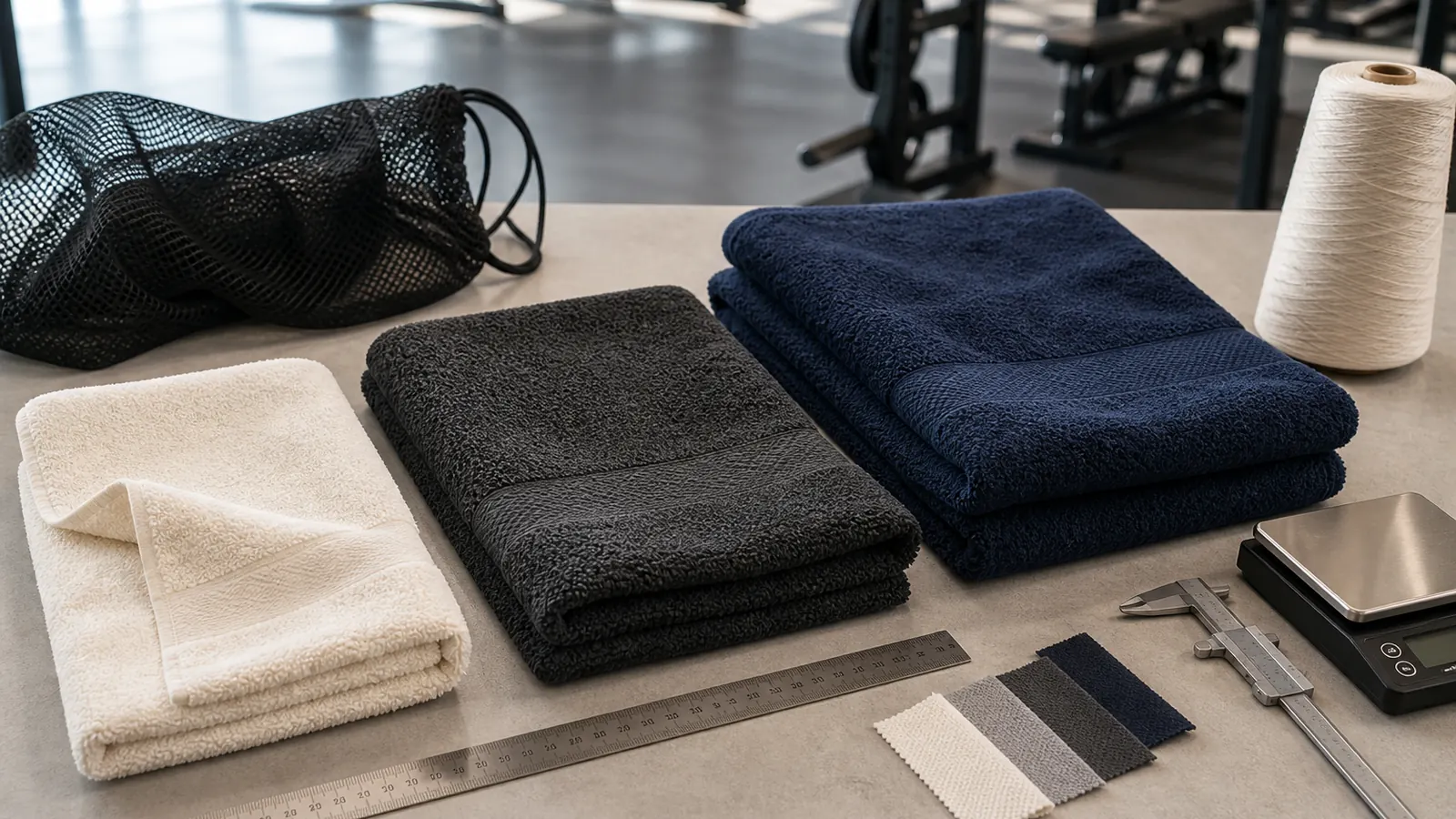
Choose wholesale gym towels by assigning each towel a job, then specifying finished dimensions, mass or GSM, fiber construction, color, hems, laundry conditions, and acceptance tests. Compare production-representative samples after the facility's intended wash and dry process. Calculate opening stock from documented daily usage, laundry turnaround, and a separate reserve for loss or disruption. Carry the approved sample and tolerances into the purchase order so bulk deliveries can be inspected against the same standard.
A fitness club may hand the same towel to a member at check-in, place it beside cardio equipment, and stock it in a shower room. Those jobs create different demands. A compact workout towel needs convenient handling and fast circulation; a shower towel needs coverage and absorbency; a towel used as a barrier on shared equipment must fit the surface and the facility's operating policy.
This guide is for gyms, studios, health clubs, recreation facilities, hospitality groups, distributors, and private-label buyers. It concentrates on procurement and textile performance. Cleaning, disinfection, and infection-control procedures should follow the facility's documented program and applicable product labels; a towel specification does not replace those controls.
Map the towel jobs before choosing a product
Walk the member route and record where clean towels are issued, where used towels are returned, and which team owns replenishment. Count separate uses rather than calling every item a "gym towel." Equipment wipe towels, member sweat towels, hand towels, shower towels, treatment-room towels, and cleaning cloths should not share a SKU automatically. Their dimensions, colors, construction, and handling may need to differ.
For each job, note the contact surface, typical handling time, expected soil, moisture load, member-facing importance, dispenser or shelf dimensions, collection bin, and laundry destination. Record whether the club supplies one towel per visit, allows exchanges, sells a towel, or asks members to bring their own. Those policies influence both the specification and the daily quantity.
The Centers for Disease Control and Prevention advises people not to share personal items such as towels and recommends a barrier between skin and shared surfaces in its MRSA prevention guidance. A facility should translate its health and cleaning policy into clear issuance, return, laundering, and surface-cleaning procedures. Avoid presenting a reusable towel as evidence that equipment has been disinfected.
| Gym towel job | Operating priority | Sample checks to emphasize |
|---|---|---|
| Member sweat towel | Comfortable handling, useful coverage, predictable issue and return | Finished size, hand, absorbency, lint, color transfer, seams, drying |
| Equipment-area towel | Fits the intended barrier or wipe task without excess bulk | Size after wash, surface absorption, lint, color coding, collection workflow |
| Hand towel | Works with the sink, rack, dispenser, and replenishment interval | Folded dimensions, absorbency, drying, shrinkage, hem stability |
| Shower towel | Coverage, absorbency, member feel, and laundry capacity | Full dimensions, total dry mass, GSM, post-wash hand, drying load, seams |
| Cleaning cloth | Clear separation from member textiles and compatibility with the cleaning process | Color identification, chemical and laundry compatibility, lint, edges, segregation |
Compare finished size, total mass, and GSM together
Ask for finished dimensions after any stated processing, not a loose market name such as "workout size" or "bath size." Measure length and width at several positions because hems, borders, and finishing can affect shape. Confirm the tolerance and whether it applies before or after laundering. Test the towel against the actual rack, cubby, dispenser, rolling cart, and member use rather than choosing from a size label alone.
GSM means grams per square metre. ASTM D3776/D3776M-20(2025) provides options for measuring fabric mass per unit area, and different options apply to full pieces, full-width samples, small swatches, and narrow fabrics. A reported GSM should identify the method or at least the conditioning, specimen, and calculation basis. GSM is not total towel weight, and it does not establish softness, absorbency, drying time, or service life by itself.
A simple planning check multiplies area by GSM. A 40 cm by 80 cm rectangle has an area of 0.32 m²; at 400 g/m², the calculated fabric mass is 128 g before allowing for measurement basis, hems, borders, dimensional variation, moisture conditioning, and manufacturing tolerances. Weigh the finished conditioned towel when total unit mass matters. The calculation is useful for spotting quotation mismatches, not for replacing a sample measurement.
There is no universal gym-towel GSM. A lighter construction may reduce the mass moving through the laundry, while a fuller construction may suit a member-facing shower program. The correct choice depends on finished size, pile and ground construction, absorbency, drying process, laundry capacity, comfort target, and acceptable replacement risk. Use the towel GSM guide for the measurement fundamentals, then approve the gym SKU from washed samples.
Keep every quotation on one measurement basis
Require the supplier to state whether dimensions and mass refer to greige goods, finished goods, pre-wash samples, or post-wash samples. Ask for the same units and tolerance format from every bidder. If one supplier gives GSM, another gives pounds per dozen, and a third gives only a product name, convert the offers into finished dimensions, conditioned unit mass, and declared GSM before comparing price.
Choose fiber, yarn, and construction for the service environment
Specify the pile, ground, border, and sewing-thread fibers rather than accepting one broad fiber claim. A cotton-pile towel may use a blended ground for structural reasons; a microfiber item may have a different construction and end use from terry. The finished label and quotation should describe the actual components accurately. The Federal Trade Commission requires most covered textile products sold in the United States to disclose fiber content, country of origin, and the identity of the manufacturer or another responsible business.
Cotton, cotton-rich blends, and manufactured-fiber constructions can each be developed for gym service. Fiber name does not decide performance without yarn, pile, density, finish, dimensions, and laundering. Terms such as ring-spun or combed describe yarn or fiber preparation, while Egyptian cotton describes origin or type claims; the cotton construction comparison explains why those attributes can coexist.
Inspect the ground, pile anchorage, borders, and hems closely. Long decorative borders may distort or tighten differently after washing. Bulky seams can make a small towel awkward to fold. Loose loops, hard edges, skew, and puckering can turn into maintenance complaints even when the shade and GSM meet the order. If a logo is planned, approve embroidery size, placement, backing, thread, and post-wash behavior using the controls in the custom embroidered towel guide.
Match the towel specification to the actual laundry route
Document the washer type, load size, detergent, additives, water temperature, cycle, extraction, dryer type, dryer setting, finishing, folding, and time from collection to clean return. An onsite club laundry and an outsourced commercial laundry can expose the same towel to different chemistry, heat, mechanical action, and turnaround. Ask the laundry operator which parts of the process are fixed and which can be adjusted.
ISO 6330:2021 specifies domestic washing and drying procedures for textile testing, including reference machines, detergents, ballast, and six drying procedures. It warns that machine, detergent, and dryer parameters can affect results. ISO 105-C06:2010 addresses colorfastness to domestic and commercial laundering with stated detergent and bleach systems, while AATCC TM61 is an accelerated colorfastness method that approximates defined laundering effects under its selected conditions. None of these summaries proves compatibility with an unnamed gym laundry process.
ISO 15797 is sometimes cited for industrial laundry claims, but its stated scope is workwear, including certain personal protective equipment where appropriate. Do not present it as a gym-towel standard without qualified justification. When a commercial laundry will process the towels, retain the relevant laboratory evidence and run a controlled trial in the actual intended process before bulk approval.
Separate textile performance from hygiene claims
Colorfastness, absorbency, dimensional stability, and appearance are textile properties. They do not establish that a towel is antimicrobial, sanitized, or a disinfectant. If a supplier offers a treated towel, request the treatment identity, applicable regulatory basis, test method, test report, wash-durability evidence, label language, and any limitations. The facility's cleaning and infection-control team should review those documents separately from the purchasing scorecard.
Test production-representative samples before bulk release
Request enough identical towels to keep an untouched control, run the intended wash sequence, repeat a disputed result, and check unit-to-unit variation. Mark every sample with supplier, construction, color, revision, and date. The towel sample testing checklist provides a structured record for dimensions, mass, laundering, absorbency, lint, loops, hems, labels, and packaging.
Condition samples consistently before comparing mass or physical results. ASTM D1776/D1776M-20(2024) and ISO 139:2005 both address standard atmospheres for conditioning and testing textiles. If the club cannot run laboratory conditioning, use a consistent internal procedure and label it as an internal comparison. Do not describe an uncontrolled room measurement as a formal ASTM or ISO result.
ASTM D5433-24 covers selected performance characteristics for institutional and household towel products and can be used by purchaser and supplier agreement to establish requirements. ASTM also permits requirements to be modified for a style by agreement. Build the purchase specification by naming the characteristics, method editions, specimen identity, conditions, and acceptance limits that matter to the gym.
| Buyer question | Named authority or method | Record to retain |
|---|---|---|
| Does the terry surface absorb water as agreed? | ASTM D4772-26 | Method, specimen identity, result, laboratory, and agreed interpretation |
| Is fabric mass per unit area reported consistently? | ASTM D3776/D3776M-20(2025) | Option, conditioning basis, specimen dimensions, calculations, and result |
| How much do dimensions change after the chosen wash and dry procedure? | ISO 6330:2021 with ISO 5077:2007 | Preparation, measurements, wash procedure, dry procedure, cycles, and percentage change |
| How does a colored towel withstand laundering? | ISO 105-C06:2010 or AATCC TM61 | Exact method and option, detergent, bleach status, temperature, rating, and limitations |
| How does color respond to simulated acid perspiration? | AATCC TM15-2021e | Color-change and transfer results tied to the final color and construction |
| What broader towel characteristics belong in the agreement? | ASTM D5433-24 | Included, modified, and excluded requirements with acceptance limits |
After each planned checkpoint, compare the test towel with the control under stable light. Measure dimensions and mass; inspect shade, staining, lint, loose loops, pile loss, skew, border distortion, hem opening, label condition, hand, and odor; and observe drying under the recorded process. ASTM D4772-26 notes that surface water absorption is only one characteristic used to judge terry fabric. A towel can produce an acceptable absorption result and still fail the gym on seams, shape, color, lint, or turnaround.
Calculate opening par from usage and laundry turnaround
Start with measured usage, not a supplier's generic ratio. Track issued and returned towels by SKU and day, including peak periods, class schedules, shower demand, exchanges, staff use, rejects, and unreturned units. Record the time from collection to clean return. A club with same-day onsite laundering has a different working-stock requirement from a site that sends towels away for two days.
A transparent worksheet can use three lines: daily demand, laundry-turnaround stock, and reserve. Daily demand equals documented towels used per operating day. Turnaround stock equals daily demand multiplied by the number of days a towel is unavailable. Reserve is added separately for peak demand, rejected pieces, shipment delay, or other risks chosen by the buyer.
Planning example, not a universal standard: if one site records 180 workout towels per day and the full laundry cycle keeps towels unavailable for 2 days, working stock is 360 towels. A buyer-selected 15% reserve adds 54, producing an opening plan of 414. The club should replace those assumptions with its own peak usage, turnaround, loss, and disruption data, then round quantities to the approved pack and order structure.
Track the reserve reason instead of hiding every uncertainty inside one oversized percentage. Lost towels, rejected quality, peak events, and laundry downtime are different problems and may need different remedies. Review consumption after launch and adjust reorder points. The wholesale towel MOQ guide helps connect the operational par to color, size, and production minimums.
Normalize supplier quotations before comparing unit price
Put every offer on the same basis: finished dimensions, conditioned total mass, stated GSM and measurement basis, fiber by component, yarn and pile description, color, border, hem, label, packaging, test package, quantity, Incoterm, destination, and payment terms. A lower unit price may describe a smaller or lighter towel, fewer tests, simpler packaging, or a different shipping responsibility.
Separate development costs from production costs. Ask whether lab dips, sample rounds, logos, woven labels, test reports, inspection, cartons, barcodes, and replacement samples are included. Compare landed cost and risk using the wholesale towel pricing guide. For imported orders, align classification, valuation, marking, labeling, and shipping documents with the Pakistan-to-USA towel import guide.
Review the supplier's process control, traceability, change approval, laboratory access, and complaint handling. The supplier vetting checklist and manufacturer certifications guide separate product evidence from factory, management-system, and social-audit documents.
Write the approved gym towel into the purchase order
Identify the signed pre-production sample by code and date. Attach the finished specification, color reference, label artwork, packaging standard, test requirements, and inspection plan. State which document controls if a physical sample conflicts with a numerical tolerance. Require written authorization before any change to fiber, yarn, pile, GSM, dimensions, dye, finish, border, thread, label, packaging, or production site.
Define sample selection, inspection stage, responsible party, laboratory cost, report deadline, retest procedure, remedy, and handling of nonconforming units. Set the accepted tolerance and measurement method before production. A vague promise such as "commercial grade" gives an inspector no reproducible decision rule.
For U.S. textile labeling, verify fiber content, country of origin, and the responsible company name or eligible Registered Identification Number. The Federal Trade Commission states that an RN is optional and is issued to qualifying U.S. firms, not businesses outside the United States. Check the final sewn label and any retail or case packaging for consistent claims.
Wholesale gym towel buyer checklist
Complete these items before bulk release
- Map every towel job, issue point, return point, responsible team, and laundry destination.
- Record peak daily use, exchange policy, laundry turnaround, rejects, losses, and disruption reserve by SKU.
- Specify finished dimensions, dimensional tolerance, conditioned unit mass, GSM basis, fiber by component, yarn, pile, border, hem, thread, color, and finish.
- Confirm the towel fits racks, cubbies, dispensers, carts, equipment surfaces, and member use after laundering.
- Document the intended wash and dry process, including machine, detergent, additives, temperature, cycle, extraction, dryer, and finishing.
- Request named test methods, editions, options, conditions, results, and acceptance limits tied to the quoted construction.
- Keep an untouched control and test production-representative samples for size, mass, absorbency, color, lint, loops, seams, shape, drying, and hand.
- Separate textile performance evidence from antimicrobial, sanitation, or disinfection claims.
- Normalize quotations for product, testing, packaging, quantity, trade terms, and landed cost.
- Approve fiber, origin, responsible-company or RN labeling and all packaging claims.
- Link the signed sample, specification, artwork, test sheet, and inspection plan to the purchase order.
- Define bulk sampling, retest, remedy, and written change approval before manufacturing begins.
Frequently asked questions
What GSM is best for wholesale gym towels?
There is no universal best GSM for every gym towel. Choose it with finished size, total mass, pile and ground construction, absorbency, drying process, laundry capacity, member feel, and towel job. Compare conditioned samples after the intended wash sequence and state the accepted measurement basis and tolerance.
What size should a bulk gym towel be?
Choose finished size from the job and facility hardware. A workout towel, equipment barrier, hand towel, and shower towel need different coverage and handling. Test the washed sample against racks, cubbies, dispensers, carts, and equipment, then put post-wash dimensions and tolerances in the specification.
Are cotton or blended gym towels better?
Neither fiber label guarantees the better finished towel. Compare pile and ground fibers, yarn, construction, mass, absorbency, colorfastness, shrinkage, lint, seams, drying behavior, and post-wash hand. Require the supplier to identify each component and test the final construction in the intended laundry process.
How many gym towels should a facility order?
Use measured peak daily demand multiplied by the time each towel is unavailable in collection, washing, drying, folding, and transport. Add a separately documented reserve for rejects, losses, peak events, or disruption, then round to pack and production quantities. Review actual usage after launch.
How should a buyer test commercial gym towels?
Keep an untouched control and run representative samples through the intended wash and dry sequence. Record dimensions, conditioned mass, absorbency, color change or transfer, lint, loose loops, pile, borders, hems, shape, drying behavior, and hand. Use named laboratory methods where applicable and agree on limits before testing.
Buy a repeatable towel program
A reliable gym towel order connects the member experience to measurable purchasing controls. Separate the towel jobs, compare size and mass honestly, match construction to the laundry, test the final sample, and calculate stock from observed demand. The result is a specification that operations, purchasing, the supplier, and an independent inspector can all read the same way.
When the towel jobs, sizes, fiber construction, colors, laundry process, quantities, testing, labels, packaging, destination, and delivery target are ready, review Loft Weave's wholesale gym towel capabilities or request gym towel pricing, MOQ, and samples.
Primary authorities
- ASTM International: ASTM D5433-24, Standard Performance Specification for Towel Products for Institutional and Household Use
- ASTM International: ASTM D4772-26, Surface Water Absorption of Terry Fabrics
- ASTM International: ASTM D3776/D3776M-20(2025), Mass Per Unit Area of Fabric
- ASTM International: ASTM D1776/D1776M-20(2024), Conditioning and Testing Textiles
- International Organization for Standardization: ISO 139:2005, Standard Atmospheres for Conditioning and Testing
- International Organization for Standardization: ISO 6330:2021, Domestic Washing and Drying Procedures for Textile Testing
- International Organization for Standardization: ISO 5077:2007, Determination of Dimensional Change in Washing and Drying
- International Organization for Standardization: ISO 105-C06:2010, Colour Fastness to Domestic and Commercial Laundering
- AATCC: TM61, Colorfastness to Laundering: Accelerated
- AATCC: TM15, Colorfastness to Perspiration
- Federal Trade Commission: Threading Your Way Through the Labeling Requirements
- Centers for Disease Control and Prevention: Preventing MRSA