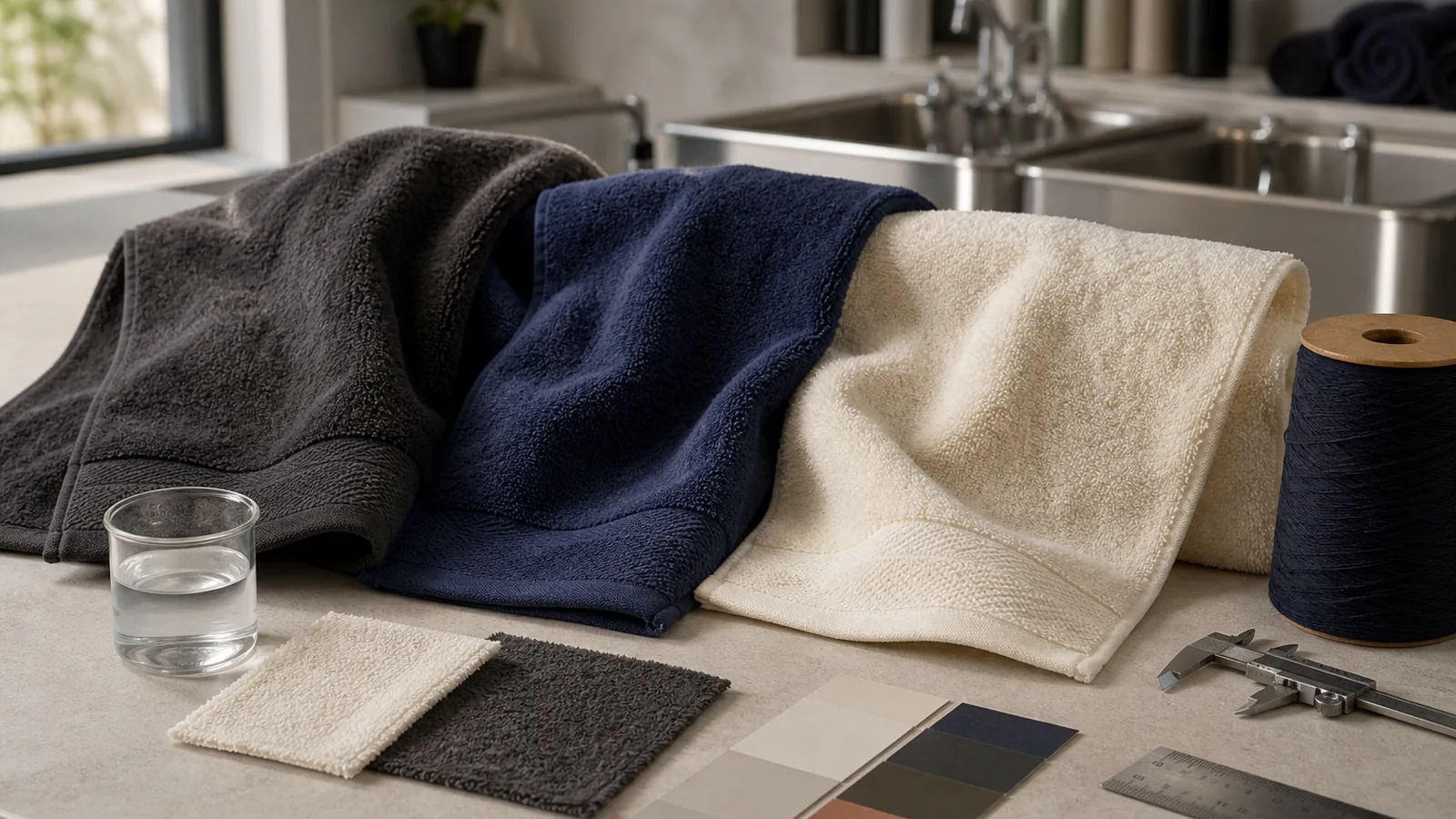
Buy bleach-resistant salon towels by defining the chemical exposure and laundry process first, then requiring method-specific colorfastness evidence for the finished color and construction. Test production-representative samples in the salon's real wash routine, measure color change, absorbency, shrinkage, lint, and seam condition, and approve the bulk order against written limits and a retained sample. Treat "bleach-proof" as an unverified marketing phrase unless the supplier identifies the bleach system, test method, result, and limitations.
Dark towels can hide hair color, makeup, and daily soil, but a dark shade also makes chemical spotting obvious. Salons expose textiles to a mix of oxidative color products, lighteners, cleaners, detergents, heat, abrasion, and repeated drying. Those conditions vary enough that a towel suitable for one operation can fail quickly in another.
This guide is written for salon groups, spas, beauty schools, hospitality buyers, distributors, and private-label programs. It explains the questions that belong in a wholesale request for quotation and sample trial. It does not provide chemical-handling instructions; follow product labels, safety data sheets, equipment instructions, and the salon's workplace procedures.
Start with a testable bleach-resistance claim
"Bleach-resistant," "bleach-safe," and "bleach-proof" are often used without a shared technical definition. A useful claim says what the towel was exposed to, how it was tested, how color change was assessed, and what result the buyer can expect. Without those details, two supplier quotations may describe very different performance.
AATCC TM188 is specifically intended to determine colorfastness to sodium hypochlorite bleach in home laundering for textiles expected to withstand frequent laundering. The AATCC summary describes five laundering cycles with controlled temperature, detergent, chlorine bleach, and abrasive action, followed by color-change evaluation. AATCC also states that TM188 is distinct from the accelerated chlorine options in TM61 and that there is no known correlation between those sections and TM188. A report for one method should not be presented as proof of the other.
ISO 105-N01:1993 addresses colorfastness to hypochlorite bleaching and is mainly applicable to natural and regenerated cellulose materials. ISO 105-C12:2024 covers resistance of color to industrial laundering. These standards answer different questions. The intended laundry and the chemical risk should decide which evidence belongs in the specification.
Keep performance and hygiene claims separate: colorfastness to bleach does not show that a towel is antimicrobial, sanitized, or disinfected. The U.S. Environmental Protection Agency treats laundry antimicrobial claims through separate efficacy and labeling requirements. Use the laundering product according to its registered label and do not convert a color test into a public-health claim.
Map the salon's actual chemical and laundry exposure
Ask the operating team what reaches the towel before asking the mill for a construction. Capture colorants, lighteners, developers or oxidizers, shampoos, cleaning products, laundry detergent, chlorine or oxygen bleach if used, water temperature, wash pH where known, cycle, extraction, drying temperature, and weekly turn rate. Note whether towels are spot-rinsed, left damp in bins, washed onsite, or sent to a commercial laundry.
The distinction between incidental contact and a formulated bleach wash matters. A stylist may wipe a spill onto one small area at high local concentration, while a washer exposes the full towel to a diluted and controlled bath. A laboratory report using a different chemical system may still be useful background, but it does not recreate the salon's failure mode.
ISO 105-C06:2010 covers colorfastness to domestic or commercial laundering with defined reference detergents. ISO cautions that its methods are designed around the detergent and bleach systems specified and that other systems may need different conditions. That limitation belongs in a buying decision: request standard evidence for comparison, then add a controlled service trial using the operation's intended process.
Build the towel program around separate jobs
One salon may need client hand towels, shampoo-area towels, color-service towels, facial towels, cleaning cloths, and spa treatment linens. Putting every job into one SKU can make the specification unnecessarily severe or leave a high-risk area under-protected. Separate items when size, absorbency, softness, chemical exposure, color, or hygiene procedures are materially different.
Record consumption per service, daily service volume, laundry return time, reserve stock, and loss or discard rate. Those numbers determine quantity and replenishment. The wholesale towel MOQ guide helps translate color and size variants into an order plan without fragmenting production into uneconomic combinations.
Specify the finished towel, not a dye buzzword
Fiber content, yarn, pile construction, mass, size, border, hem, sewing thread, dye class, dyeing route, finishing, and laundering all affect the result. Ask the supplier to declare those components and explain which part of the construction carries each fiber. A cotton pile can be paired with a blended structural ground; the label and quotation should describe the finished product accurately.
Avoid assuming that a single phrase such as "vat dyed," "reactive dyed," or "solution dyed" settles performance. Solution dyeing is associated with manufactured fibers because color is added to the polymer or spinning solution; it should not be casually used to describe cotton. For cotton-rich towels, ask the mill for the actual dye class and process, then judge the final towel through appropriate test results. Process names are inputs, not acceptance evidence.
GSM also needs context. A lighter towel may dry and turn faster, while a fuller towel may change client perception and laundry load. There is no universal salon GSM that proves chemical resistance. Compare size, dry mass, pile-to-ground construction, absorbency, drying behavior, and post-wash hand together. The towel GSM guide and cotton construction guide cover those measurements without treating one number or fiber name as a quality grade.
| Specification field | What the supplier should state | What the buyer should verify |
|---|---|---|
| Fiber construction | Pile, ground, border, and sewing-thread fibers with percentages | Declaration, label artwork, and test report refer to the same construction |
| Size and mass | Finished dimensions, dry mass or GSM target, and tolerances | Conditioned sample measurements before and after laundering |
| Yarn and pile | Yarn description, pile height or density, border, and hem | Absorbency, lint, loose loops, seam integrity, drying, and hand |
| Color process | Color reference, dye class, process route, finishing, and shade tolerance | Lab dip or sample, wash result, chemical colorfastness, and bulk shade |
| Packaging | Fold, units per pack, labels, carton count, and assortment | Representative pack-out and reorder identification |
Request test evidence that matches the risk
Begin with the report itself. It should identify the laboratory, supplier or applicant, sample description, color, fiber content, method and edition, test option, conditions, date, result, rating scale, and any deviation. Check that the tested sample is the towel being quoted. A report for a different shade, fiber blend, unfinished fabric, or earlier construction may not support the proposed order.
ASTM D5433-24 is a performance specification covering towel products for institutional and household use. ASTM says purchaser and supplier can use it by mutual agreement to establish purchasing requirements and can modify characteristics for a particular style. That makes it a useful contract framework. It does not remove the need to name the required characteristics and acceptance limits.
| Buyer question | Relevant authority | Evidence to retain |
|---|---|---|
| Does the shade resist sodium hypochlorite in a defined home-laundering procedure? | AATCC TM188 | Method edition, conditions, color-change result, and tested sample identity |
| How does color respond to accelerated laundering with the chosen option? | AATCC TM61 | Exact option, chlorine status, detergent, temperature, result, and limitations |
| Does color resist hypochlorite bleaching on the specified cellulosic construction? | ISO 105-N01 | Method result tied to final fiber, shade, and construction |
| How does color withstand industrial laundering? | ISO 105-C12:2024 | Named procedure, conditions, color change or staining result, and acceptance limit |
| Does the terry surface absorb water as specified? | ASTM D4772-26 | Laboratory result and agreed requirement, considered with other towel properties |
| What broader towel requirements apply? | ASTM D5433-24 | Purchase specification listing included, modified, and excluded characteristics |
Write the acceptance rating before testing
Colorfastness results are commonly assessed with defined scales, but the acceptable grade depends on method, shade, exposure, and end use. Put the required grade in the request before samples arrive. If a report only says "pass," ask for the measured or graded result and the pass criterion. Keep photographs under controlled light as supporting evidence, not as a substitute for the named method.
Test production-representative salon towel samples
Request enough identical units to keep an untouched control, run the planned laundry sequence, repeat a disputed result, and examine unit-to-unit variation. Label each towel with a sample ID, supplier, construction, color, revision, and date. The towel sample testing checklist provides the full record for dimensions, mass, wash conditions, absorbency, shrinkage, lint, seams, labels, and pack-out.
Before washing, condition comparison samples consistently, then photograph and record shade, dimensions at several positions, dry mass, border and hem condition, loose loops, odor, surface residue, and hand. Run every candidate in the same controlled load. Document machine type, load, detergent, additives, temperature, cycle, extraction, dryer setting, and cycle count. An outsourced laundry should confirm whether it can reproduce a sample protocol or supply its own operating conditions.
After each planned checkpoint, compare the test towel with the untouched control under stable light. Record overall color change, localized spotting, staining onto other textiles, absorbency, dimensions, shape, lint, pile loss, hardening, seam opening, and drying behavior. ASTM D4772-26 addresses surface water absorption of terry fabric, but ASTM notes that absorbency is only one characteristic used to judge a towel. A colorfast towel that stops absorbing properly is still a poor salon purchase.
Use salon-chemical spot trials as internal screens
If the operation wants to reproduce incidental contact with a named salon product, have its safety and operations team write a controlled internal protocol using the product label and safety data sheet. Fix the product, concentration or prepared-use form, contact time, rinse, laundering, specimen area, and evaluation. Do not mix products or improvise bleach formulas. Record the outcome as an internal service screen unless a qualified laboratory performed a recognized method.
The internal screen complements standard colorfastness data because it represents the local process. It should not be advertised as AATCC, ASTM, or ISO testing, and it cannot support disinfectant efficacy. A failed service screen deserves investigation even when a general laboratory result looks strong.
Compare wholesale salon towel quotations on the same basis
A quote comparison should normalize finished size, mass, fiber construction, color, dye route, test package, packaging, order quantity, and commercial terms. Otherwise the lowest unit price may reflect a smaller towel, lower mass, simpler shade, different pack-out, or excluded testing. Use the landed-cost structure in the wholesale towel pricing guide and include replacement risk as a scenario rather than inventing a guaranteed service life.
Ask whether test charges, lab dips, sample rounds, color minimums, custom labels, packaging, pre-shipment inspection, and replacement samples are included. Confirm which variations share an MOQ and which are separate production lots. For imported goods, align the final fiber and origin declarations with the customs and labeling controls in the towel import guide.
Supplier capability still matters after a sample passes. Review process control, shade management, lot traceability, test access, complaint handling, and change authorization using the supplier vetting checklist. The certifications guide helps distinguish product evidence from factory, social-audit, and management-system documents.
Put the approved performance into the purchase order
Identify the signed pre-production sample by code and date. Attach the written specification, color reference, label artwork, pack-out, and test requirements. State the order of precedence among those documents so a physical sample does not silently override a numerical tolerance or legal label requirement.
For U.S. products covered by the Textile Fiber Products Identification Act, the Federal Trade Commission requires disclosures including fiber content, country of origin, and the identity of the manufacturer or another responsible business; an eligible company may use an RN. Verify that the bulk label describes the actual pile and ground construction and that packaging does not introduce a contradictory fiber claim.
Add the inspection stage, sample selection, party responsible for laboratory cost, reporting deadline, retest rule, remedy, and authorization process for changes in yarn, fiber, dye, finish, color, sewing thread, dimensions, or packaging. If custom embroidery or woven branding is included, carry over the placement, thread, backing, wash, and approval controls from the custom embroidered towel guide.
Wholesale salon towel buyer checklist
Complete these items before bulk release
- List each towel job, expected chemical contact, laundry process, drying process, and daily turn rate.
- Separate SKUs where service, size, color, softness, absorbency, or chemical exposure differs materially.
- Specify fiber by component, yarn, pile, border, hem, sewing thread, finished dimensions, mass, color, dye class or process route, and tolerances.
- Request test reports tied to the final shade and construction, with laboratory, method, edition, option, conditions, result, and sample identity.
- Set colorfastness and other acceptance limits before the supplier tests the sample.
- Keep an untouched control and run production-representative samples through the documented salon laundry sequence.
- Compare color change, spotting, staining, absorbency, dimensional change, shape, lint, pile, seams, drying, and hand.
- Record any salon-product spot screen as an internal method and follow the product label and safety data sheet.
- Verify U.S. fiber, origin, and responsible-company or RN labeling where applicable.
- Approve the representative packaging and confirm units per pack, carton assortment, and reorder identifiers.
- Seal the signed sample and link its code, test sheet, specification, and artwork to the purchase order.
- Define production inspection, retest, nonconformance remedy, and written change approval before manufacturing begins.
Frequently asked questions
What makes a salon towel bleach-resistant?
A bleach-resistant salon towel is one whose finished shade and construction meet an agreed color-change requirement after a defined bleach exposure or laundering method. The supplier should identify the fiber construction, color process, test method, conditions, result, and limitations. A dark color or a dye-process name alone does not establish performance.
Are bleach-resistant salon towels completely bleach-proof?
No unqualified "bleach-proof" promise should be assumed to cover every chemical, concentration, contact time, temperature, shade, or number of cycles. Ask what was tested and compare that evidence with the salon's process. Use a written acceptance limit and production-representative sample trial.
What GSM is best for salon towels in bulk?
There is no universal salon-towel GSM. Choose mass and construction with finished size, absorbency, drying time, laundry capacity, client feel, and intended job. Compare conditioned samples after the planned wash sequence; GSM does not measure bleach resistance.
Which test should I request for bleach-resistant towels?
The right method depends on the exposure. AATCC TM188 addresses sodium hypochlorite bleach in home laundering, ISO 105-N01 addresses hypochlorite bleaching colorfastness, and ISO 105-C12 covers industrial laundering colorfastness. Ask a qualified laboratory to select the applicable method and state the edition, conditions, result, and acceptance limit.
How should I compare wholesale salon towel suppliers?
Normalize the towel size, mass, fiber construction, color, dye route, test package, packaging, quantity, and trade terms. Then compare production control, traceability, sample performance, laboratory evidence, inspection rights, change approval, and landed cost. Retain a signed sample for bulk verification.
Buy the evidence with the towel
Salon towels in bulk should arrive with a repeatable specification, not a vague durability adjective. Define the chemical and laundry environment, select relevant test methods, approve a final sample, and make the order conditional on measurable bulk conformity. That record gives purchasing, operations, the supplier, and an independent laboratory the same basis for a decision.
When the towel jobs, sizes, fiber construction, colors, chemical exposure, laundering, quantity, testing, labeling, packaging, destination, and delivery target are ready, request wholesale salon towel pricing and samples. Loft Weave can structure the development and approval sequence around the intended service conditions.
Primary authorities
- ASTM International: ASTM D5433-24, Standard Performance Specification for Towel Products for Institutional and Household Use
- AATCC: TM188, Colorfastness to Sodium Hypochlorite Bleach in Home Laundering
- AATCC: TM61, Colorfastness to Laundering: Accelerated
- International Organization for Standardization: ISO 105-N01:1993, Colour Fastness to Bleaching: Hypochlorite
- International Organization for Standardization: ISO 105-C12:2024, Colour Fastness to Industrial Laundering
- International Organization for Standardization: ISO 105-C06:2010, Colour Fastness to Domestic and Commercial Laundering
- ASTM International: ASTM D4772-26, Surface Water Absorption of Terry Fabrics
- Federal Trade Commission: Textile Fiber Products Identification Act
- Federal Trade Commission: Threading Your Way Through the Labeling Requirements
- U.S. Environmental Protection Agency: Laundry Additives, Disinfection and Sanitization