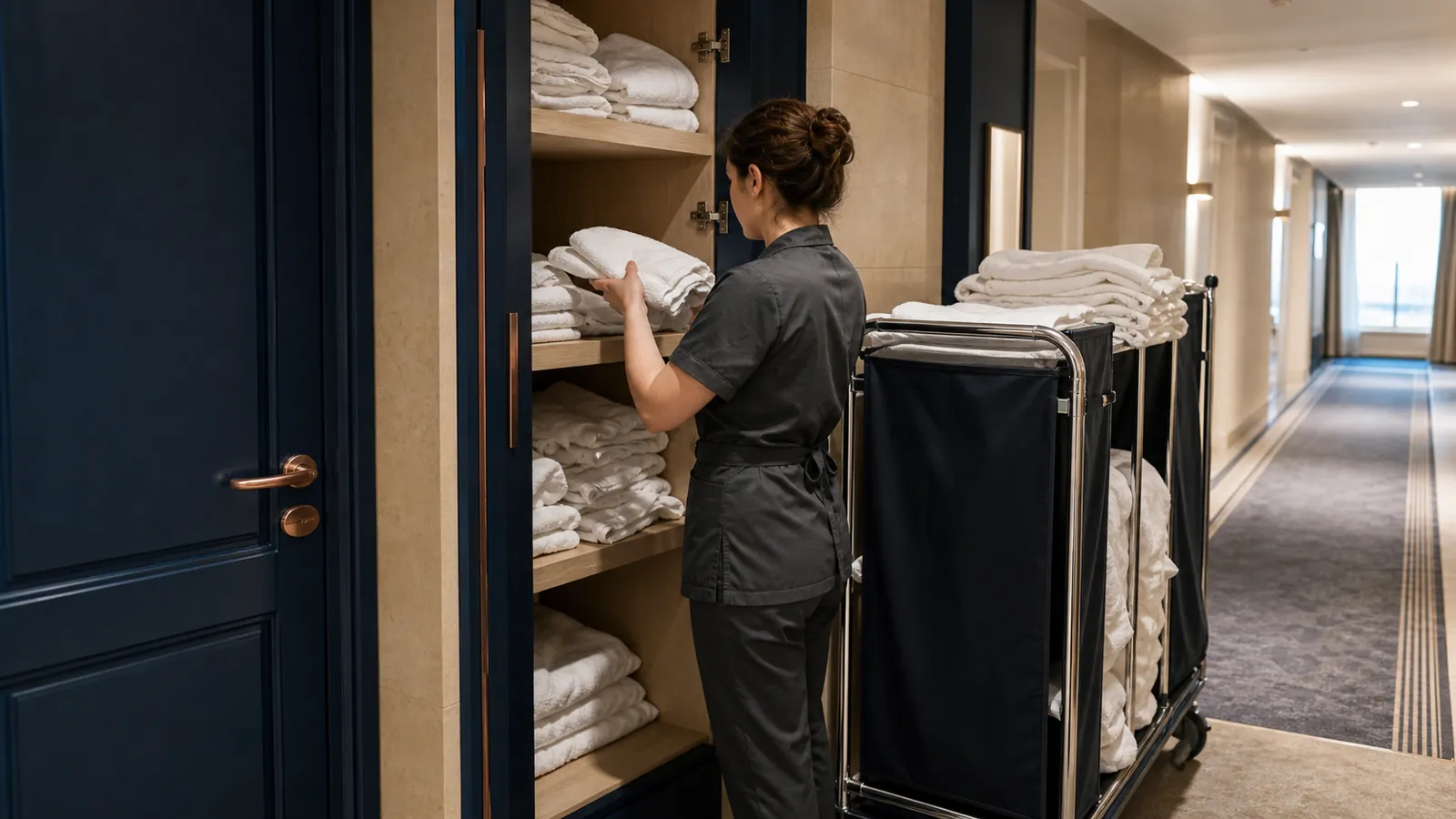
Choose wholesale hotel towels as a coordinated room-linen system, not as one generic bath towel. Define each SKU by finished post-wash dimensions, conditioned unit mass and GSM basis, fiber by component, pile and border construction, color, label, pack-out, and agreed tests. Approve production-representative samples after the intended laundry sequence. Calculate opening par from occupied-room demand, the time linen remains outside clean storage, and a separately documented reserve.
Housekeeping feels every specification decision. An oversized bath sheet can overwhelm a small cart or slow a dryer. A washcloth with a deep decorative border can fold badly. Two white towel styles that look alike in a sample room may sort differently once shrinkage, shade, lint, and replacement batches enter the laundry.
This guide is for hotels, motels, resorts, serviced apartments, management groups, laundries, distributors, and private-label buyers. It does not prescribe one size, GSM, par level, or wash life for every property. Those figures must come from the room standard, actual equipment, measured use, a controlled sample program, and the commercial agreement.
Build the room-set matrix before requesting prices
Walk a standard room with housekeeping and record the function of every item: washcloth, hand towel, bath towel, bath sheet, bath mat, pool towel, spa towel, and any staff or cleaning cloth. Note the number placed for each occupancy type, the display fold, rack or shelf dimensions, cart slot, clean-storage location, used-linen route, and replenishment rule. Keep cleaning textiles visibly separate from guest linen.
A market name is not a specification. “Bath towel” can describe many finished dimensions, and a quoted size may refer to an unwashed or nominal product. Record the acceptable post-wash size and how it will be measured. Confirm that the finished item fits the rack without dragging, folds into the intended stack, clears the bathroom floor, and occupies a workable share of the cart and shelf.
| Hotel towel job | Operational question | Sample evidence |
|---|---|---|
| Washcloth | Does the fold and border fit the amenity presentation? | Post-wash size, shape, border distortion, hand, staining, seam bulk |
| Hand towel | Does it hang and dry without crowding the rail? | Finished length, absorbency, lint, edge stability, guest feel |
| Bath towel | Does it balance coverage, comfort, cart volume, and dryer load? | Finished area, conditioned mass, GSM basis, absorption, drying observation |
| Bath sheet | Is the larger format supported by room tier and laundry capacity? | Guest-use trial, rack fit, unit mass, fold volume, cycle timing |
| Bath mat | Does the construction remain flat and distinct from body towels? | Shape, skid-management policy, pile, borders, laundering, identification |
Specify finished dimensions, total mass, and GSM on one basis
GSM is grams per square metre. ASTM D3776/D3776M-20(2025) provides different options for measuring fabric mass per unit area, while ASTM D1776/D1776M-20(2024) and ISO 139:2005 address textile conditioning atmospheres. A supplier should identify the measurement basis, specimen, conditioning, and tolerance. GSM alone does not establish towel size, total weight, softness, absorbency, drying time, or service life.
Use area × GSM only as a quotation check. A nominal 70 cm × 140 cm rectangle has an area of 0.98 m²; at 500 g/m², the simple calculation is 490 g. Hems, borders, dimensional tolerance, finishing, moisture condition, and the method used can move the finished unit away from that estimate. Weigh conditioned finished towels when cart load, shipping weight, or dryer load depends on unit mass.
There is no universal hotel-towel GSM. A higher number may increase mass and perceived fullness, but the operating result also depends on yarn, pile, ground, size, finish, laundering, extraction, drying, and the room standard. Use the towel GSM guide to normalize measurements, then approve the actual washed towel instead of buying a number.
Fit the towel to the property’s real laundry route
Document every step from a guest bathroom to clean storage: collection interval, chute or bag, transport, soil sorting, washer type, load, detergent, builder, bleach or other additives, water temperature, cycle, extraction, dryer type, heat setting, finishing, folding, cart loading, and return schedule. If an outside laundry handles the towels, record the hand-off times and which process variables the property can control.
ISO 6330:2021 defines reference domestic washing and drying procedures for textile testing; it is useful when the selected procedure matches the question being asked. ISO 105-C06:2010 addresses colorfastness to domestic and commercial laundering under stated conditions. Neither standard summary guarantees survival in an unnamed hotel process. Pair named laboratory evidence with a trial in the intended laundry, using the same chemistry and drying decisions the production stock will receive.
Compare clean-return time as well as appearance. A towel that remains wet longer, needs a special sort, or consumes too much dryer or folding capacity can destabilize par even when guests like the first-use hand. Ask laundry and housekeeping to sign the same sample report so comfort, throughput, and quality failures are not judged in separate conversations.
Inspect pile, ground, borders, hems, and labels
Require fiber content by component when pile, ground, border, or sewing thread differ. The Federal Trade Commission’s textile-labeling guidance explains the required disclosures for most covered textile products sold in the United States, including fiber content, country of origin, and the identity of the manufacturer or another responsible business. The sewn label, packaging claim, quotation, and purchase order should not contradict one another.
Look beyond fiber adjectives. Inspect pile anchorage, ground visibility, loop regularity, border width, hem turns, seam density, corner build-up, loose threads, skew, and puckering. Rub the edges where a guest will handle them. Fold the towel the way housekeeping will fold it. A decorative feature that photographs well may tighten, ripple, or slow production folding after repeated washing.
If a logo or woven identity element is required, approve placement on every size rather than scaling one artwork blindly. Check embroidery backing, thread, pile compression, fold position, post-wash distortion, and whether the mark creates sorting problems. The custom embroidered towel guide provides a separate control sheet for branded programs.
Approve production-representative samples after laundering
Request enough identical samples to keep an untouched control, complete the agreed wash sequence, repeat a disputed observation, and check variation between units. Label each sample with supplier, construction, size, color, revision, and date. Do not allow a showroom sample from a different yarn, dye lot, finish, or factory line to become the approval standard for the bulk order.
ASTM D5433-24 covers selected performance characteristics for institutional and household towels and permits buyer and seller to agree on the requirements relevant to a style. ASTM D4772-26 measures surface water absorption of terry fabrics but notes that surface absorption is only one towel characteristic. ISO 5077:2007, used with an agreed preparation, washing, and drying procedure such as ISO 6330:2021, supports dimensional-change reporting.
| Buyer question | Named method | Retained record |
|---|---|---|
| Is mass per area being compared consistently? | ASTM D3776/D3776M-20(2025) | Option, conditioning basis, specimen dimensions, calculations, result |
| Does terry surface absorption meet the agreement? | ASTM D4772-26 | Specimen identity, laboratory, method, result, interpretation |
| How do finished dimensions change? | ISO 6330:2021 with ISO 5077:2007 | Wash/dry procedure, cycles, pre/post measurements, percentage change |
| Does color withstand the selected laundering condition? | ISO 105-C06:2010 | Exact option, detergent, bleach status, temperature, ratings |
| Which broader towel characteristics form the purchase agreement? | ASTM D5433-24 | Included, changed, or excluded requirements and acceptance limits |
After each checkpoint, compare sample and control under stable light. Record dimensions, conditioned mass, shade, absorbency, lint, loose loops, pile loss, seams, corners, skew, border distortion, label condition, fold quality, hand, and drying observation. The towel sample testing checklist keeps those observations tied to one approved revision.
Calculate hotel towel par from occupancy and turnaround
Par is an inventory decision, not a universal hospitality constant. Start with the room-set matrix and measured peak occupied-room demand by SKU. Add the full time each item is unavailable in guest use, collection, transport, sorting, washing, drying, finishing, and clean return. Model stayovers, departures, suite occupancy, extra requests, spa or pool transfers, rejects, losses, new-room openings, and delivery risk separately.
Planning example, not a hotel standard: if 80 occupied rooms require two bath towels during the measured service interval, demand is 160 towels. If the full route keeps each towel unavailable for two such intervals, working stock is 320. A buyer-selected 12% disruption reserve adds 38.4, producing 358.4 before rounding to the approved case pack. Replace every assumption with property data.
Count where losses occur instead of treating all missing linen as wear. Guest removal, cross-department transfer, stain rejection, torn hems, unexplained shrinkage, and late laundry return need different corrections. A simple SKU-level issue, return, reject, and discard log gives purchasing a cleaner reorder signal than one annual replacement percentage.
Normalize wholesale hotel towel quotations
Compare suppliers on finished post-wash dimensions, conditioned unit mass, stated GSM and method basis, fiber by component, yarn and pile description, border, hem, color, optical or other finish claims, label, packaging, quantity, test package, inspection, Incoterm, payment, and destination. A price per dozen is not comparable if the pieces differ in area, mass, tests, packaging, or trade responsibility.
Separate development charges from production charges. Ask who pays for lab dips, samples, embroidery or woven labels, testing, third-party inspection, cartons, barcodes, and replacement samples. Use the wholesale towel pricing guide to compare landed scope and the MOQ guide to map every size-color combination.
Write the approved hotel towel into the purchase order
Identify the signed pre-production sample by code and date. Attach the room-set matrix, finished specification, color reference, artwork, label, packaging standard, test sheet, and inspection plan. State whether the numerical specification or physical sample controls if they conflict. Require written approval before changing fiber, yarn, pile, ground, GSM, size, dye, finish, border, thread, label, pack, or production location.
Define bulk sampling, inspection stage, responsible party, laboratory, report deadline, tolerance, retest, remedy, and nonconforming-goods procedure before production. “Hotel quality” and “commercial grade” are marketing descriptions, not reproducible acceptance criteria. The supplier vetting checklist helps assess traceability, change control, and complaint handling behind the product sample.
Wholesale hotel towel buyer checklist
Complete before bulk release
- Map every guest, bath, pool, spa, and staff towel SKU without mixing cleaning cloths into the room set.
- Record placement quantity, fold, rack fit, cart slot, clean storage, and used-linen route by room type.
- Specify post-wash dimensions, tolerance, conditioned unit mass, GSM basis, fiber by component, pile, border, hem, color, and label.
- Document the actual wash, extraction, dry, finish, transport, and clean-return route.
- Keep an untouched control and test production-representative samples through the agreed process.
- Record absorbency, dimensions, mass, color, lint, loops, seams, shape, hand, fold quality, and drying observation.
- Calculate par from measured occupied-room demand and total unavailable time; track reserve reasons separately.
- Normalize every quote for product, test, package, quantity, trade term, and destination.
- Verify fiber, origin, and responsible-company labeling on the final sewn label and packaging.
- Link the signed sample, specification, testing, artwork, and inspection plan to the purchase order.
Frequently asked questions
What GSM is best for wholesale hotel towels?
There is no universal best GSM for every hotel. Choose it with finished size, conditioned unit mass, yarn and pile construction, absorbency, guest feel, laundry equipment, drying capacity, fold volume, and room tier. Compare production-representative towels after the intended wash and dry sequence.
How many hotel towels should be ordered per room?
Build the quantity from the room-set matrix, measured occupied-room demand, and the full time linen remains unavailable in collection, transport, laundering, finishing, and return. Add documented reserves for rejects, loss, disruption, and opening rooms, then round each SKU to its approved case or production quantity.
Should hotel towel sizes be specified before or after washing?
Use a clearly identified finished measurement basis and state when the tolerance applies. For operational approval, post-wash dimensions matter because they determine rack fit, fold, guest coverage, cart capacity, and stack height. Keep the pre-wash supplier data too, but do not compare bidders using mixed measurement bases.
Are heavier hotel towels always more durable?
No. Higher mass does not guarantee longer service. Durability also depends on yarn, pile anchorage, ground construction, borders, hems, dye and finish, laundering, drying, handling, and acceptance limits. A washed sample program provides stronger evidence than GSM or fiber terminology alone.
How should a hotel approve a wholesale towel sample?
Keep an untouched control and run identical samples through the intended laundry checkpoints. Record dimensions, conditioned mass, absorbency, color, lint, loose loops, pile, borders, hems, corners, shape, label condition, hand, folding, and drying observation. Sign the approved revision and attach it to the purchase order.
Buy the room-linen system housekeeping can repeat
Wholesale hotel towels perform as a system: room placement, cart capacity, laundry, clean storage, par, replacement, and guest use all meet in one specification. A disciplined buyer defines the room set, approves washed samples, records the full linen route, and makes every supplier quote answer the same questions.
When the room types, towel jobs, finished sizes, construction, colors, laundry process, quantities, labels, packaging, destination, and delivery target are ready, request wholesale hotel towel pricing, MOQ, and samples.
Primary authorities
- ASTM International: ASTM D5433-24, Standard Performance Specification for Towel Products for Institutional and Household Use
- ASTM International: ASTM D4772-26, Surface Water Absorption of Terry Fabrics
- ASTM International: ASTM D3776/D3776M-20(2025), Mass Per Unit Area of Fabric
- ASTM International: ASTM D1776/D1776M-20(2024), Conditioning and Testing Textiles
- International Organization for Standardization: ISO 139:2005, Standard Atmospheres for Conditioning and Testing
- International Organization for Standardization: ISO 6330:2021, Domestic Washing and Drying Procedures for Textile Testing
- International Organization for Standardization: ISO 5077:2007, Determination of Dimensional Change in Washing and Drying
- International Organization for Standardization: ISO 105-C06:2010, Colour Fastness to Domestic and Commercial Laundering
- Federal Trade Commission: Threading Your Way Through Textile and Wool Labeling Requirements