Commercial towel buying guide
Wholesale Dog Grooming Towels: Size, GSM & Laundry Guide
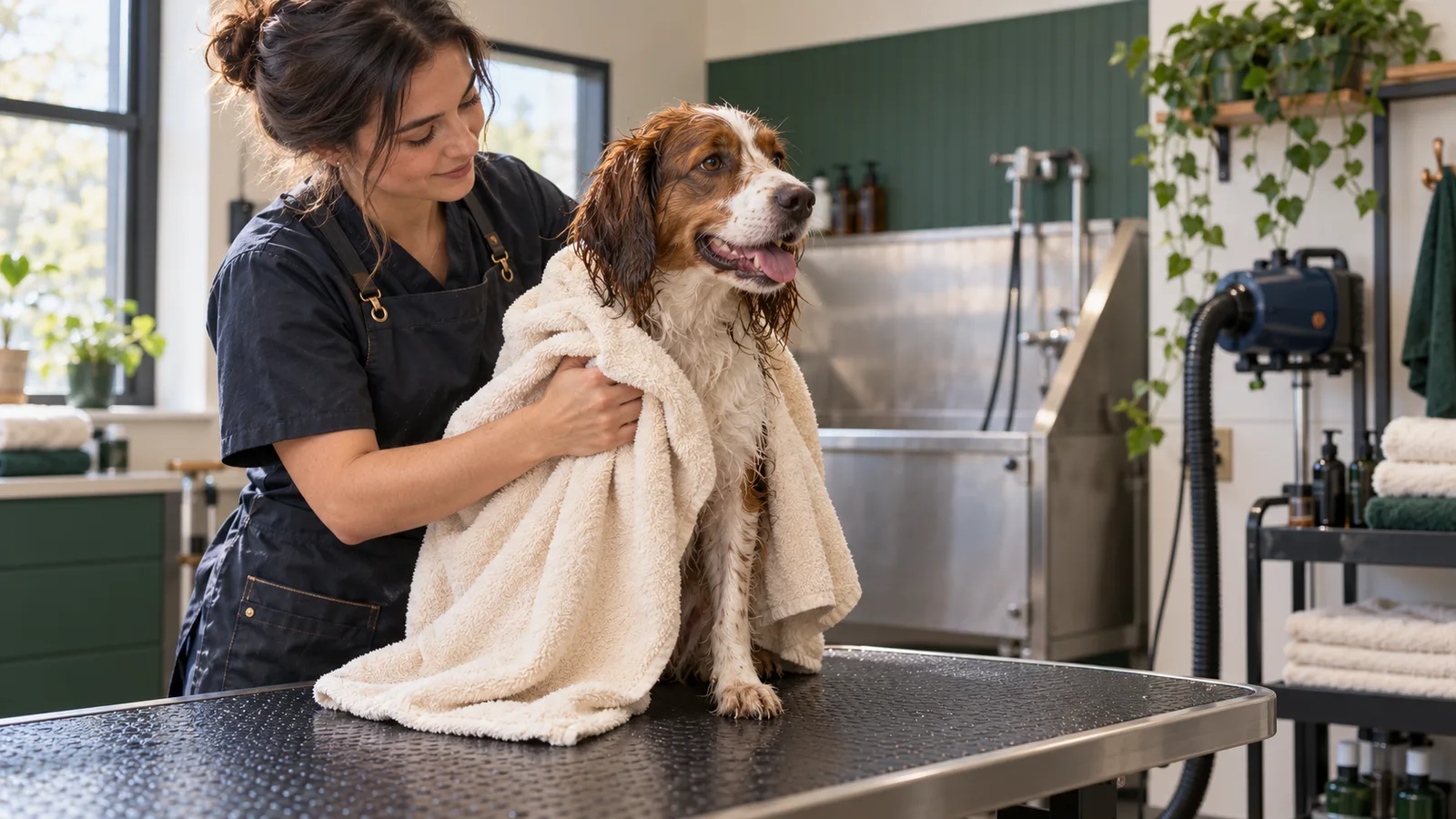
A grooming towel has an unusually mixed assignment. It must lift water from a moving coat, stay manageable in a groomer's hands, release enough hair in laundering, and return to service without severe shrinkage, hard edges, odor retention, or color transfer. A towel that feels plush in a dry sample room may be slow on a dense double coat. A very light towel may handle neatly around a small dog yet saturate too soon on a large one.
This guide is for grooming chains, independent salons, mobile groomers, boarding facilities, distributors, and private-label buyers. It focuses on a defensible purchasing process. For the wider sourcing sequence, pair it with Loft Weave's towel supplier vetting checklist, sample testing checklist, and MOQ planning guide.
Start with jobs, not one universal pet towel
Map every point at which a towel enters the grooming workflow. Bath drying is the obvious use, but salons also keep textiles for face and paw work, cage or table cleanup, and accidental floor spills. Those jobs should not automatically share one towel pool. Separating them makes purchasing clearer and reduces the chance that a cleanup towel returns to body-drying service.
| Job | Useful buying focus | Trial observation |
|---|---|---|
| Primary body drying | Coverage, wet handling, water pickup, edge comfort | Time and number of towels used for representative coat types |
| Face and paw detail | Smaller finished size, controlled bulk, soft finished edge | Grip, access, and visibility during careful handling |
| Table or kennel cleanup | Fast identification, soil release, durability | Whether the textile is kept out of body-drying stock |
| Floor spill response | Dedicated color, clear storage separation | No return to animal-contact circulation |
Color can support that separation, but it is only a visual control. It does not clean or disinfect a towel. Write the color-to-job map into operating procedures, storage labels, and purchase orders. A color code that exists only in a buyer's spreadsheet will not guide a busy shift.
Build a size matrix around dogs and workstations
There is no responsible single best size for every salon. Breed size, coat volume, tub geometry, table height, groomer reach, folding practice, washer capacity, and storage all affect the decision. Request finished dimensions, not loom-state or nominal cut dimensions. Then set a tolerance that the factory can inspect and your receiving team can verify.
Small detail towel
Useful for paws, faces, ears from the outside, and targeted moisture. It should stay controllable in one hand. Keep it distinct from general cleaning textiles.
General drying towel
The daily workhorse for small and medium dogs. Judge coverage while wet, not just the folded shelf footprint.
Large-coat towel
Provides more wrap and surface area for large bodies or dense coats. Check whether wet weight creates unnecessary wrist load.
Cleanup towel
May use a different construction or color because its job is soil pickup, not coat drying. Store and launder according to the site's hygiene procedure.
Ask suppliers to identify how and where they measure length and width. Record the conditioned finished measurement in the specification, and repeat it after an agreed wash-and-dry sequence. ISO 5077:2007 provides a method for determining dimensional change after specified washing and drying procedures. The standard does not decide an acceptable shrinkage limit for your business; buyer and supplier still need to agree that limit.
Use GSM as a controlled measurement, not a quality score
GSM means grams per square metre. It describes mass per unit area. It does not, by itself, identify fiber quality, pile geometry, water pickup, softness after laundering, drying time, or service life. Two towels with a similar reported GSM can behave differently because yarn, weave, pile height, finishing, and edge construction differ.
Require the method, sample location, conditioning, number of specimens, and tolerance behind any GSM figure. ASTM D3776/D3776M-20(2025) covers standard methods for mass per unit area of fabric. For towels, ASTM D5433-24 addresses specification requirements for institutional and household terry towels, including buyer-supplier agreement where choices are left open. Confirm that the proposed construction falls within the method's scope before naming it in a purchase order.
Use GSM to describe an approved sample, compare production lots, and investigate drift. Do not convert an untested GSM range into a universal performance claim. Loft Weave's towel GSM guide explains this distinction in more detail.
Compare cotton and microfiber by declared fiber and task
Cotton terry is familiar, comfortable in hand, and widely available in commercial constructions. Microfiber products can be engineered with different piles and blends for fast pickup or lighter handling. Neither category wins every grooming task. The useful question is whether the exact sample meets the defined job after laundering.
In the United States, the Federal Trade Commission Textile Fiber Rule governs generic fiber-name and percentage disclosures for covered textile products. The FTC's Threading Your Way guidance helps businesses understand fiber content, country-of-origin, and responsible-company identification. Microfiber alone is not the generic fiber declaration. Ask for percentages of the constituent fibers, not only a marketing label.
Do not cite that rule as a blanket towel care-label requirement. The FTC guidance explains that care instructions sit under a separate Care Labeling Rule for specified apparel and piece goods; commercial buyers should still agree care information that supports their own laundry process.
Measure absorbency with a named method and a salon trial
Absorbency has more than one useful dimension: how quickly water enters the structure, how much is held under defined conditions, how the towel feels as it becomes wet, and how much working surface remains before replacement. Supplier language often blends those questions together.
AATCC TM79-2025 is a recognized method for evaluating textile absorbency. If a laboratory result is requested, specify the exact method and specimen condition. Then add a practical test with groomers. Record dog size and coat description, starting condition, number of towels used, handling comments, and the point at which the towel is judged saturated. This is an operational comparison, not a claim that every dog or coat will produce the same result.
Test hair release instead of accepting a lint claim
Hair release matters because a towel that holds large amounts of coat can burden sorting, equipment cleaning, and finishing. There is no single number in a product listing that proves good release for every breed and laundry system. Build a repeatable in-house comparison.
- Use production-representative towels that have completed the agreed prewash.
- Assign samples across several relevant coat types.
- Weigh or photograph a controlled amount of recovered hair if that is practical, and use the same collection approach for each candidate.
- Launder candidates separately under the salon's proposed settings.
- Inspect remaining hair, lint screens, seams, hook-and-loop contact, and folding labor.
- Repeat enough cycles to expose changes rather than relying on one clean sample.
Document the result as an approved-sample observation. Avoid absolute terms such as hair-free or lint-free unless a defined and supported test justifies the wording.
Inspect loops, edges, labels, and snag behavior
Long loops can feel full but may meet claws, tags, kennel hardware, or hook-and-loop closures. Shorter or lower-profile constructions may handle differently. Edge seams, binding, corners, and sewn labels deserve their own inspection because a hard or curling edge can make careful drying awkward.
Run a snag screen
Check dry and wet samples around representative table surfaces, grooming leads, closures, and storage bins. Stop the trial if a construction presents a foreseeable entanglement issue. Do not place a textile test ahead of safe animal handling.
Check the label position
Confirm that the brand or care label does not create a stiff corner or a scratchy contact point. If private labeling is planned, approve label dimensions, material, fold, seam allowance, placement, and artwork together.
Review seam recovery
After repeated laundering, look for edge waviness, open stitching, broken threads, distortion, and corners that dry slowly. Photograph failures with the cycle count and laundry conditions.
Match laundry testing to the real process
A domestic laboratory procedure is useful only when its limits are understood. ISO 6330:2021 specifies domestic washing and drying procedures for textile testing, including reference detergents, ballast, machine types, and drying options. The ISO page warns that machine type, detergent, and dryer parameters can affect results. A salon using commercial equipment, a particular detergent, or a different soil load should not assume one laboratory sequence predicts every outcome.
ISO 105-C06:2010 addresses color fastness to domestic and commercial laundering with its stated systems. The standard also notes that industrial articles can face different, sometimes more severe, procedures. AATCC TM61-2025 offers accelerated laundering evaluations under specified conditions. Name the method, option, detergent, temperature, drying route, and number of cycles when requesting data.
Alongside laboratory work, run the approved sample through the site's intended cycle. Record load composition, soil, detergent and additives, water temperature, extraction, dryer temperature, cool-down, and folding condition. Never improvise chemical compatibility or disinfection claims from a generic test report. Your veterinary, hygiene, equipment, and chemical procedures remain separate controls.
Set colorfastness controls for wet work
Dark or saturated colors can support department coding and hide some staining, but they also need colorfastness review. ISO 105-X12:2016 specifies dry and wet rubbing tests for resistance to color transfer. For grooming towels, wet rubbing is especially relevant to the conversation because the textile works against damp coats and hands. It still does not recreate every shampoo, topical product, or disinfectant.
Approve shade against a physical standard under controlled lighting, set an allowable color difference if your program requires it, and retain a production sample. Test any intended bleach or chemical process on the exact dyed construction with the chemical supplier's instructions. "Bleach-safe" should never be assumed from color alone.
Separate towel performance from animal-care claims
Ask for substantiation before using antimicrobial, hypoallergenic, chemical-resistant, or odor-control language. A fiber name, dye name, finish trade name, or casual wash trial is not enough. Marketing claims should match the evidence for the finished product and the intended market.
Create a production-representative sample plan
A hand-picked show sample may not represent bulk production. Ask whether samples come from the intended yarn, loom or knitting line, dye route, finish, sewing construction, and labeling process. If anything differs, list it. Approve separately for each construction and color that could change behavior.
| Stage | What to record | Decision |
|---|---|---|
| Incoming dry review | Finished size, mass, shade, odor, edges, labels, visible defects | Eligible for wet trial or rejected |
| Grooming trial | Coat type, handling, coverage, water pickup, saturation point, snags | Job assignment and preferred sample |
| Laundry trial | Exact cycle, hair release, lint, drying behavior, hand, odor, edge condition | Continue, revise, or stop |
| Repeated-cycle review | Dimensions, mass where relevant, shade, seams, loops, labels, usability | Approve specification and limits |
| Production verification | Random samples against retained approval sample and written criteria | Accept, hold, or investigate lot |
For a reusable worksheet, use the wholesale towel sample testing checklist. Buyers comparing towel constructions may also use the cotton construction comparison as background, while keeping claims tied to the actual submitted sample.
Write the purchase specification before pricing
Pricing is meaningful only when suppliers quote the same item. A thinner towel, smaller finished dimension, simpler edge, lighter label, different packing count, or untested color can look cheaper without being equivalent. Issue a specification sheet and request line-by-line exceptions.
Product fields
State intended job, generic fiber percentages, construction, finished dimensions and tolerances, mass per unit area and method, color standard, pile description, edge and corner construction, label details, and performance tests.
Packaging fields
State fold, inner pack quantity, carton quantity, carton marking, barcode or label placement, moisture protection, and whether mixed colors are allowed. Confirm whether compression could delay recovery or trap residual moisture.
Commercial fields
Request sample cost, MOQ by size and color, price basis, tooling or label charges, production lead time, inspection timing, shipping term, carton dimensions, estimated weights, payment milestones, claim process, and reorder conditions. For cost structure, see the wholesale towel pricing guide.
Plan quantities from peak circulation
Estimate towels in active use, towels waiting for laundry, towels inside machines, clean reserve, and an agreed buffer for peaks or equipment downtime. Do this by role and size. If small face towels and large body towels share one total, shortages can hide until the shift begins.
Compare that circulation requirement with supplier MOQs and carton packs. A low unit price does not help if the order forces too much slow-moving color stock or too few high-use sizes. Our wholesale towel MOQ guide covers the commercial tradeoffs.
Use receiving inspection to protect the approval
Keep a sealed or protected approval sample and the signed specification. At receipt, sample cartons across the shipment rather than taking every specimen from the top of one box. Verify labels and packaging first, then inspect the defined product attributes.
If results sit outside the agreed tolerance, place the affected lot on hold and investigate before mixing it into existing stock. Record lot identifiers, carton locations, specimen counts, method, photos, and the supplier response. A vague statement such as "these feel different" is hard to resolve; documented differences are actionable.
Wholesale dog grooming towel buyer checklist
- Map body drying, detail drying, table or kennel cleanup, and floor-spill roles separately.
- Define finished sizes and tolerances for each role.
- Request generic fiber names and percentages rather than "microfiber" alone.
- Specify GSM with a named method, sample plan, and tolerance.
- Run absorbency, wet handling, hair-release, snag, edge, and repeated-laundry trials.
- Document the exact wash and dry process used for comparison.
- Approve colorfastness requirements and a physical shade standard.
- Keep body-contact and cleanup textiles visibly separated.
- Approve label placement, fold, pack count, and carton marking.
- Calculate circulation by size and job before accepting MOQ.
- Freeze an approved sample and written production specification.
- Set receiving sampling, hold, claim, and reorder procedures.
Questions to send a dog grooming towel supplier
- What are the generic fiber percentages and the production construction?
- Are dimensions and GSM stated for the finished, conditioned towel, and what test method and tolerances apply?
- Which sample is production-representative for each size and color?
- What absorbency, dimensional-change, colorfastness, and laundering data are available, with exact methods and options?
- How are loops, edges, corners, labels, and private-label artwork made and inspected?
- What are the MOQ, carton pack, price basis, lead time, inspection window, shipping term, and reorder conditions?
- How will a production lot be identified if a claim or corrective action is needed?
Buyers considering custom branding should also review custom logo embroidery on towels and private label versus OEM towels. Embroidery can change hand, drying, and snag behavior, so the branded sample needs its own trial.
Frequently asked questions
What GSM is best for dog grooming towels?
There is no universal best GSM. Use GSM as a controlled mass-per-area specification, then compare the exact towel's water pickup, wet handling, drying time, hair release, edges, and laundering performance in your operation.
Are cotton or microfiber towels better for dog grooming?
Either can work, depending on construction and task. Request generic fiber percentages, test production-representative samples on relevant coat types, and approve the one that meets the written job and laundry requirements.
How many dog grooming towels should a salon order?
Calculate towels in use, waiting for laundry, inside machines, in clean reserve, and in a peak-demand buffer. Do the calculation separately by towel role and size, then reconcile it with carton packs and MOQ.
Can one towel color be used for every grooming task?
It can, but a documented color code can help separate body-drying towels from table, kennel, or floor-cleanup textiles. Color is only a visual control and does not replace laundering, hygiene, or storage procedures.
How should wholesale dog grooming towel samples be tested?
Record incoming dimensions, mass, shade, edges, and labels; run controlled grooming trials across representative coat types; repeat the intended laundry cycle; and inspect hair release, shrinkage, color transfer, lint, seams, loops, odor, and usability against written acceptance limits.
Primary references used for this guide
- Federal Trade Commission: Textile Fiber Rule
- Federal Trade Commission: Threading Your Way
- ASTM D3776/D3776M-20(2025): Mass Per Unit Area of Fabric
- ASTM D5433-24: Towel Products for Institutional and Household Use
- AATCC TM79-2025: Absorbency of Textiles
- AATCC TM61-2025: Colorfastness to Laundering
- ISO 6330:2021: Domestic Washing and Drying Procedures
- ISO 5077:2007: Dimensional Change in Washing and Drying
- ISO 105-C06:2010: Colour Fastness to Laundering
- ISO 105-X12:2016: Colour Fastness to Rubbing
Build a dog grooming towel specification with Loft Weave
Share the intended jobs, towel sizes, fiber preference, color map, laundry process, branding, pack quantities, order volume, and destination. Loft Weave can prepare a sample and quotation path around a written commercial specification.