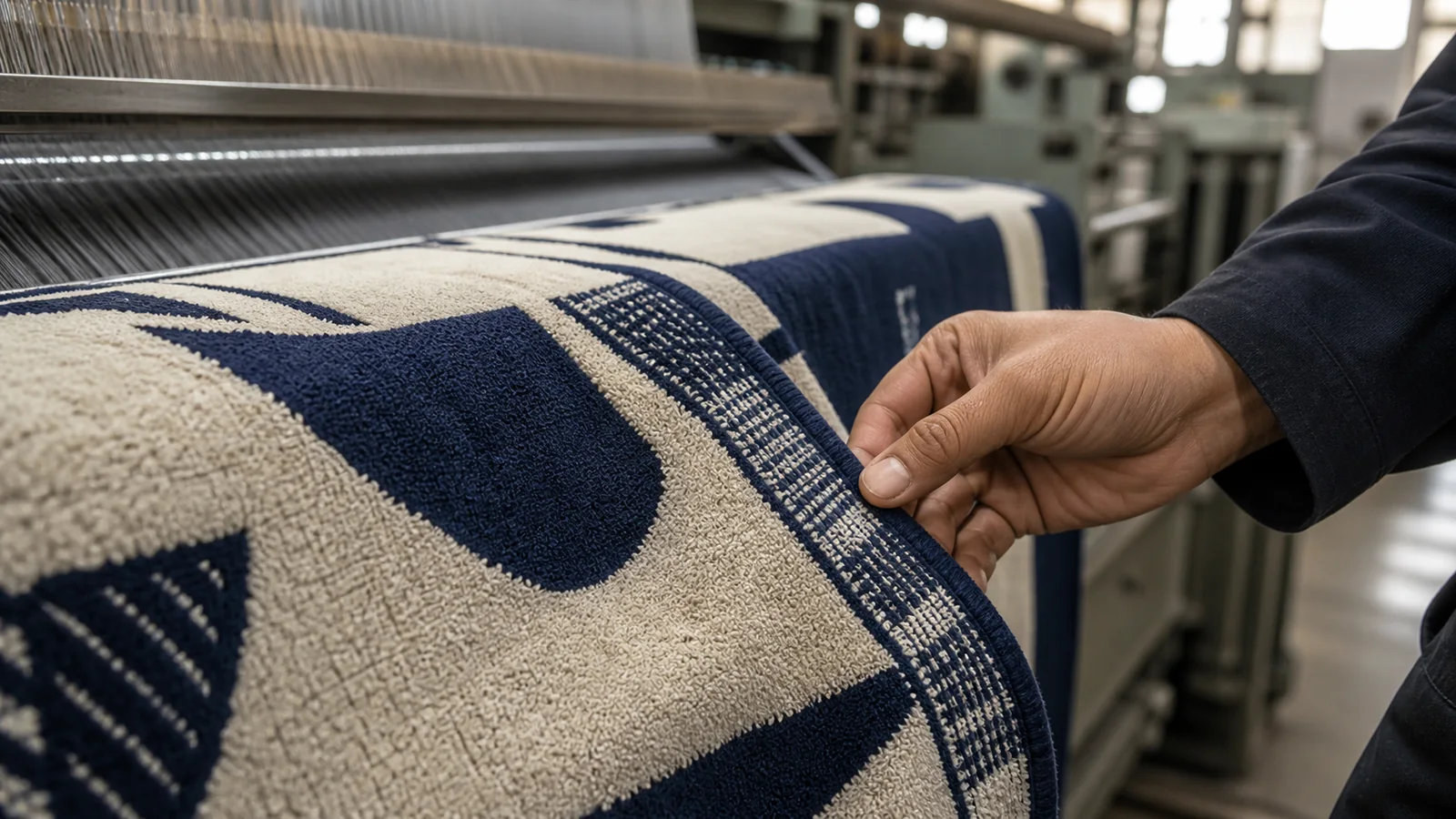
For custom jacquard towels wholesale, approve the woven design on the exact towel construction before bulk production. The order should lock the artwork version, face and reverse appearance, yarn colors, finished size, GSM basis, border or all-over repeat, hems, fiber content, wash and colorfastness tests, labels, packaging, inspection limits, and reorder references. Do not accept a screen rendering as the production standard or assume a woven design cannot change shade, dimensions, or clarity in laundering.
A jacquard towel carries a pattern, wordmark, or graphic as part of the woven structure. That is different from stitching a logo onto a finished towel or placing ink on its surface. The woven route can create a broad tonal design, a contrasting border, or an all-over pattern, but it also ties the artwork to loom planning, yarn selection, pile direction, finishing, and order scale.
This guide is for private-label brands, hotel and resort groups, promotional distributors, sports programs, retailers, importers, and procurement teams buying woven logo towels in commercial quantities. It does not set a universal MOQ, lead time, color limit, size, GSM, wash life, or price. Those figures depend on the selected construction, artwork, yarn plan, number of SKUs, sample path, packing, factory schedule, and delivery terms.
Decide whether the identity belongs in the weave
Start with the way the towel will be sold, handled, washed, folded, and seen. A hotel may want a restrained name inside a decorative border. A resort shop may need a two-color graphic that remains visible when folded. A sports program might prefer an all-over pattern that reads from a distance. A small employee name, detailed crest, or multicolor photographic image may point to another method.
Ask the supplier for a woven sample that is close to the proposed structure, not just a photograph of unrelated jacquard work. Look at it from normal viewing distance, then close enough to see pile direction and yarn transitions. Turn it over. Fold it as the customer will see it. Wet it, dry it, and inspect the edges. The reverse appearance and the way long floats, pile, ground, or color transitions behave are part of the product.
Loft Weave's private-label and OEM towel program separates brand application from full product development. If an existing towel can carry an approved woven border, the project may stay closer to a private-label route. If the artwork changes the towel's construction, dimensions, color plan, or performance target, treat it as an OEM development project and price the extra sampling and control work.
Compare jacquard, woven borders, embroidery, and print
Branding methods solve different design and production problems. The table is a scoping tool, not a universal ranking. A buyer may use more than one method in a range, but each SKU still needs one controlled approval standard.
| Branding route | Good fit to investigate | Questions for the supplier | Approval risk |
|---|---|---|---|
| Jacquard woven design | Large tonal or contrasting pattern integrated into the towel | Face/reverse, repeat, pile direction, yarn colors, edge definition, construction file | Artwork changes when converted to weave; shade, distortion, or definition shifts after finishing |
| Woven border or band | Repeated name, stripe, or compact identity within a flatter zone | Border width, usable design height, repeats, margins, reverse, scaling by towel size | Small text closes up; border draws in or sits unevenly after laundering |
| Embroidery | Raised mark, several thread colors, or post-weaving application | Digitizing, stitches, thread, backing, topping, placement, reverse finish | Stiff hand, buried detail, puckering, abrasion, or inconsistent placement |
| Print or transfer | Fine graphics, campaign artwork, or color effects suited to the base material | Ink or transfer compatibility, pretreatment, print face, wash method, hand, absorbency impact | Cracking, migration, fading, poor penetration, or changed hand |
The custom embroidered towel guide covers stitch files, thread, backing, and placement in detail. A woven design needs a different approval trail because the mark is planned with the towel rather than added as a separate stitched layer.
Translate the logo into actual-size woven artwork
Send vector artwork where possible, along with a PDF showing the intended appearance. The supplier should return a weave-ready interpretation that identifies the artwork version, finished dimensions, design repeat, face and reverse, orientation, yarn colors, and any simplification. Review it at actual size. Enlarging a small border on a monitor hides the exact problem that the loom must solve.
State dimensions numerically. For example, a buyer might request a 120 mm-wide wordmark centered inside an 80 mm border with 20 mm clear space on each side. Those numbers are only an illustration, not a recommended layout. They show why phrases such as "small logo" and "centered in the border" are not production instructions.
Reduce detail deliberately
Thin gaps, tight counters, tiny registered symbols, soft gradients, and closely spaced letters can lose clarity when converted from a smooth digital curve to a woven repeat. Ask the supplier to flag every compromised detail instead of redrawing the logo without notice. Keep the original file, the revised weaving file, and the approval PDF under separate version numbers.
Approve face, reverse, and orientation
A two-color woven image may reverse or change emphasis on the back. If the towel has a preferred face, name it in the specification and show how the label, border, fold, and pack orientation relate to that face. If both sides are customer-facing, approve both. Product photography should not conceal the reverse or crop out the construction area that matters.
Scale artwork by SKU
One artwork file may not suit a washcloth, hand towel, bath towel, and beach towel without adjustment. A 120 mm mark occupies a very different share of each surface. Create a size-specific placement or repeat sheet. If the supplier proposes one scaled rule, approve the result on every materially different size before bulk production.
Specify the base towel with the woven design
Record fiber content by component, yarn description, pile and ground construction, face arrangement, border, hems, finished size, conditioned unit mass, mass per unit area, color references, finish, label, hanging loop, and packing. A headline such as "100% cotton jacquard towel" leaves the buyer without enough information to compare two factories or investigate a failed reorder.
ASTM International's ASTM D5433-24 covers specified performance characteristics for woven and knitted kitchen towels, washcloths, hand towels, bath towels, and bath sheets used in institutional and household settings. It also says purchaser and supplier may establish requirements by mutual agreement. Use that principle: write the properties and methods that matter to this order rather than treating a generic certificate of conformity as a complete specification.
If the project claims ring-spun, combed, origin-specific, recycled, or organic cotton, link the evidence to the exact SKU and components in scope. The cotton terminology guide explains why spinning, preparation, and fiber origin are separate attributes. The certifications guide shows how to check certificate holder, article scope, number, and validity.
Control yarn color, contrast, and shade transfer
A screen color, printed Pantone reference, dyed yarn, and terry surface do not look identical. State the color reference, viewing condition, approved physical standard, and permitted production difference. Decide whether the goal is an exact controlled shade, a tonal effect, or an intentionally high-contrast design. Keep the approved yarn reference with the signed towel sample.
Color count can affect loom planning, design route, MOQ, cost, and reverse appearance, but there is no safe universal maximum to quote. Ask the factory to confirm how many yarn colors its proposed construction uses and what changes if the artwork adds another. A visually simple three-color logo may still be a poor match for a two-color woven plan.
The International Organization for Standardization's ISO 105-X12:2016 describes dry and wet rubbing tests for color transfer from textiles, including pile fabrics. For commercial laundering, ISO 105-C12:2024 specifies methods for resistance of color to industrial laundering. Select and document the method that matches the product and use; do not turn a test name into an unsupported promise that no color will ever move.
Set finished dimensions, GSM, borders, and tolerances on one basis
State whether measurements apply before washing, after an agreed wash and dry cycle, or at another defined production state. Include length, width, border width, design position, hem depth, skew or distortion criteria, and the way an average and an individual unit are judged. A tolerance without a method, sample size, and product state cannot resolve a dispute.
ASTM International's ASTM D3776/D3776M-20(2025) provides several options for measuring fabric mass per unit area. Ask which option, sample form, conditioning, and reporting basis produced the number. Finished-towel GSM calculations can differ from a conditioned fabric test when hems, borders, moisture, and the measured area are handled differently.
An arithmetic check helps expose inconsistent quotes. A towel measuring 70 cm by 140 cm has a rectangular area of 0.98 m2. At 450 g/m2, the simple calculated fabric mass is 441 g before method, moisture, border, and sewing effects. That is not a recommended size or GSM. It is a way to ask why a physical sample or supplier quote differs materially from its stated dimensions and mass.
The towel GSM guide explains why weight alone does not prove absorbency, loop stability, drying time, softness, design clarity, or useful service life. For jacquard work, a higher number can also make a border or pattern feel different; approve the complete construction rather than upgrading GSM in isolation.
Build a sample path that ends with a signed physical standard
Use a staged approval path: artwork interpretation, construction proposal, yarn or shade approval, woven development sample, corrected sample where needed, and pre-production sample made with the intended labels and pack-out. The stages may combine for a simple repeat or expand for a complex all-over design. Name the decision at each stage and the person authorized to approve it.
A digital rendering can confirm spelling, orientation, and layout. It cannot confirm pile, hand, reverse appearance, border draw-in, shade on terry, edge definition, finished dimensions, mass, or post-wash behavior. The physical woven sample should become the product reference only after it passes the written test and appearance checks.
Photograph the approved sample under controlled lighting and record its weight, dimensions, artwork version, yarn references, label, fold, and date. Seal or sign the retained samples held by buyer and supplier. The towel sample testing checklist provides a broader route from incoming sample to production signoff.
Test the finished towel, not the artwork in isolation
The test plan should match the towel's actual end use and claimed properties. Inspect dimensional change, skew, edge wave, loose loops, yarn pull, color change, staining, rubbing transfer, hem behavior, lint, design definition, and any relevant absorbency or strength property. State the method, equipment, detergent, temperature, drying route, number of cycles, conditioning, sample count, rating scale, and acceptance limit.
ISO 6330:2021 specifies domestic washing and drying procedures for textile testing, including reference detergents, ballast, machine types, and drying routes. ISO 5077:2007 covers determining dimensional change after an appropriate specified wash and dry procedure. Naming only ISO 5077 without the preparation, wash, dry, measurement, and reporting details leaves the buyer with an incomplete test instruction.
For illustration, a 70 cm by 140 cm sample that measures 68.6 cm by 135.8 cm after the agreed process has changed by -2% in width and -3% in length. Whether that passes depends on the purchase specification. The example does not create an industry-wide tolerance.
Use both appearance and measured criteria
A design can remain within size tolerance but lose legibility at a letter edge, show an unintended reverse float, or develop a wavy border. Pair numeric limits with an approved sample and clear defect photographs. Define the viewing distance and lighting for appearance decisions so a microscopic inspection does not become the standard after delivery.
Match the wash route to the buyer's operation
A domestic retail program and an industrial hotel laundry do not impose the same chemistry, temperature, mechanical action, or drying conditions. If a hospitality buyer needs an industrial process, specify it separately and consider ISO 105-C12:2024 for colorfastness. Do not claim "commercial-laundry proof" from a domestic wash alone.
Handle fiber labels, country of origin, care claims, and logo rights separately
The U.S. Federal Trade Commission's Textile Fiber Rule requires covered textiles sold in the United States to disclose generic fiber names and percentages by weight, the responsible manufacturer or marketer identity, and country of processing or manufacture. FTC guidance in Threading Your Way Through the Labeling Requirements specifically discusses towels among covered flat goods and explains recordkeeping and imported-product labeling.
Do not confuse the Textile Fiber Rule with the FTC Care Labeling Rule for textile wearing apparel and certain piece goods. A towel program still needs useful, substantiated care information for its market and customer, but the legal scope of those two rules is different. Ask U.S. counsel or a qualified compliance adviser to confirm the final retail label and origin-marking path.
The buyer should also confirm it owns or has permission to use every logo, name, crest, character, or artwork supplied to the factory. The United States Patent and Trademark Office explains that a trademark can be a word, phrase, symbol, design, or combination that identifies the source of goods or services. Put written artwork authorization, approved symbol use, and file ownership into the order record.
Apply certification scope to the complete woven article
If OEKO-TEX STANDARD 100 is required, ask whether the exact towel article and its yarns, sewing thread, labels, and other accessories fall within the certificate scope. The 2026 OEKO-TEX STANDARD 100 applies to textile products and accessory materials and states that its mark concerns harmful-substance testing in the as-produced state. It also states that the mark is not a general quality label and does not establish fitness for use or behavior in cleaning.
That boundary matters for jacquard towels. Certification evidence does not replace the buyer's dimensional-change, colorfastness, construction, or laundry testing. Verify the certificate number and holder, then keep performance acceptance in the purchase specification.
Compare MOQ, price, and lead time by cost driver
Jacquard pricing can include artwork conversion, construction setup, sample weaving, custom yarn dyeing, loom planning, towel production, finishing, labels, packaging, inspection, and freight. Ask suppliers to separate one-time development charges from recurring unit cost. A cheap first quote may omit the exact sample, custom color, inspection, or pack-out that the approved product needs.
MOQ may apply per design, yarn-color combination, size, construction, or packaging SKU. Ask whether several sizes can share a yarn plan, whether each colorway starts a separate minimum, and which components carry supplier minimums of their own. The wholesale towel MOQ guide shows how yarn, dyeing, loom setup, trims, and cartons can create different minimums inside one order.
Lead time begins at a named approval point. Separate artwork conversion, sampling, corrections, yarn preparation, bulk weaving, wet processing, sewing, inspection, packing, and transit. Do not count from the first email if the clock actually starts after sample approval and deposit. Compare quotes using the wholesale towel pricing guide, which normalizes setup, recurring cost, landed cost, and cost per usable unit.
Write a jacquard towel RFQ that factories can quote consistently
| RFQ field | What to state | Evidence to request |
|---|---|---|
| Use and market | Retail, hotel, resort, sports, promotional, or private-label use; destination country | Comparable construction sample and relevant capability record |
| Artwork | Version, actual dimensions, repeat, face/reverse, orientation, permitted simplification | Weave-ready proof and physical woven sample |
| Construction | Fiber by component, yarn, pile/ground, border, hems, finish, hanging loop | Technical sheet and retained reference |
| Color | Physical or controlled color reference, yarn count, viewing condition, tolerance | Yarn references and approved towel shade |
| Size and mass | Finished length, width, GSM or unit-mass basis, border dimensions, tolerances | Method, conditioning, sample count, and report |
| Testing | Wash/dry route, cycles, colorfastness, dimensional change, appearance, other claims | Named laboratory or supplier report tied to the sample/SKU |
| Labels and pack | Fiber/origin/responsible-party label, care information, fold, bag, insert, carton | Final label proof, packed sample, carton marks |
| Commercial terms | Quantity by design/color/size, Incoterm, destination, target arrival date | Setup and unit price, MOQ scope, timeline, payment and remedy terms |
Send the same RFQ to every candidate. The towel supplier vetting checklist covers ownership, testing, change control, corrective action, and export records that should sit behind the quote.
Set inspection limits for the woven design and the towel
Define critical, major, and minor defects in buyer language. Critical issues may include unauthorized artwork or wrong fiber labeling. Major issues may include unreadable logos, wrong colorway, reversed orientation, missing labels, incorrect dimensions, severe shade variation, exposed yarn faults, broken hems, or a design outside approved position. Minor issues might include a small appearance variation that does not affect identity or use. The categories and limits must be agreed for the product; they are not universal.
State the sampling plan, lot definition, inspection level, acceptance criteria, measurement methods, and remedy. Include how the inspector compares face, reverse, border, repeat, color, size, mass, labels, fold, and carton. Keep a defect library with the approved sample so the inspection team does not improvise from marketing images.
Inspect early enough to correct a problem. A first-production review can catch wrong orientation or yarn allocation before the whole lot is woven. Inline and pre-shipment checks serve different purposes. The purchase order should say who can approve a deviation and how that approval is recorded.
Protect the digital file and physical standard for reorders
A reorder is not "same as last time" unless the supplier can identify last time. Record the SKU, artwork and weave-file versions, yarn references, loom or construction notes where available, finished size, mass basis, border and hem, finish, labels, pack-out, approved sample ID, test reports, inspection results, and production date. Ask the supplier to notify the buyer before changing yarn source, dye route, loom plan, finish, sewing, label stock, or packaging.
Retain at least one approved production sample from the first bulk lot in addition to the development sample. The development sample shows what was approved; the production sample shows what was actually accepted. Compare the next sample and first bulk units to both when the difference matters.
Shade continuity deserves an explicit rule. A new dye lot may not be visually identical to an old one even when it meets an agreed tolerance. Decide whether the reorder will be sold alongside old stock, used within one property, or treated as a fresh season. That commercial context determines how tight the shade decision needs to be.
Custom jacquard towel buyer checklist
- End use, customer, laundry route, destination market, and required arrival date are written.
- Jacquard was chosen against embroidery, woven border, and print for a documented reason.
- Artwork version, actual dimensions, repeat, margins, orientation, face, reverse, and permitted simplification are approved.
- Fiber content by component, yarn, pile/ground, border, hems, finish, and construction are specified.
- Finished size, border width, design position, conditioned mass or GSM basis, method, state, and tolerances are stated.
- Yarn colors, physical shade references, viewing condition, and colorfastness requirements are controlled.
- The complete physical woven sample passed the agreed wash, dry, measurement, transfer, appearance, and claim checks.
- Fiber, origin, responsible-party, care, brand, and packaging information received compliance review.
- Trademark or artwork permission and symbol use are documented.
- MOQ scope, setup charges, recurring price, sample cost, timeline, Incoterm, freight, and remedy terms are separated.
- Inspection plan, defect examples, lot definition, acceptance limits, and change-control process are attached.
- Buyer and supplier retain the signed sample, production sample, file versions, yarn references, reports, and pack standard.
Frequently asked questions
What is a custom jacquard towel?
A custom jacquard towel carries a buyer-approved pattern, wordmark, or graphic within the woven towel structure rather than adding it only after weaving. The production file must define the design repeat, face and reverse appearance, yarn colors, construction, finished size, border or placement, and the physical sample used as the approval standard.
Are jacquard towels better than embroidered towels?
Neither method is universally better. Jacquard suits a broad woven pattern or identity integrated into the towel. Embroidery suits a raised stitched mark and can be applied after the base towel is made. Compare artwork detail, hand, reverse appearance, order scale, sampling, laundering, cost, and the intended customer experience before choosing.
Can a jacquard towel design fade or change after washing?
Yes. A woven design is part of the construction, but its yarn colors can still change or transfer and the towel can shrink, distort, or lose edge definition. Test production-representative samples with a documented wash and dry procedure, colorfastness method, dimensional-change method, cycle count, and acceptance limits that match the intended use.
What artwork should I send for woven logo towels?
Send controlled vector artwork where possible, plus an actual-size PDF showing dimensions, orientation, face, reverse expectations, colors, repeat, margins, and permitted simplification. The factory should return a weave-ready interpretation. Approve the physical woven result on every materially different size or construction before bulk production, not only the screen proof.
What affects the MOQ and price of custom jacquard towels wholesale?
Artwork conversion, yarn colors, dyeing, loom planning, design and colorway count, towel construction, size, GSM, sample rounds, labels, packaging, inspection, and total quantity can affect MOQ and price. Ask whether minimums apply per design, color, size, or packaging SKU and separate one-time development charges from recurring unit cost.
Primary sources
- ASTM International, ASTM D5433-24, Standard Performance Specification for Towel Products for Institutional and Household Use
- ASTM International, ASTM D3776/D3776M-20(2025), Mass Per Unit Area (Weight) of Fabric
- International Organization for Standardization, ISO 6330:2021, Domestic washing and drying procedures for textile testing
- International Organization for Standardization, ISO 5077:2007, Determination of dimensional change in washing and drying
- International Organization for Standardization, ISO 105-X12:2016, Colour fastness to rubbing
- International Organization for Standardization, ISO 105-C12:2024, Colour fastness to industrial laundering
- Federal Trade Commission, Textile Fiber Rule
- Federal Trade Commission, Threading Your Way Through the Labeling Requirements Under the Textile and Wool Acts
- OEKO-TEX, STANDARD 100, Edition 01.2026
- United States Patent and Trademark Office, What is a trademark?