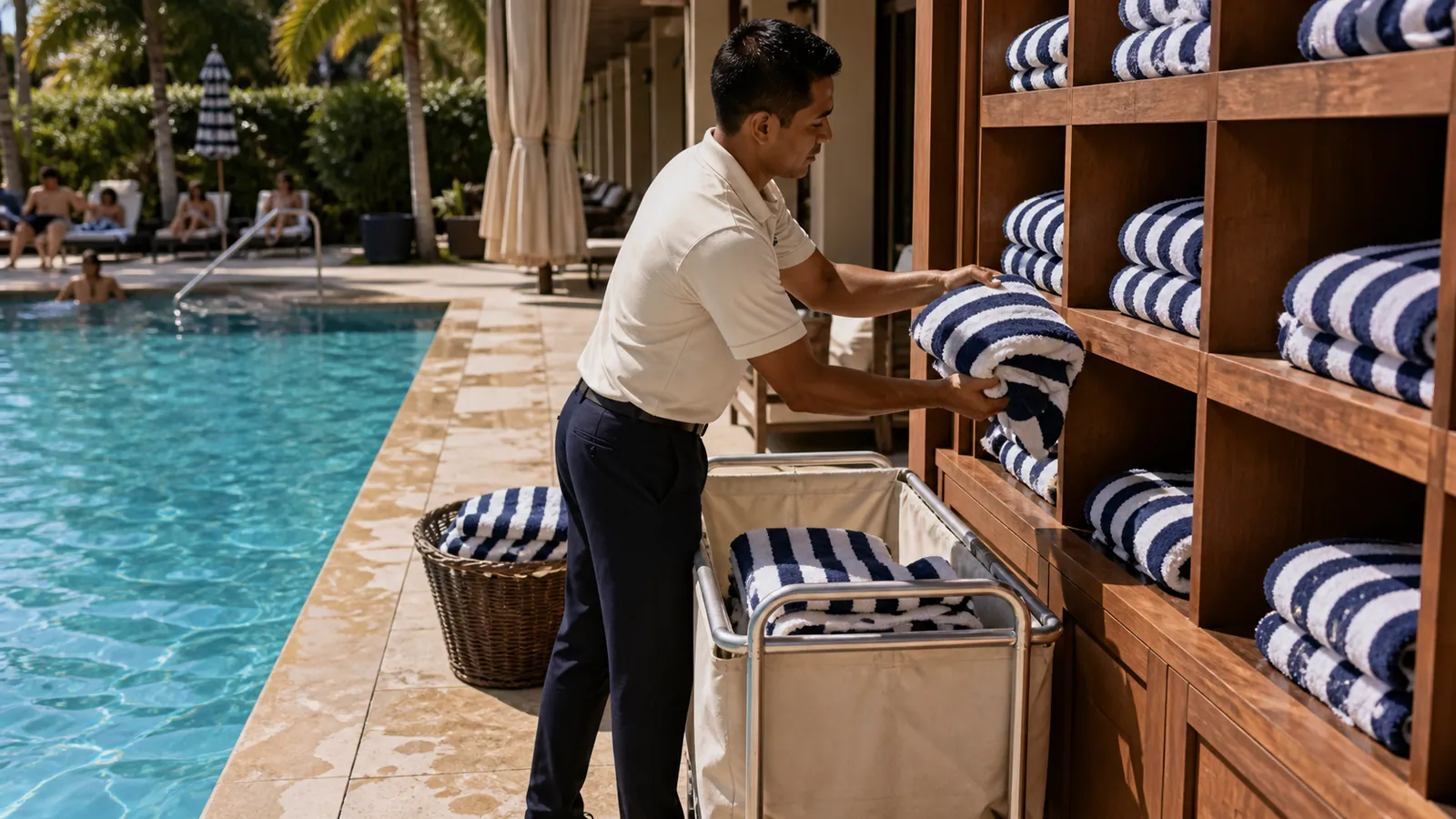
Choose wholesale pool towels by defining the guest use, finished post-wash size, total mass and GSM basis, fiber construction, stripe or solid-color design, wet-return route, laundry process, and acceptance tests. If color will contact chlorinated pool water, request a method and condition that match the claim, such as ISO 105-E03:2010 or AATCC TM162, then confirm laundering and real-site performance separately. Calculate par from measured issues, returns, unavailable time, and documented reserves.
A pool towel moves through more than a picturesque deck. It leaves a clean cubby, absorbs water, sunscreen, and body soil, lands in a wet-return bin, waits for collection, enters a mixed or dedicated laundry sort, dries, folds, and returns to service. Each stage can expose a weak choice in size, color, construction, collection, or stock.
This guide is for hotels, resorts, waterparks, health clubs, universities, recreation centers, distributors, and private-label buyers. It separates controlled textile tests from an aquatic facility’s real operating trial. A chlorine colorfastness result does not prove laundering durability, hygiene, absorbency, sunscreen release, or a universal service life.
Map the pool-towel route before selecting a construction
Begin at the clean issue point. Record whether towels are handed out, scanned, placed in open cubbies, delivered to loungers, or included in a guest room. Note exchange rules, busiest hours, child and adult use, cabana service, special events, indoor or outdoor exposure, and whether one towel must cover a lounger as well as dry a person.
Follow the used towel. Measure the distance to return bins, the time wet pieces wait for collection, the weight staff can handle safely under the facility’s own procedures, and whether pool towels remain separated from room, gym, spa, or cleaning textiles. A good textile cannot correct an undersized return area, delayed collection, or unclear sort.
| Pool operation | Specification pressure | What to observe in a trial |
|---|---|---|
| Open cubby issue | Consistent fold, stack height, visual identity, fast replenishment | Post-wash dimensions, fold volume, stripe alignment, shade variation |
| Lounger or cabana service | Coverage, presentation, wind handling, wet pickup | Finished area, total mass, edge behavior, guest handling |
| High-turnover public pool | Fast circulation, clear return, laundry throughput | Issue/return counts, wet-bin loading, drying, lint, seams |
| Indoor aquatic center | Humidity, storage, repeated daily circulation | Holding time, odor-control process, dry return, color, stock availability |
| Outdoor resort pool | Sun, pool water, sunscreen and guest-facing appearance | Controlled color tests, site exposure, staining, laundering, presentation |
Choose finished size, total mass, and GSM together
Specify the finished size after the agreed preparation or wash condition. “Pool size” and “beach size” are not reproducible measurements. The towel must fit the body-coverage goal, lounger if relevant, cubby, cart, return opening, washer, dryer, folding method, and shelf. Large area can create operational bulk even when GSM is moderate.
ASTM D3776/D3776M-20(2025) provides options for measuring fabric mass per unit area. Ask which option, conditioning basis, and tolerance support a stated GSM. Also request conditioned total unit mass. Two towels with the same GSM but different dimensions place different loads on carts, wet collection, shipping, storage, and drying.
A 90 cm × 180 cm rectangle has an area of 1.62 m²; at 450 g/m², the simple area calculation is 729 g before allowing for borders, hems, dimensional variation, moisture condition, and measurement basis. This example checks quotation logic only. It does not predict drying time or quality, and it is not a recommended pool-towel specification.
No single GSM fits every pool. A facility should compare coverage, conditioned unit mass, pile and ground construction, absorbency, drying capacity, wet handling, guest feel, and circulation speed. The towel GSM guide explains the measurement, while a washed site trial decides the operating fit.
Treat stripe, solid color, and white as operating choices
Color can identify a department, distinguish pool linen from guest-room linen, hide or reveal certain soils, and support the property’s visual standard. It can also create shade-control and replenishment risks. Define the color reference, stripe repeat, stripe placement, border width, face/back appearance, yarn-dyed or piece-dyed basis if relevant, acceptable shade band, and evaluation light.
Approve every final construction and color. A lab result for one navy dye, one printed stripe, or one fiber blend does not automatically transfer to another. Retain an approved control and compare replacement lots under stable lighting. If old and new stock will circulate together, decide whether the agreement permits a managed shade difference or requires closer continuity.
White avoids a colored-pool-water claim but still needs evidence for laundering, absorbency, dimensional stability, lint, staining, and the actual bleach or non-bleach process. A colored towel avoids no test merely because the shade is dark. Choose the test package from the exposure and the purchase agreement, not from a general statement that one color is “commercial.”
Use chlorinated-water methods within their stated scope
ISO 105-E03:2010 specifies a method for determining the resistance of textile color to active chlorine concentrations used for swimming-pool water. Its published abstract identifies three alternative conditions and states that the 20 mg/L active chlorine condition is intended for accessories such as beach robes and towels. Record the selected condition, specimen, result, rating method, laboratory, and acceptance limit.
AATCC TM162 evaluates resistance of dyed, printed, or otherwise colored textile yarns and fabrics to chlorinated pool water. Its published summary describes agitation in diluted chlorine solution under specified temperature, time, pH, and hardness, followed by evaluation of dried specimens for color change. AATCC describes it as related to ISO 105-E03, not interchangeable without naming the method and condition.
These are colorfastness methods. They do not determine absorption, drying, laundering durability, sunscreen release, seam strength, sanitation, or service life. They also do not reproduce every pool’s chemistry, contact time, wet storage, sun exposure, or maintenance practice. Use the controlled result to answer a defined color question, then run an actual site exposure and laundry sequence.
| Buyer question | Named authority | Evidence to retain |
|---|---|---|
| How does the final color resist chlorinated pool water? | ISO 105-E03:2010 or AATCC TM162 | Exact method, condition, solution details, specimen, rating, laboratory, limit |
| How does color respond to the selected laundering condition? | ISO 105-C06:2010 | Option, detergent, bleach status, temperature, change and transfer ratings |
| How do dimensions change after washing and drying? | ISO 6330:2021 with ISO 5077:2007 | Preparation, cycles, wash/dry procedure, pre/post measurements |
| Does the terry surface absorb water as agreed? | ASTM D4772-26 | Method, sample identity, result, laboratory, agreed interpretation |
| Which towel characteristics belong in the contract? | ASTM D5433-24 | Included, modified, and excluded requirements with acceptance limits |
Test pool exposure, laundering, and drying as separate checkpoints
Create a labeled sequence. Keep one untouched control; expose one set using the agreed chlorinated-water method; expose another in the site pool under recorded conditions if operations permit; then launder samples using a named laboratory procedure and the intended facility process. Separate checkpoints make it easier to see whether a change came from pool exposure, wet holding, washing, drying, or their combination.
ISO 6330:2021 provides reference washing and drying procedures for textile testing. ISO 5077:2007 supports dimensional-change determination after the chosen preparation, washing, and drying process. ISO 105-C06:2010 addresses colorfastness under specified laundering conditions. The method report should state the procedure rather than compressing several conditions into “commercial wash tested.”
After each cycle, record shade, color transfer, dimensions, conditioned mass, absorbency, lint, loose loops, pile loss, hems, borders, shape, hand, odor, and drying observation. Compare wet pickup and transport with the property’s carts and bags. A towel may keep its color and still be wrong for circulation because the finished mass or drying route is poorly matched.
Inspect construction for wet handling and repeated folding
Specify pile, ground, border, and sewing-thread fibers. Under Federal Trade Commission guidance, most covered textile products sold in the United States need fiber content, country of origin, and manufacturer or responsible-business identification. Ensure the sewn label, quotation, packaging, and website claim describe the same towel.
Inspect pile anchorage, loop length, ground visibility, stripe transitions, border tightness, hem turns, seam density, corners, loose threads, and skew. Pull the towel from a stack and fold it with damp hands during the site trial. Narrow cubbies, heavy wet bundles, and rapid folding reveal handling issues that a dry tabletop review misses.
For logos, decide whether the mark must remain visible in the approved fold and whether embroidery adds a stiff area, sorting feature, or snag risk. Approve the exact color, thread, backing, placement, and washed result using the controls in the embroidered towel guide.
Run a site trial across more than one operating day
Issue a controlled quantity of marked trial towels without mixing their results with existing stock. Record clean starting count, issue time, exchange, return, wet holding, collection, washer load, dry completion, folding, rejection, and clean-cubby return. Repeat the trial across ordinary and peak periods. A one-hour deck review cannot show whether towels bottleneck in a wet bin, mixed sort, dryer, or late transport.
Outdoor pools add exposure that controlled pool-water tests do not cover by themselves. Record sun duration, shade, deck heat under safe operating procedures, sunscreen or cosmetic contact, and whether wet towels remain on loungers or in carts. Do not turn those observations into a universal weathering claim. They describe the property’s use and help the buyer decide which laboratory evidence or longer trial is justified.
Ask attendants and laundry staff for specific observations rather than a single “good” or “bad” score. Useful notes identify fold speed, stack stability, guest coverage, wet weight, snag points, visible lint, stain locations, stripe alignment, shade, and clean-return time. Photographs taken under the same lighting and a signed sample code make later supplier discussions more reliable.
When a trial towel fails, preserve the piece and the route record. A faded towel may point to the pool exposure, a laundering condition, a dye or construction issue, or several combined factors. A torn hem may reflect sewing, handling, or equipment. Diagnose the stage before changing GSM, fiber, color, or supplier.
Calculate circulation stock from actual issues and returns
Count issued, exchanged, returned, rejected, lost, and still-unavailable towels by day and hour. Include peak occupancy, weather, event schedules, cabana bookings, indoor and outdoor seasons, laundry shutdowns, and transport. The number in clean cubbies is only one part of the stock; towels can be in guest use, wet return, collection, washing, drying, folding, transit, repair, or reject review.
Planning example, not an aquatic-industry standard: if a resort issues 260 towels on a measured peak day and the full wet-return-to-clean-cubby route keeps towels unavailable for 1.5 days, working stock is 390. A buyer-selected reserve of 15% adds 58.5, creating 448.5 before rounding to the approved case pack. Replace those figures with the facility’s own counts and risk decisions.
Track loss separately from rejection. A towel that leaves with a guest, a stained unit, a failed hem, a pool-to-room transfer, and a late laundry return are different operating problems. Review the log before reordering so purchasing does not reproduce a preventable circulation failure.
Normalize quotes and write a testable purchase order
Put every quote on finished dimensions, conditioned unit mass, GSM and method basis, fiber by component, pile and ground construction, stripe or color reference, borders, hems, label, packaging, quantity, testing, inspection, Incoterm, payment, and destination. Use the pricing guide to separate product price from development, testing, artwork, packaging, freight, and inspection.
Attach the signed sample, color reference, test reports, label artwork, packaging standard, and inspection plan to the purchase order. Name the method edition, condition, acceptance limit, bulk sampling rule, retest procedure, and remedy. Require written authorization before any change to fiber, yarn, dye, stripe, pile, GSM, dimensions, finish, border, thread, label, pack, or production site.
Use the supplier vetting checklist to review traceability and change control. If a minimum applies to each stripe, color, or size, map those SKU-level requirements with the MOQ guide before approving the range.
Wholesale pool towel buyer checklist
Complete before bulk release
- Map clean issue, guest use, exchange, wet return, collection, laundry, and replenishment.
- Specify finished post-wash size, tolerance, conditioned unit mass, GSM basis, fibers, pile, stripe, borders, hems, label, and pack.
- Confirm the towel fits loungers, cubbies, carts, return openings, storage, washer, dryer, and folding process.
- Approve each final color and construction; retain a signed shade and construction control.
- Name the chlorinated-water colorfastness method, condition, result, laboratory, and acceptance limit.
- Test laundering, dimensional change, absorbency, lint, loops, seams, shape, drying, staining, and hand separately.
- Run a recorded site trial because controlled color tests do not reproduce the whole pool operation.
- Calculate par from peak issues and full unavailable time; separate loss, rejects, events, and disruption reserves.
- Normalize quotes for product, testing, inspection, packaging, trade terms, and destination.
- Attach approved samples, specifications, color, reports, labels, packaging, and remedies to the purchase order.
Frequently asked questions
What GSM is best for wholesale pool towels?
There is no universal best GSM. Compare finished size, conditioned unit mass, pile and ground construction, absorbency, guest coverage, wet handling, drying capacity, laundry process, cubby space, and circulation speed. Approve the choice from washed production-representative samples and a recorded site trial.
Do striped pool towels need chlorine testing?
If the buyer or supplier makes a chlorinated-water colorfastness claim, test the final stripe colors and construction using a named method and condition such as ISO 105-E03:2010 or AATCC TM162. The result answers a controlled color question; it does not replace laundering or site testing.
Are white pool towels safer than colored towels?
White avoids evaluating dyed color against pool water, but it still requires a suitable specification and testing for dimensions, mass, absorbency, lint, seams, staining, laundering, drying, and the property’s actual bleach or non-bleach process. Color alone does not establish operational suitability.
How many pool towels should a resort order?
Use measured peak issues multiplied by the time each towel remains unavailable in guest use, wet return, collection, washing, drying, folding, and transport. Add separately documented reserves for loss, rejects, events, weather, or disruption, then round to the approved case and production quantities.
How should a buyer compare wholesale pool towel samples?
Keep an untouched control and record each sample revision. Compare post-wash dimensions, conditioned mass, absorption, chlorinated-water color change where relevant, laundering colorfastness, lint, loops, pile, borders, hems, shape, staining, drying behavior, fold, cubby fit, wet handling, and guest-use feedback.
Buy the circulation system, not a stripe alone
A reliable pool towel program connects guest coverage and visual identity to wet return, controlled color evidence, laundering, drying, folding, replenishment, and par. The specification works when the pool team, laundry, purchasing, supplier, and inspector can all judge the same approved construction against the same record.
When size, construction, stripe or color, laundry route, circulation, quantities, testing, labels, packaging, destination, and delivery target are ready, request wholesale pool towel pricing, MOQ, and samples.
Primary authorities
- International Organization for Standardization: ISO 105-E03:2010, Colour Fastness to Chlorinated Water (Swimming-Pool Water)
- AATCC: TM162, Colorfastness to Water: Chlorinated Pool
- ASTM International: ASTM D5433-24, Standard Performance Specification for Towel Products for Institutional and Household Use
- ASTM International: ASTM D4772-26, Surface Water Absorption of Terry Fabrics
- ASTM International: ASTM D3776/D3776M-20(2025), Mass Per Unit Area of Fabric
- ASTM International: ASTM D1776/D1776M-20(2024), Conditioning and Testing Textiles
- International Organization for Standardization: ISO 6330:2021, Domestic Washing and Drying Procedures for Textile Testing
- International Organization for Standardization: ISO 5077:2007, Determination of Dimensional Change in Washing and Drying
- International Organization for Standardization: ISO 105-C06:2010, Colour Fastness to Domestic and Commercial Laundering
- Federal Trade Commission: Threading Your Way Through Textile and Wool Labeling Requirements