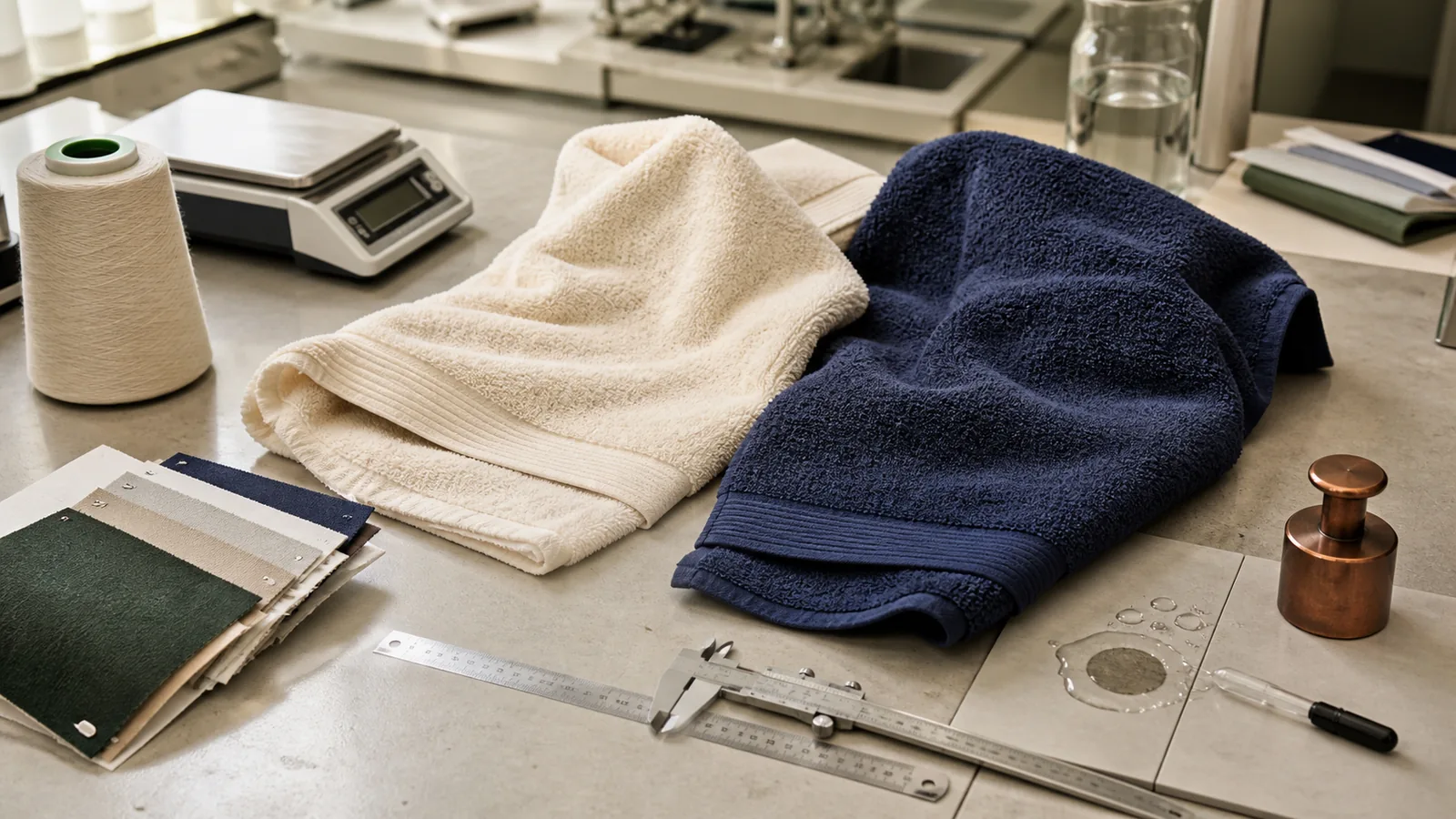
Test wholesale towel samples in three stages: verify the construction and measurements before washing, run a controlled wash-and-dry trial that matches the intended use, then compare the washed sample against written limits for size change, absorbency, color, lint, seams, decoration, labels, and packaging. Record the method and result for every check, retain an approved reference sample, and make bulk release conditional on the purchase order matching that signed sample and specification.
This guide is for hotel, gym, spa, retail, laundry, and distribution buyers who already have towel samples in hand. It helps a procurement team screen samples consistently and decide what requires an independent textile laboratory. It does not turn an office wash trial into a laboratory certificate.
Use three sample gates, not one attractive prototype
A development sample answers whether the supplier understood the brief. A pre-production sample answers whether the final yarn, construction, dye, decoration, label, and packing plan are ready for bulk. A shipment sample or inspection sample checks whether production still matches the approved reference. Buyers often call all three a "sample," which makes approvals difficult to enforce.
Label each gate in the purchase file. A development sample can be accepted for design direction while still failing production approval. A pre-production sample should use the intended materials and processes; if the mill substitutes a yarn, dye route, border, embroidery thread, or label, the revision needs a new ID and another approval. The physical reference should not be the only record. Photograph it, record measurements, and attach the test sheet.
ASTM D5433-24 is a performance specification for institutional and household towel products. ASTM says it can be used by agreement between purchaser and supplier to establish purchasing requirements, and it also recognizes that the parties may modify requirements for a particular style. That is the right commercial principle: name the characteristics, test methods, limits, and exceptions in the contract instead of relying on a broad promise of "hotel quality."
Keep enough units to avoid testing the same towel to exhaustion
For a practical buyer trial, request at least three identical units per size and color when possible. Keep one unwashed control, use one for the planned wash sequence, and reserve one for repeat or destructive checks. Larger or regulated programs may need more specimens because a laboratory method can specify sampling quantities and preparation. A single towel cannot show unit-to-unit variation and may be altered by every test performed on it.
Build a sample request that can become a production specification
The sample request should state intended use, finished size, target mass or GSM, fiber content by component, yarn and spinning description, pile construction, border, color reference, decoration, label, packaging, and laundry conditions. Link the request to the same commercial assumptions used in the wholesale towel pricing guide. A lower quote is not comparable if the sample is smaller, lighter, packed differently, or made with a different ground construction.
Ask the supplier to declare whether the sample is hand-made, pilot-run, or taken from normal production. Hand-made samples are useful for appearance, but their hems, dimensions, and decoration may not represent bulk equipment. For custom work, identify whether the logo is a simulation or the final stitch file. The custom embroidered towel guide covers stitch placement, backing, pile compression, and approval details that belong in that sample record.
| Sample record | What to capture | Why it matters |
|---|---|---|
| Identity | Supplier, style code, revision, date, size, color, lot, and sample stage | Stops results from being attached to the wrong construction |
| Materials | Pile, ground, border, sewing thread, decoration, and declared fiber percentages | Explains performance and supports label review |
| Construction | Finished dimensions, mass, target GSM, yarn, pile style, border, and hem | Creates measurable bulk requirements |
| Process | Dye route, finish, washing, drying, and any pre-shrink treatment | Connects the prototype to expected bulk production |
| Pack-out | Fold, units per pack, labels, inserts, cartons, and assortment | Prevents a good towel from failing at fulfillment |
Measure the unwashed towel before judging hand feel
Textiles take up and release moisture, so mass and dimensions can shift with the surrounding atmosphere. ASTM D1776/D1776M-20(2024) covers conditioning when a textile test method requires it, while ISO 139:2005 defines standard atmospheres for conditioning and testing and was confirmed current in 2025. A buyer without a conditioning room can still improve repeatability by storing every comparison sample in the same indoor conditions for the same period and documenting that limitation.
Lay the towel flat without stretching it. Measure length and width at several positions, because hems and borders can pull the fabric unevenly. Record the average and the range rather than one convenient reading. Weigh the dry towel on a suitable scale and photograph the setup. Check the pile, ground, border, selvedges, hems, sewing, loose loops, stains, shade variation, odor, and visible finishing residue under consistent light.
Use GSM as a comparison, not a complete quality grade
ASTM D3776/D3776M-20(2025) covers fabric mass per unit area and includes an option used for commercial shipment acceptance testing. A buyer can make a rough whole-towel screen by dividing dry mass in grams by finished area in square meters. For example, a 620 g towel measuring 0.70 m by 1.40 m has a screening value of about 633 g/m2: 620 divided by 0.98.
That whole-towel calculation includes borders and hems, and it does not reproduce specimen conditioning or the chosen ASTM option. Use it to catch obvious differences among like-for-like samples. If the purchase order requires ASTM D3776 results, name the edition and option, specimen location, conditioning, tolerance, and laboratory. The towel GSM guide explains why weight alone does not settle absorbency, drying time, softness, or durability.
Write the wash protocol before the first cycle
A towel wash test has little value when the buyer changes detergent, load, temperature, cycle, or dryer setting between samples. Base the protocol on the intended laundry. A hotel using a commercial tunnel washer, a gym outsourcing laundry, and a retail consumer product may need different conditions. If the real process is severe, a gentle domestic cycle can approve the wrong product.
ISO 6330:2021 specifies domestic washing and drying procedures for textile testing. It provides procedures for three reference washing-machine types and six drying procedures; ISO notes that machine, detergent, and dryer parameters can affect results. ISO 5077:2007 provides the method for determining dimensional change after the selected washing and drying combination. For color, ISO 105-C06:2010 addresses resistance to domestic or commercial laundering with defined detergents and methods.
An internal screen can use staged checkpoints such as after 1, 3, 5, and 10 cycles, provided every sample follows the same documented process. Those counts are a buyer protocol, not a universal standard or a prediction of service life. At each checkpoint, let the sample reach the same dry condition, then repeat dimensions, mass if relevant, photographs, absorbency screen, shade comparison, lint review, seam inspection, and hand assessment.
Record the exact process: machine model or type, load mass, ballast, water temperature, detergent name and dose, bleach or additives, cycle, extraction, dryer setting, drying time, and number of cycles. "Washed five times" is not enough to reproduce a result.
Test what the towel must do after laundering
Absorbency
ASTM D4772-26 measures the ability of terry fabric to rapidly absorb and retain liquid water from a surface. ASTM also states that surface water absorption is only one characteristic used to judge terry products and points buyers to D5433 for others. When absorbency is commercially important, specify D4772 and an agreed result rather than relying on a drop video or an undefined "highly absorbent" claim.
A controlled in-house comparison can still expose a finish that initially repels water. Use equal dry specimens or equal towel areas, the same water volume and temperature, the same contact time, and the same pre-wash state. Record the method as an internal screen. Do not report the result as ASTM D4772 unless the standard was followed.
Dimensional change and shape
Measure length and width again at the same marked positions. Calculate dimensional change separately: (before minus after) divided by before, multiplied by 100. A length that moves from 70.0 cm to 68.6 cm changed by 2.0%. Also photograph border rippling, skew, torque, bowed hems, and corners that no longer lie flat. A single average can hide a distorted towel.
The acceptable limit belongs to the end use and contract. A fitted retail set, embroidered border, and institutional utility towel do not need the same tolerance. Agree the limit before the wash trial and state whether it applies after one cycle, a specified sequence, or a laboratory procedure.
Colorfastness and shade
Inspect color change, staining onto adjacent materials, uneven fading, crocking concerns, and shade differences between units. ISO 105-C06 explains that its single test can approximate one domestic or commercial laundering, while a multiple test can in some cases approximate up to five launderings at temperatures no higher than 70 C. It also cautions that the method does not represent every detergent, bleach system, or optical brightener.
Use a light cabinet or controlled neutral light for serious color approvals. If chlorine, peroxide, disinfectant, cosmetics, or salon chemicals matter, specify the relevant exposure and test method. A general wash-fastness result does not automatically support every chemical environment.
Lint, pile, seams, and hand
Clean the lint filter before the trial, weigh or photograph collected lint when practical, and use the same load conditions for each sample. Inspect pulled loops, pile loss, bald spots, pilling, hardening, snagging, and flattened areas. Then examine both sides of every hem and border for skipped stitches, seam opening, thread breakage, puckering, and loose ends.
Hand feel is worth recording because guests and consumers notice it, but it should not replace measured checks. Use a small panel, blind the supplier identity, and score softness, fullness, drag, damp feel, and post-dry recovery on the same scale. Tie that score to the cotton construction guide rather than assuming a fiber name guarantees the finished result.
Check branding, labels, and packaging as part of the sample
Measure embroidery or woven-label position from fixed towel edges. Confirm dimensions, color, orientation, pile compression, backing, thread tails, and the way the towel folds around the decoration. Wash the decorated sample through the same protocol. A clean unwashed logo can pucker, bleed, abrade, or become uncomfortable after laundering.
For U.S. sales, the Federal Trade Commission says most textile products need fiber content, country of origin, and the identity of the manufacturer or another responsible business. A U.S. company may use a valid RN instead of its name. Compare label artwork with the declared pile and ground construction, product origin, and commercial invoice. Optional care instructions should be truthful for the exact towel, dye, and decoration.
Build and open a representative pack. Confirm fold, insert placement, barcode zone, assortment, units per inner pack, moisture protection, carton count, gross and net weight, and shipping marks. Blank or prototype artwork may be acceptable at an early stage, but final pre-production approval should identify every unresolved item. Packaging changes affect carton dimensions, freight density, and landed cost.
Use a scorecard with pass, fail, and conditional results
Averages can hide a critical failure. Give each characteristic a status and evidence. A sample may score well overall yet fail because the fiber label is wrong, the towel shrinks outside the agreed size, or the embroidery damages the pile. Mark such items as release blockers rather than letting a weighted total override them.
| Check | Method and evidence | Acceptance decision |
|---|---|---|
| Identity and construction | Sample ID, specification, photos, supplier declaration | Must match the intended production revision |
| Size, mass, and GSM screen | Condition, positions, scale, formula, range | Pass within the written tolerance |
| Wash and dimensional change | Named protocol, cycle checkpoints, before-and-after data | Pass each direction and shape review |
| Absorbency and color | Internal comparative screen or named lab standard | Pass the agreed method and limit |
| Lint and workmanship | Lint record, seam and pile photographs, defect count | No critical defects; minor limit agreed |
| Decoration, label, and pack | Placement measurements, wash result, artwork, pack-out | All release items approved or listed as conditional |
Turn the approved sample into purchase-order language
The purchase order should identify the retained sample by code and date, then state that bulk production must match it together with the written specification. Add the test method and edition, specimen preparation, units, target, tolerance, inspection level where applicable, who pays for testing, when approval is due, and what happens after a failure. The certification guide helps separate product tests from factory and management-system documents.
Do not let the retained sample silently override the specification or vice versa. Write an order of precedence. For example: signed specification, approved artwork, approved pre-production sample, then general correspondence. If a deviation is accepted, issue a dated amendment. This record also protects the supplier from being judged against a new requirement after production.
Set bulk verification before the shipping deadline. Depending on order risk, that may include mill reports, third-party laboratory testing, an in-line inspection, a pre-shipment inspection, or randomly selected production samples. Review the supplier vetting checklist and the MOQ guide when deciding how much sampling and independent testing the order can support.
Towel sample signoff checklist
Release the pre-production sample only when these are complete
- Assign the sample stage, supplier, style code, revision, date, size, color, and lot.
- Keep an untouched control and label every tested unit.
- Confirm pile, ground, border, sewing thread, decoration, and declared fiber content.
- Record conditioned dimensions, mass, whole-towel GSM screen, construction, and workmanship.
- Run the written wash-and-dry protocol with fixed checkpoints.
- Calculate dimensional change in both directions and inspect shape.
- Evaluate absorbency, shade, staining, lint, pile, hems, and hand after washing.
- Wash-test the final decoration and verify its placement and dimensions.
- Approve fiber, origin, company or RN, optional care, and packaging artwork.
- Build the representative pack and verify fold, count, assortment, carton, and shipping marks.
- Record pass, fail, or conditional status for every requirement and resolve conditions in writing.
- Seal and retain the signed reference sample, then place its ID and acceptance terms in the purchase order.
Frequently asked questions
How many towel samples should I request before a bulk order?
Three identical units per size and color are a practical minimum for buyer screening: one untouched control, one wash-test unit, and one reserve for repeat or destructive checks. This is a purchasing recommendation, not a universal laboratory sampling rule. A named ASTM or ISO method, inspection plan, or retailer program may require more specimens.
How do I check the GSM of a towel sample?
For a rough comparison, weigh the dry towel in grams and divide by its finished area in square meters. Record dimensions, mass, conditioning, and the fact that borders and hems are included. For contractual acceptance, specify ASTM D3776/D3776M, the option, specimen location, conditioning, units, and tolerance rather than relying on a whole-towel estimate.
How many washes should a towel sample pass?
There is no universal wash count for every towel. Choose checkpoints that represent the intended laundry and state the machine, detergent, temperature, load, drying method, and acceptance limits. An internal 1, 3, 5, and 10-cycle screen can compare samples, but it does not predict service life or replace a specified laboratory method.
Can I test towel absorbency at home or in an office?
You can run a repeatable comparative screen using equal dry samples, water volume, temperature, contact time, and pre-wash condition. Record it as an internal method. If absorbency is a contractual claim, use ASTM D4772-26 with an agreed limit and qualified laboratory rather than describing a drop or soak test as ASTM compliant.
What is a gold sample for towel production?
A gold sample is the signed, dated physical reference approved for bulk production. It should carry a unique code and match the written specification, artwork, test sheet, and packaging approval. Keep it sealed when possible. The purchase order should say how bulk goods will be compared with it and which written document controls if there is a conflict.
Approve evidence, not adjectives
A towel sample testing checklist works when another person can repeat it and reach the same decision. Replace "soft," "commercial grade," and "colorfast" with a sample identity, method, conditions, result, tolerance, and approval. Retain the reference and carry those controls into production inspection.
When your towel type, dimensions, GSM, fiber construction, colors, branding, quantity, wash conditions, packaging, destination, and testing requirements are ready, request a quote and sample plan. Loft Weave can build the product specification and approval sequence around the intended use before bulk production begins.
Primary authorities
- ASTM International: ASTM D5433-24, Standard Performance Specification for Towel Products for Institutional and Household Use
- ASTM International: ASTM D4772-26, Surface Water Absorption of Terry Fabrics
- ASTM International: ASTM D3776/D3776M-20(2025), Mass Per Unit Area of Fabric
- ASTM International: ASTM D1776/D1776M-20(2024), Conditioning and Testing Textiles
- International Organization for Standardization: ISO 139:2005, Standard Atmospheres for Conditioning and Testing
- International Organization for Standardization: ISO 6330:2021, Domestic Washing and Drying Procedures
- International Organization for Standardization: ISO 5077:2007, Dimensional Change in Washing and Drying
- International Organization for Standardization: ISO 105-C06:2010, Colour Fastness to Laundering
- Federal Trade Commission: Textile and Wool Acts Labeling Guide