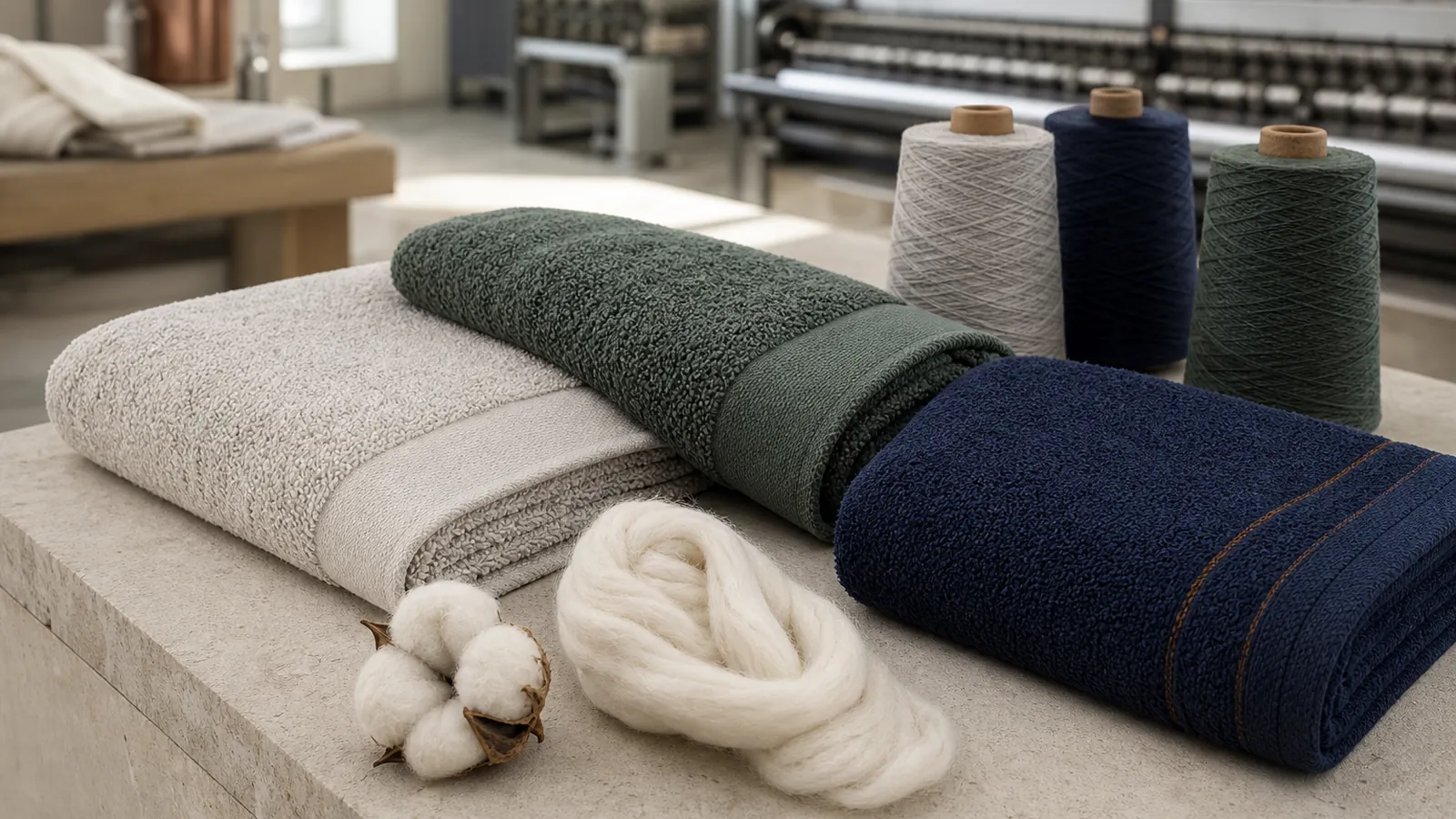
Ring-spun, combed, and Egyptian cotton are not three equivalent towel grades. Ring-spun describes how yarn is spun, combed describes an added fiber-preparation step, and Egyptian cotton is an origin or type-of-cotton claim. A towel can be all three. For wholesale buying, specify each claim separately and approve the finished towel through GSM, absorbency, dimensional-change, color, lint, and wash testing.
This distinction matters when a hotel group, gym operator, spa, distributor, or private-label brand is comparing quotes. Two suppliers can use the same headline term and deliver towels with different yarn counts, loop constructions, weights, finishes, and laundering results. The useful comparison starts with the process behind the label, then moves to evidence from the finished article.
Start with four separate specification layers
A cotton towel begins with raw fiber, but the finished result reflects several decisions after the crop leaves the field. Cotton origin or variety is one layer. Carding and optional combing prepare the fiber. A spinning system turns prepared fiber into yarn. Weaving, loop geometry, yarn count, twist, GSM, dyeing, finishing, and laundering complete the towel construction.
The U.S. Department of Agriculture Agricultural Marketing Service measures raw-cotton properties such as fiber length, length uniformity, strength, micronaire, color, and trash. Those measurements show why a geographic name alone cannot replace technical data. Cotton lots from any origin can vary, and the mill's preparation and spinning choices influence the yarn made from them.
A buyer should therefore keep four questions apart: What fiber content and origin are claimed? Was the cotton carded or combed? Which spinning system and yarn specification were used? How did the finished towel perform under the agreed tests? Treating these as separate fields makes supplier quotes easier to compare and reduces the chance of paying a premium for an ambiguous description.
What ring-spun cotton means in a towel specification
Ring spinning is a yarn-manufacturing route. Cotton Incorporated's CottonWorks Textile Yarns technical bulletin shows that cotton for ring-spun yarn passes through carding, drawing, roving, and ring spinning. Combing may be inserted after carding when the yarn specification calls for it. The same production map includes both carded ring-spun and combed ring-spun yarns.
That is the first correction to many towel comparisons: "ring-spun versus combed" is usually the wrong choice. Ring-spun describes the spinning system; combed describes fiber preparation. A quote can legitimately say "combed ring-spun cotton pile yarn." If it says only "ring-spun cotton," the buyer still needs to know whether the input was carded or combed and whether the claim covers the pile, ground, or whole towel.
Ring spinning can produce a broad range of yarn counts and twist levels. A finer yarn, a heavier pile, or a lower-twist loop may change hand feel and absorbency, while ground yarn and border construction affect dimensional stability and appearance. Ring-spun wording by itself does not establish how thick, soft, absorbent, or durable the towel will be.
When ring-spun cotton is a practical baseline
For a commercial towel program, ring-spun yarn can be a sensible baseline because mills can specify it clearly and pair it with carded or combed preparation. The purchasing decision should still be tied to a sample and a performance table. A high-wash gym towel, a white hotel bath towel, and a plush spa towel may all use ring-spun cotton, yet require different GSM, dimensions, pile height, color, border, and laundering tolerances.
Ask the supplier for yarn type, nominal yarn count or count system, single or plied construction where relevant, pile and ground fiber content, finished GSM, and the test plan. If the supplier cannot explain which parts of the towel are ring-spun, treat the phrase as marketing copy rather than a complete specification.
What combed cotton changes before spinning
Combing is an additional preparation step after carding. CottonWorks explains that the comber removes short fibers and foreign matter while producing a more uniform sliver for later processing. Its technical bulletin also warns that combed-yarn quality varies with both the percentage of noil removed and the quality of the incoming fiber.
The bulletin gives a noil-removal range of roughly 4% to 24% and notes that, with consistent input quality, removing 16% could produce a better-quality combed yarn than removing 10%. Those figures are useful for understanding the process, but they are not a universal purchase specification. A high noil percentage cannot rescue poor raw cotton, and two mills may use the word "combed" for different preparation levels.
Longer average fiber length and better yarn evenness can allow a mill to make finer, more even yarn. CottonWorks describes combed yarns as more even in diameter and potentially softer because comparable strength can be achieved with less twist. Finished-towel performance still depends on how that yarn is used. Dense pile, excessive finishing agents, loose loops, weak hems, or unstable borders can outweigh the benefit of cleaner yarn preparation.
How to buy combed cotton without relying on the label
Put "combed ring-spun cotton pile" in the specification only when that is the construction you need, then define the rest of the article. Request a retained pre-production sample, nominal yarn count, finished GSM and tolerance, dimensions and tolerance, pile height or construction description, color standard, edge and hem details, and agreed performance limits after laundering.
Lint should be evaluated with a method agreed by buyer and supplier. A new towel can shed loose fiber created during manufacturing and finishing, while repeated laundering may reveal a different pattern. Record the wash procedure, dryer conditions, number of cycles, load, detergent, and how lint is collected or assessed. Without that protocol, "low lint" is open to interpretation.
What an Egyptian cotton towel claim does and does not prove
Egyptian cotton is a named cotton claim. It does not identify whether the yarn was ring-spun, open-end, air-jet, carded, or combed. It also does not state the towel's GSM, yarn count, pile construction, finish, colorfastness, absorbency, shrinkage, or expected service life. Each of those items needs its own evidence.
The U.S. Federal Trade Commission's Calling It Cotton guidance is especially useful for wholesale programs sold in the United States. When a label names a type of cotton, the statement must be truthful and not deceptive. A product containing 50% Egyptian cotton and 50% upland cotton cannot be labeled "100% Egyptian Cotton." The named percentage must be disclosed appropriately.
Towels add another complication because pile loops and ground can use different fibers. The FTC explains that "100% Cotton, 100% Egyptian Cotton Loops" can be acceptable when it is accurate, while a simple "100% Egyptian Cotton" claim is not acceptable if only the loops use Egyptian cotton and the ground uses another cotton. Procurement teams should ask suppliers to map the claim to the pile, ground, border, sewing thread, and decorative components before approving packaging.
How to verify an origin premium
The Egyptian Cotton Association says it manages the Egyptian Cotton trademark licensing program and uses supply-chain traceability, audits, and DNA testing with Bureau Veritas in its accreditation process. A licensed trademark or program record can support an origin claim, but the buyer should still match the evidence to the supplier, product, quantity, and shipment.
Ask for the claimed cotton percentage, pile and ground breakdown, supplier invoice description, traceability records, license or accreditation information where the trademark is used, and any shipment-specific documentation. Then test the finished towel against the same performance requirements applied to other options. Origin evidence can justify a provenance claim; it does not remove the need for product testing.
Ring-spun, combed, and Egyptian cotton towels compared
| Term | What it describes | What can overlap | Evidence to request | What it cannot prove alone |
|---|---|---|---|---|
| Ring-spun cotton | Yarn-spinning route | Can be carded or combed; can use cotton from different origins | Pile and ground yarn specification, count, twist or construction details, sample, test report | Softness, absorbency, lint, GSM, shrinkage, colorfastness, service life |
| Combed cotton | Added fiber-preparation step before spinning | Often paired with ring spinning; can use Egyptian or other cotton | Combed status for pile or ground, yarn specification, sample, agreed lint and laundering results | Spinning system, origin, towel weight, wash performance, whole-towel fiber content |
| Egyptian cotton | Named cotton origin or type claim | Can be carded or combed and made with different spinning systems | Named percentage, pile/ground breakdown, traceability and licensing evidence, invoice and shipment records | Yarn preparation, spinning method, GSM, absorbency, shrinkage, durability |
| Combed ring-spun Egyptian cotton pile | A combined fiber-origin, preparation, spinning, and component claim | Ground yarn may still differ | Full fiber declaration, pile/ground construction, traceability, retained sample, test results | Performance unless the finished towel is tested |
Relative price depends on more than the cotton term. Combing removes material and adds processing; verified origin programs add documentation and supply-chain controls; finer yarns and heavier constructions use different amounts of fiber and machine time. Order volume, dyeing, embroidery, labels, packaging, inspection, freight, and import costs can be larger quote differences than the yarn label. The wholesale towel pricing guide shows how to normalize those inputs before comparing cost per dozen.
Choose the construction for the end use
Hotels and hospitality
Hotels usually need a repeatable balance of hand feel, absorbency, appearance, dimensional stability, replacement cost, and laundry compatibility. A combed ring-spun pile may suit an upscale program, but the premium should be judged after the hotel's actual wash and dry conditions. White towels exposed to repeated laundering also need stable hems, borders, and ground construction.
Set the size, finished GSM, color, pile construction, fiber declaration, shrinkage limit, absorbency requirement, and appearance standard after a defined number of cycles. Use the towel GSM guide to select a weight range, then compare cotton and yarn choices within that range rather than treating GSM and fiber terms as substitutes.
Gyms, wellness clubs, and high-turnover programs
High-turnover environments often value drying time, predictable dimensions, low replacement cost, and controlled lint over a very plush new-towel hand. Carded or combed ring-spun constructions can both be viable when the finished towel meets the program's limits. A heavier or softer sample can become expensive if it lengthens drying, sheds, or loses shape.
Run the sample through the intended laundering route and measure it again. Compare dry weight, dimensions, appearance, absorbency, and lint under the same conditions. The result gives procurement and laundry teams a shared basis for approval instead of asking them to agree on subjective words such as "luxury" or "commercial grade."
Spas, salons, and branded programs
Spas and salons may prioritize softness, dye stability, chemical exposure, stain release, and presentation. A combed pile can support a refined hand, while an Egyptian cotton claim may support a provenance story when it is documented. Neither choice guarantees that a dark shade will tolerate the program's chemistry or that a plush towel will dry within the available cycle.
For embroidery or woven branding, approve the decorated towel after laundering. Thread, backing, hoop tension, placement, and dense stitching can change local stiffness and drying. The custom embroidered towel guide covers the artwork and wash-test decisions that belong beside the cotton specification.
Test the finished towel, not the cotton name
ASTM International's D5433-24 performance specification covers characteristics used for institutional and household towel products and allows buyer and supplier to agree on purchasing requirements. ASTM D4772-26 measures how rapidly a terry fabric absorbs and retains surface water. The standard also cautions that surface water absorption is only one characteristic and that comparative commercial testing may need careful agreement between laboratories.
Finished mass per unit area can be measured under ASTM D3776/D3776M-20(2025). That figure supports a GSM tolerance but does not describe pile height, density, yarn type, or wash behavior on its own. Record whether the quoted weight is unfinished, finished, conditioned, or measured after laundering.
For repeatable washing and drying, ISO 6330:2021 specifies textile test procedures, reference detergents, machine types, and drying options. ISO 5077:2007 covers dimensional change after an appropriate washing and drying combination. Commercial laundries may use conditions outside a domestic procedure, so the purchase order should state the real program or an agreed simulation and keep that procedure constant across samples.
A practical sample-comparison sheet
- Condition and identify each sample without revealing the supplier to evaluators where practical.
- Record finished length, width, dry weight, GSM, color reference, pile and ground fiber declaration, yarn description, and construction details.
- Photograph the face, reverse, border, hems, corners, and any decoration under consistent lighting.
- Run every sample through the same agreed wash and dry sequence. Record machine type, load, temperature, chemistry, drying condition, and cycle count.
- Remeasure dimensions and weight, inspect seam and border distortion, and evaluate lint using the agreed method.
- Test terry surface-water absorption with a suitable method and compare results against the written limit.
- Score hand feel only after the objective measurements are complete, using the same evaluators and a defined scale.
- Retain the approved sample, test report, shade standard, packaging approval, and signed specification for production inspection.
Put the cotton and yarn claims into the RFQ
A supplier quote should be specific enough to become part of the purchase order. If a claim matters to price or positioning, name the component it covers and the proof required. The towel supplier vetting checklist and certification verification guide can be used to review the mill and its supporting records.
Cotton towel RFQ checklist
- State fiber percentages for the whole towel and identify any different pile, ground, border, sewing-thread, or decorative components.
- Specify cotton origin or named type only when required, with the documentation and shipment connection needed to support the claim.
- Identify carded or combed preparation for the pile yarn and ground yarn.
- Identify the spinning system, nominal yarn count or count system, and single or plied construction where relevant.
- Set finished dimensions, tolerances, GSM, GSM tolerance, pile construction, border, hems, color, and decoration.
- Name the washing and drying procedure, cycle count, chemistry, load, and acceptance limits.
- Define absorbency, dimensional change, colorfastness, appearance, lint, seam, and workmanship requirements with agreed methods.
- Require a retained approved sample and written approval before bulk production.
- State inspection level, sampling plan, defect classification, test-report timing, and remedy for nonconforming goods.
- Require final packaging and labeling to match the verified fiber and origin claims.
Frequently asked questions
Is combed cotton better than ring-spun cotton for towels?
The terms are not alternatives. Combing prepares cotton by removing some shorter fibers and impurities; ring spinning turns prepared fiber into yarn. A towel can use combed ring-spun cotton. Compare the finished towel's GSM, absorbency, lint, shrinkage, color, construction, and wash results before deciding which specification is better for the program.
Can a towel be ring-spun, combed, and Egyptian cotton?
Yes. Egyptian cotton can be combed and then ring-spun into yarn. The claim should identify the named cotton percentage and whether it covers the pile, ground, or whole towel. Buyers should request traceability for the origin claim plus finished-towel test results, because the combined wording still does not prove performance.
Does Egyptian cotton always make a softer towel?
No origin name guarantees the hand of a finished towel. Fiber properties, combing, yarn count, twist, loop construction, GSM, dyeing, finishing, and laundering all influence softness. Verify the Egyptian cotton claim, then compare production-representative samples after the same wash and dry sequence rather than approving the new-towel feel alone.
Do combed cotton towels shed less lint?
Combing removes some shorter fibers before spinning and can improve yarn evenness, but finished lint depends on incoming fiber, yarn, pile construction, shearing, finishing, and laundering. Require an agreed lint-assessment method and compare samples after the same number of controlled wash and dry cycles. Do not accept "low lint" without a defined limit.
What should a wholesale cotton towel specification include?
Include whole-towel and component fiber percentages, cotton-origin evidence when claimed, carded or combed preparation, spinning system, yarn description, finished dimensions, GSM and tolerances, pile and border construction, color, laundering procedure, absorbency, dimensional change, lint, workmanship, packaging, inspection plan, and a retained approved sample.
Buy the construction you can verify
Ring-spun cotton towels are not automatically carded or combed, and an Egyptian cotton description does not replace a yarn or performance specification. Separate the fiber claim, preparation route, spinning method, construction, and finished-towel tests. That structure lets a buyer compare like with like and decide whether any premium produces a measurable benefit for the intended laundry and guest experience.
For a custom program, combine this material decision with the private-label versus OEM towel comparison. When the size, GSM, cotton and yarn specification, quantities, destination, testing, branding, and delivery date are ready, request wholesale pricing, MOQ, and lead time.
Primary authorities
- Cotton Incorporated, CottonWorks: Textile Yarns
- U.S. Federal Trade Commission: Calling It Cotton
- U.S. Department of Agriculture Agricultural Marketing Service: Cotton Classing Services
- ASTM International: D5433-24 towel performance specification
- ASTM International: D4772-26 surface water absorption of terry fabrics
- ASTM International: D3776/D3776M-20(2025) mass per unit area
- International Organization for Standardization: ISO 6330:2021
- International Organization for Standardization: ISO 5077:2007
- Egyptian Cotton Association: accreditation and traceability program