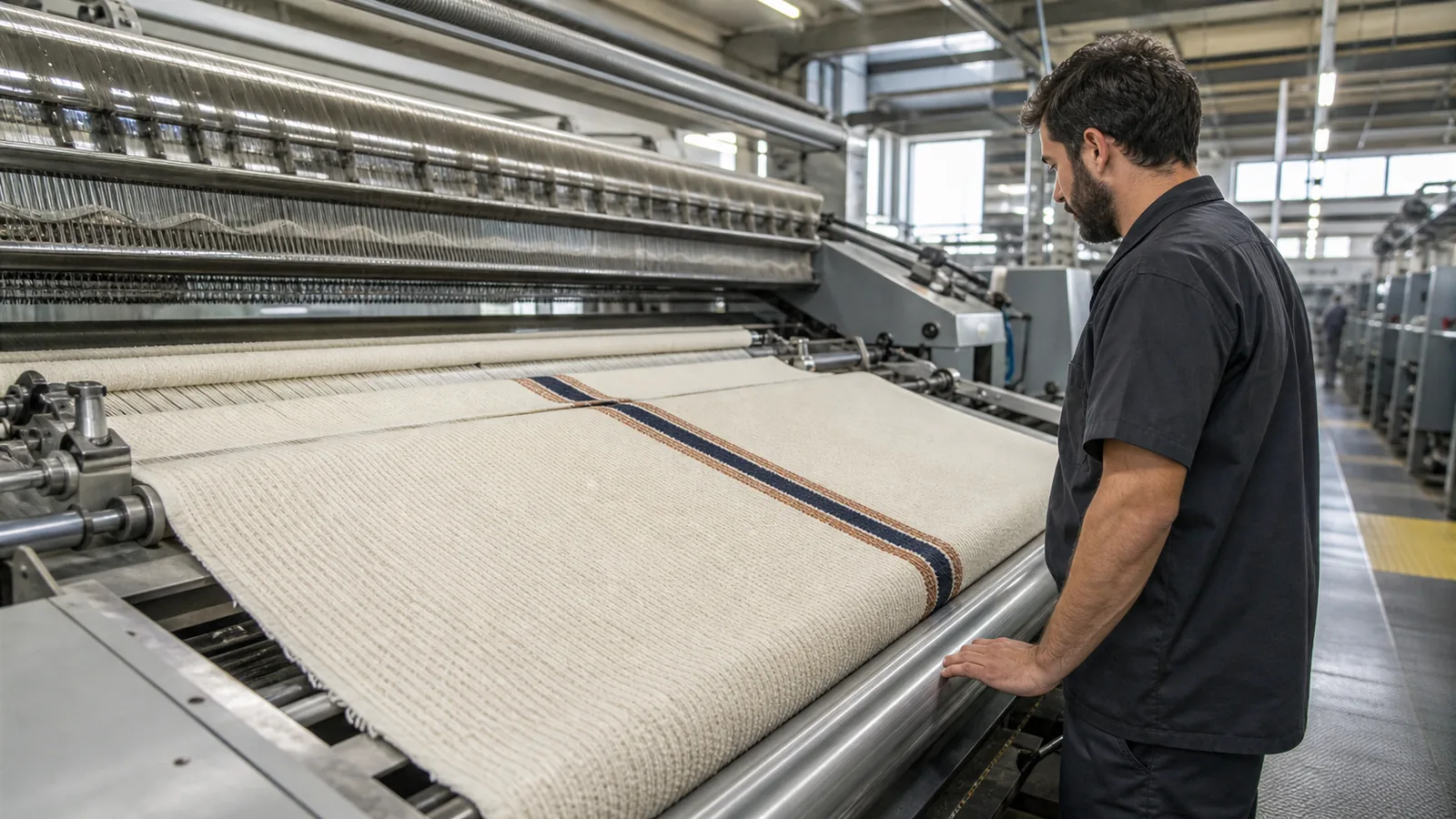
Choose wholesale bar mop towels by assigning a separate SKU to each restaurant wiping job, then specify finished post-wash dimensions, conditioned unit mass, mass-per-area basis, fiber by component, terry or rib construction, stripe or color, hems, label, and pack-out. Test production-representative samples for absorbency, dimensions, color, lint, seams, and the intended laundry process. Keep the textile purchase specification separate from the food-safety procedure: the FDA Food Code governs how wiping cloths are used, separated, held, and laundered under the code adopted by the local jurisdiction.
A low unit price can hide expensive differences. Two products sold as bar mops may have different finished areas, total mass, pile coverage, ground yarn, edge construction, shrinkage, drying behavior, and cartons. They may also be intended for different jobs. A damp counter cloth, a dry service cloth, a glass-polishing textile, and a heavy spill towel should not inherit one vague specification.
This guide is for restaurant groups, bars, cafes, commissaries, food-service distributors, linen suppliers, and private-label buyers. It does not prescribe one universal size, ounce-per-dozen figure, fiber mix, stripe color, wash formula, sanitizer, or replacement rate. Those decisions require the adopted local code, approved chemical labels, the facility's written procedures, actual laundry equipment, and an agreed textile trial.
Map every towel job before asking for a bulk quote
Walk the operation during preparation, service, closing, and laundry hand-off. Record where a clean textile is issued, what it is allowed to touch, whether it remains dry or becomes wet, what soils it receives, where it waits between uses, how it is separated after use, and when it returns. Give each job a name that staff and suppliers can recognize without relying on color alone.
“Bar towel,” “bar mop,” “kitchen towel,” and “wiping cloth” are market terms, not complete technical definitions. A terry utility towel may suit liquid pickup; a flatter herringbone or huck construction may be chosen for other wiping or polishing work. ASTM D4772-26 applies to terry surface-water absorption and explicitly excludes non-terry constructions such as huck and waffle weave. The test method has to fit the product.
| Task family | Textile question | Operating control to document |
|---|---|---|
| Wet counters and equipment surfaces | Terry/rib texture, wet pickup, size, hand fit, color or stripe | Adopted-code holding solution, concentration checks, separation, daily laundering |
| Dry service spills | Dry absorbency, lint, appearance, fold, edge bulk | Kept dry, single-purpose assignment, change and laundry rule |
| Raw-animal-food area | Clear visual identity and construction that survives its assigned process | Physical separation from cloths used for other purposes |
| Glass or flatware polishing | Low lint, surface compatibility, dimensions, seam profile | Clean storage, use boundaries, replacement and laundry process |
| Floor or non-food cleaning | Capacity, abrasion exposure, color coding, edge durability | Separate route, containers, chemicals, laundry, and clean storage |
Treat the FDA Food Code as an operating boundary, not a towel claim
The 2022 FDA Food Code is the agency's most recent full edition and is a model offered to state, local, tribal, and federal jurisdictions. A restaurant must follow the version and provisions adopted by its regulator. The buyer should therefore send the purchasing specification to the food-safety lead for review instead of advertising a towel as universally “FDA approved” or “food safe.”
Section 3-304.14 distinguishes wiping-cloth uses. Cloths used for food spills from tableware and carry-out containers during service are maintained dry and used for no other purpose. Cloths used on counters and equipment surfaces are held between uses in a chemical sanitizer solution at the concentration specified by the Code and are laundered daily under section 4-802.11(D). Cloths used on surfaces in contact with raw animal foods are kept separate. Dry cloths and holding solutions are kept free of food debris and visible soil.
Those provisions do not turn a reusable cloth into a substitute for required cleaning and sanitizing of food-contact surfaces. They also do not tell purchasing which sanitizer to choose. Use the product according to its approved label, maintain the facility's concentration and testing records, and confirm the local rule. Textile testing can show what happened to color, dimensions, absorbency, and construction under a stated condition; it does not validate a restaurant sanitation program.
Procurement boundary: keep the towel specification, chemical label, adopted-code procedure, staff training record, and laundry instruction as linked but separate documents. A stripe can support identification, yet visual coding cannot replace physical separation or the written procedure.
Specify terry, rib, ground, stripe, and hems
Start with the surface that performs the work
Full-terry and ribbed-terry products can put different amounts and distributions of pile against the surface. Ask for clear construction photographs and an approved physical sample, but write measurable characteristics into the agreement. Record pile face, ground visibility, stripe location, border width, hem turns, seam type, stitch density, corner build-up, loose-thread limits, and whether pile, ground, stripe, and sewing thread use different fibers.
Inspect wet handling as well as dry hand. Twist, bunch, fold, and wipe with the washed sample in the assigned station. Watch for a hard hem in the palm, a stripe that distorts, lint on dark equipment, loops that pull around corners, and a towel that becomes awkward when saturated. “Heavy duty” and “commercial grade” are not reproducible acceptance criteria.
Use stripes and colors as supporting identifiers
A center stripe can help separate departments or tasks, but the program needs enough contrast under real light and after laundering. Define the approved shade reference and acceptable variation. If several stripe colors are ordered, treat each color-SKU combination as a separate line in the MOQ plan and verify that new lots remain distinguishable from stock already in circulation.
The Federal Trade Commission's textile guidance lists towels, washcloths, and dishcloths among covered products and explains required fiber-content, country-of-origin, and manufacturer or responsible-business identity disclosures for most covered goods sold in the United States. Check the sewn label, packaging, quotation, and marketing claims against the same approved construction. The FTC Care Labeling Rule is directed to wearing apparel and certain piece goods; do not assume it creates a towel-specific care-label requirement.
Control finished size, total weight, and GSM on one stated basis
Restaurant towel quotations often use a weight per dozen. Convert that figure to a unit mass, then compare it with the finished dimensions and mass-per-area basis. ASTM D3776/D3776M-20(2025) provides options for measuring fabric mass per unit area. Ask which option, specimen, conditioning, and calculation produced the number, and state whether dimensional and weight tolerances apply before or after the agreed laundering sequence.
A simple check can reveal mismatched offers. If a finished towel measures 40 cm by 48 cm, its rectangular area is 0.192 m². At 500 g/m², the calculated fabric mass is 96 g before allowances for hems, borders, moisture condition, shape, and method basis. Twelve pieces would be 1.152 kg by the same calculation. This is a quotation check, not a recommended restaurant towel size or GSM.
Total unit mass affects cartons, station handling, washer loading, extraction, drying, and stock space. GSM alone does not establish wet pickup, lint, dry time, seam life, or useful service life. Use the towel GSM guide to normalize measurements, then approve the complete washed towel.
Build a sample test plan around the finished construction
Request enough production-representative samples to retain an untouched control, run the agreed laundry sequence, repeat a disputed observation, and see variation between units. Mark every piece with supplier, construction, size, stripe, revision, and date. A showroom sample from another yarn, finish, dye lot, or line should not become the bulk approval standard.
ASTM D5433-24 covers selected performance characteristics for woven and knitted kitchen towels, dishcloths, and other institutional and household towel products. It permits buyer and seller to establish purchasing requirements by agreement. ASTM D4772-26 measures rapid surface-water absorption and retention for terry fabrics, while warning that surface absorption is only one relevant towel characteristic and that comparative acceptance work may be needed because interlaboratory precision is known to be poor.
For colored or striped products exposed to industrial laundry, ISO 105-C12:2024 specifies methods for resistance of textile color to industrial laundering procedures. ISO 5077:2007 covers dimensional change after an appropriate preparation, wash, and dry combination. ISO 6330:2021 supplies reference domestic washing and drying procedures; it is useful only when a selected domestic procedure answers the question. It should not be described as a commercial-laundry simulation without evidence.
| Buyer question | Named method or trial | Record to retain |
|---|---|---|
| Which broader towel characteristics form the purchase agreement? | ASTM D5433-24 | Included, modified, and excluded requirements with limits and remedies |
| Does terry surface absorption meet the agreement? | ASTM D4772-26 | Specimen, laboratory, method, result, bias review, interpretation |
| Is mass per area being compared consistently? | ASTM D3776/D3776M-20(2025) | Option, conditioning, specimen dimensions, calculations, result |
| How does stripe or body color resist industrial laundering? | ISO 105-C12:2024 | Exact procedure, specimen, detergent and chemistry, ratings, laboratory |
| How do finished dimensions change? | ISO 5077:2007 with an agreed wash/dry procedure | Preparation, cycles, pre/post dimensions, percentage change |
| Does the towel work in this restaurant? | Documented station and laundry trial | Task, soil, use, holding, wash, dry, checkpoints, rejects, decision |
Record dimensions, conditioned mass, stripe and body color, absorbency, lint, pulled loops, pile loss, hems, corners, skew, shape, label condition, hand, drying observation, and any residue at each checkpoint. The towel sample testing checklist keeps the method, specimen, condition, and decision attached to one revision.
Trial the intended restaurant or rental-laundry route
Map the path from station issue to clean return: use, wet holding where applicable, soil separation, collection, transport, washer type, load, chemistry, temperature, cycle, extraction, dryer, finishing, inspection, folding, clean storage, and delivery. If a commercial linen service owns the process, record which variables the restaurant controls and which the service provider controls.
Use the exact proposed construction in the trial. White cotton, colored cotton, and cotton-blend products can react differently to chemistry, heat, drying, and repeated handling. Do not convert a bleach-resistance claim into a wash-life promise. The bleach-resistant towel guide explains how to separate method-specific color evidence from a facility's chemical and disinfection procedure.
Keep a clean returned towel beside the untouched control under stable light. Ask kitchen operations and laundry staff to sign the same report. A textile that wipes well but creates excessive lint, stays unavailable too long, requires a special sort, or loses its task stripe can still fail the program.
Calculate bar mop inventory from station demand and clean-return time
Count actual issues by station and shift for each task-specific SKU. Add every period the towel remains unavailable in use, holding, collection, transport, sorting, washing, drying, inspection, folding, and clean return. Model weekend or event peaks, route delays, rejected pieces, unexplained loss, and new-location openings separately instead of hiding them in one arbitrary par number.
Planning example, not a restaurant standard: if six stations issue 18 towels each during a measured peak service, demand is 108 pieces. If the full laundry route keeps that SKU unavailable for two service intervals, working stock is 216. A buyer-selected 15% disruption reserve adds 32.4, producing 248.4 before rounding to the approved case pack. Replace every figure with operating data.
Track why pieces leave circulation: permanent soil, color loss, stripe ambiguity, lint, torn hems, pulled loops, shrinkage, loss, task transfer, or delayed clean return. A rising purchase rate may point to a routing, chemical, drying, sorting, or inventory problem rather than the fiber name alone.
Normalize supplier quotations and write the approved towel into the PO
Compare finished post-wash dimensions, conditioned unit mass, stated GSM and method basis, fiber by component, pile and ground construction, stripe, hems, thread, label, packaging, quantity, testing, inspection, Incoterm, payment, and destination. A per-dozen price is not comparable when the pieces differ in area, mass, construction, test scope, packaging, or trade responsibility. Use the wholesale towel pricing guide to normalize landed scope.
Identify the signed pre-production sample by code and date. Attach the station map, finished specification, shade or stripe reference, test sheet, label, packaging standard, and inspection plan. Require written approval before changing fiber, pile, ground, yarn, GSM, size, stripe, dye, finish, hem, thread, label, pack, or production location.
Define bulk sampling, inspection stage, responsible party, laboratory, report deadline, tolerance, retest, remedy, and nonconforming-goods procedure before production. The supplier vetting checklist helps review traceability and change control, while the private-label versus OEM guide keeps customization scope clear.
Wholesale bar mop towel buyer checklist
Complete before bulk release
- Map wet, dry, raw-animal-food, polishing, spill, floor, and non-food-cleaning jobs as separate task families.
- Confirm the locally adopted food code, approved chemical labels, holding, separation, use, laundering, and training procedure.
- Specify post-wash size, tolerance, conditioned unit mass, mass-per-area basis, fiber by component, construction, stripe, hems, label, and pack.
- Keep an untouched control and test enough production-representative samples to observe variation.
- Use ASTM D4772 only for terry products within its scope; select a suitable method for non-terry constructions.
- Name the industrial-laundry colorfastness and dimensional-change procedures, conditions, checkpoints, and acceptance limits.
- Run a documented station and laundry trial with the actual soils, holding route, wash, extraction, dry, fold, and clean return.
- Record absorption, size, mass, color, lint, loops, seams, shape, label, hand, drying, residue, and task identification.
- Calculate stock from measured station issues and full unavailable time; track reserves, rejects, losses, and delays separately.
- Attach the approved sample, specification, reports, labels, packaging, change controls, inspection, and remedies to the purchase order.
Frequently asked questions
What is a bar mop towel?
A bar mop towel is a reusable utility textile used for wiping and spill work in restaurants, bars, cafes, and commercial kitchens. The market name does not define one size, weight, fiber blend, weave, or performance level, so buyers should specify the finished product and the task assigned to it.
What size and weight are best for wholesale bar mop towels?
There is no universal best size or weight. Choose finished post-wash dimensions, conditioned unit mass, and mass-per-area basis from the station, hand fit, spill volume, folding, sanitizer-container use where applicable, washer and dryer capacity, and the agreed service trial.
Are bar mop towels food safe?
A towel is not made compliant by a food-safe label. The FDA Food Code is a model for jurisdictions and controls how wiping cloths are separated, held, used, and laundered. Verify the adopted local code, approved chemical labels, facility procedures, and the exact textile specification.
Should restaurants buy cotton or cotton-blend bar mop towels?
Choose by measured performance rather than fiber shorthand. Cotton pile can provide useful wetting and absorbency, while a blended ground may be proposed for structural or process reasons. Require fiber content by component, test the finished construction after the intended laundry process, and confirm that labels and claims match the product.
How many bar mop towels should a restaurant order?
Calculate each task-specific SKU from measured peak issues per station and the full time towels remain unavailable in use, collection, separation, laundering, drying, inspection, and clean return. Add documented reserves for rejects, loss, disruption, and delivery risk, then round to the approved case pack or production quantity.
Buy a controlled restaurant towel program, not a generic dozen
The useful bar mop specification follows one textile from the mill through its assigned station, code-based handling, laundry, inspection, and clean return. That path gives the buyer measurable limits and gives restaurant staff a product they can identify and manage without guessing.
When towel jobs, finished dimensions, unit mass, construction, stripes, laundry route, quantities, testing, labels, packaging, destination, and delivery target are ready, request wholesale bar mop towel pricing, MOQ, and samples.
Primary authorities
- U.S. Food and Drug Administration: FDA Food Code
- U.S. Food and Drug Administration: 2022 Food Code, including sections 3-304.14, 4-802.11, and 4-803.11 through 4-803.13
- ASTM International: ASTM D5433-24, Standard Performance Specification for Towel Products for Institutional and Household Use
- ASTM International: ASTM D4772-26, Surface Water Absorption of Terry Fabrics
- ASTM International: ASTM D3776/D3776M-20(2025), Mass Per Unit Area of Fabric
- International Organization for Standardization: ISO 105-C12:2024, Colour Fastness to Industrial Laundering
- International Organization for Standardization: ISO 5077:2007, Determination of Dimensional Change in Washing and Drying
- International Organization for Standardization: ISO 6330:2021, Domestic Washing and Drying Procedures for Textile Testing
- Federal Trade Commission: Threading Your Way Through Textile and Wool Labeling Requirements