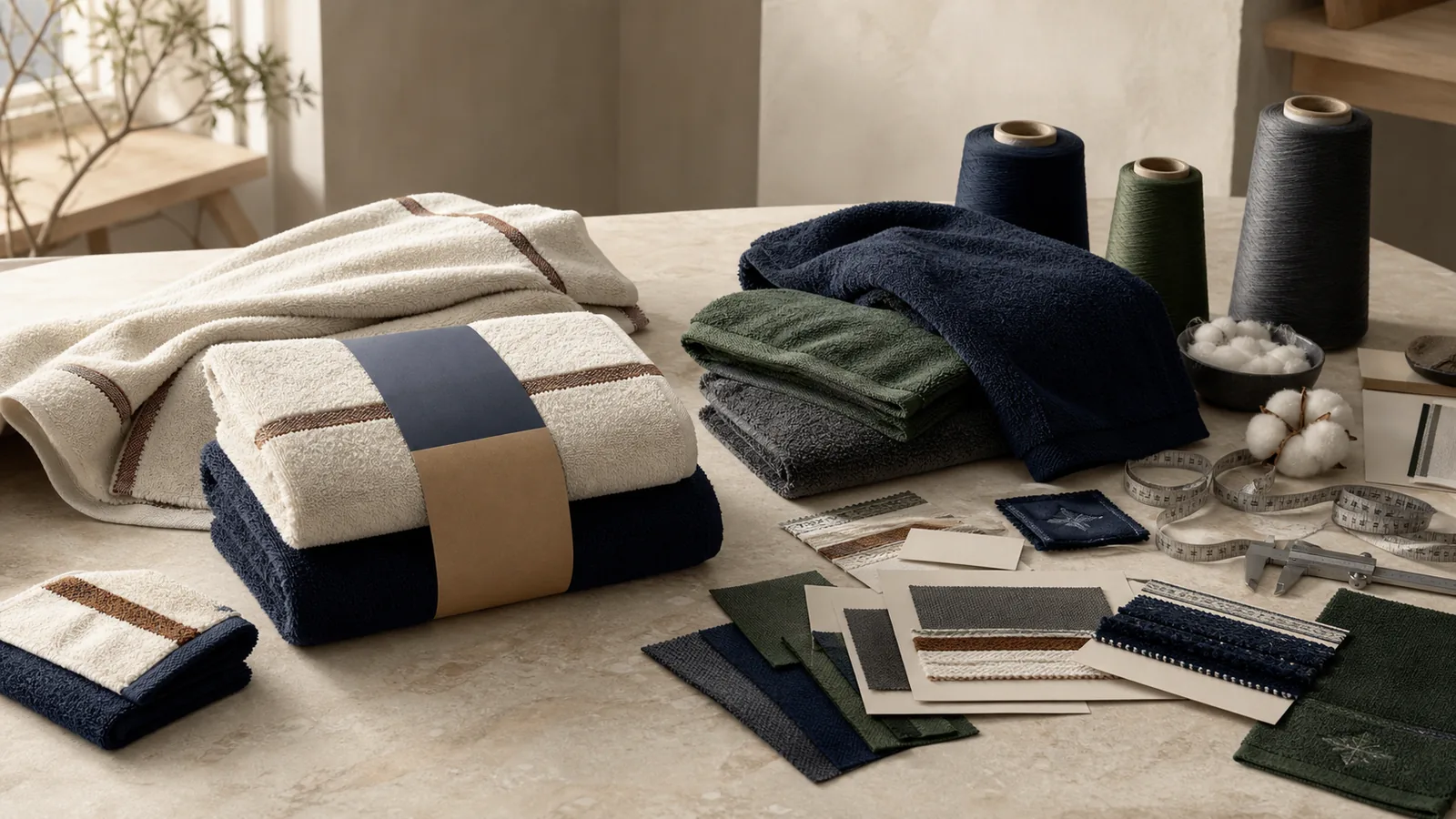
Private label towels use an existing, proven towel construction and add your brand, packaging, and selected presentation options. OEM towels are developed to a buyer-controlled specification that may change the yarn, GSM, dimensions, construction, colour, border, finish, or performance standard. Private label is usually the faster route with less development work. OEM offers more product control but normally requires more sampling, testing, time, and volume.
Buyers often use “private label” and “OEM” as if they mean the same thing. A supplier may do the same in an early sales conversation. The distinction becomes important when a quote, sample, or delivery date depends on how much of the product is already established and how much must be developed for one buyer.
The right route is not determined by which label sounds more advanced. It depends on whether a proven towel already meets the customer promise you intend to make. A brand launching a dependable hotel-style bath collection may benefit from a private label programme. A distributor developing a towel around a specific commercial laundry cycle, proprietary border, or unusual size may need OEM development.
What is the practical difference between private label and OEM towels?
A private label programme begins with a towel the manufacturer already knows how to produce. Its core construction has been established, even if the buyer can choose among available colours, sizes, packaging formats, woven labels, or embroidery options. Development focuses on adapting the presentation and confirming that the chosen product is suitable for the brand’s market.
An OEM programme begins with the buyer’s product brief. The factory may need to source a different yarn, develop a construction, create a border, match a colour, produce strike-offs or samples, test performance, and set production tolerances. Some OEM projects modify a proven platform rather than starting with a blank loom plan, but the finished specification belongs to the buyer’s programme and must be validated as a new combination.
The terminology is not perfectly standardized across the textile industry. One supplier may call a custom colour on an established towel “OEM,” while another treats it as a private label option. Avoid deciding from the label alone. Ask for a written scope showing the base construction, selectable options, new development work, ownership of artwork and specifications, and the changes that trigger a new sample.
Private label vs. OEM towels at a glance
| Decision area | Private label towels | OEM towels |
|---|---|---|
| Starting point | Established towel construction or product family | Buyer-defined requirement or significantly modified construction |
| Product control | Control within available sizes, colours, branding, and packaging options | Broader control over yarn, construction, GSM, dimensions, border, colour, finish, and testing |
| Sampling | Approval sample selected or adapted from a proven line | Development samples, revisions, and often a pre-production sample |
| Minimum order | Often lower when the base product and materials are already in use | Often higher when yarn, dyeing, loom setup, finishing, or packaging is unique |
| Lead time | Usually shorter after branding and packaging approval | Usually longer because development and validation occur before bulk production |
| Best fit | Faster launch, line extension, market testing, or a standard commercial specification | Distinct performance target, proprietary design, unusual size, or established high-volume programme |
When private label is the stronger choice
Private label works well when product availability and execution matter more than owning every construction detail. A buyer can compare proven samples, select the closest fit, then concentrate on colour, logo placement, packaging, carton marking, and the customer experience around the towel.
This route can reduce development risk because the factory has production history for the base construction. That does not remove the need for a specification. The purchase order should still state fibre content, dimensions, target GSM and tolerance, colour reference, border, stitching, finish, packaging, branding, and inspection criteria. The towel GSM guide explains why weight should be considered with construction and end use rather than treated as a stand-alone quality grade.
Private label is particularly useful for a first collection when the brand needs real sales data before committing to a custom platform. A successful programme can later move toward OEM if customer feedback shows a clear reason to change absorbency, drying time, size, border design, or another construction feature.
When OEM development earns the extra work
OEM makes sense when an established product cannot deliver the required result. That requirement should be specific enough to test. “More premium” is not a development brief. A target washed dimension, drying-time range, lint limit, colourfastness method, border geometry, yarn specification, or laundering protocol gives the factory and buyer a standard to work against.
The sampling plan should identify what each sample proves. A lab sample or colour strike-off may confirm shade but not bulk hand feel. A showroom towel may demonstrate construction but not the buyer’s final yarn or finish. A pre-production sample should represent the approved combination as closely as practical, and production checks should use the same written requirements.
OEM is also appropriate when the product’s design is central to the brand: a proprietary woven border, a distinctive construction, a non-standard dimension set, or a packaging system engineered for a particular channel. Confirm who owns the artwork, technical files, tooling, and approved samples, and whether the manufacturer may offer the same design to other buyers.
How MOQ, cost, and lead time really change
There is no universal MOQ for either route. Minimums arise from practical production units: yarn purchasing, dye-lot size, loom setup, finishing, embroidery, printed packaging, carton quantities, and the number of colours or sizes in the order. A supplier should explain the constraint behind the number instead of presenting an unexplained factory minimum.
Private label can be more economical when stock yarns, current colours, established constructions, and standard packaging are used. Custom labels or boxes can still carry their own minimums. OEM may require development charges, additional samples, laboratory testing, dedicated materials, or a higher production quantity. These costs should be separated in the quote so the buyer can see which decisions are creating the minimum.
Lead time should be shown as stages: brief confirmation, sample development, approval, material booking, production, inspection, packing, and transit. A quoted production time that begins only after sample approval is not the full launch timeline. Build revision time into an OEM schedule, especially when colour or construction changes require another sample.
Branding, packaging, and U.S. textile labelling
A branded towel programme involves more than adding a logo. The product label, packaging, carton marks, barcode, fibre claim, country-of-origin statement, and responsible company identity must agree. The FTC states that most covered textile products sold in the United States must disclose fibre content, country of origin, and the manufacturer or another responsible business. A U.S. company may use its full business name or an FTC Registered Identification Number where the rules allow.
For cotton products, fibre claims must match the product’s actual construction. A towel with cotton loops and a different ground yarn may need a more specific disclosure than “100% cotton.” The FTC’s cotton guidance provides an example separating the loop and ground composition. Buyers should review the final label with qualified compliance counsel or their importer because the correct statement depends on the product and sales channel.
The FTC Care Labeling Rule applies to textile wearing apparel and certain piece goods, not as a blanket care-label rule for every household towel. Even when a permanent care label is not required under that rule, accurate care information may be commercially important and other obligations can apply. Confirm intended claims and washing instructions through testing rather than copying them from a similar product.
Whether the programme is private label or OEM, approve every visible brand element before bulk production. That includes embroidery size and position, woven-label artwork, packaging colour, insert copy, barcode data, case markings, and the exact identity used on required labels.
Quality control should not change with the sourcing label
An existing private label line can still vary between dye lots or production batches. A custom OEM product can still be packed incorrectly after the construction is approved. Both routes need a controlled reference: specification, approved sample, tolerance table, inspection points, and a written remedy process.
Retain the yarn or colour reference, construction data, sample identification, test results, artwork versions, packing standard, and production records needed for a reorder. Ask what must be reapproved if raw materials, machinery, subcontractors, or processing methods change. Loft Weave’s quality and certification approach explains how documentary evidence should connect to the actual product and production site.
A six-question decision checklist
- Does an existing construction already meet the intended use, feel, durability, and price target?
- Which features are essential to the product promise, and which are preferences?
- Can each custom requirement be stated and tested objectively?
- Does expected volume justify dedicated materials, setup, development, and packaging minimums?
- Can the launch schedule absorb sampling and possible revision cycles?
- Who owns the specification, artwork, approved sample, testing records, and future change approvals?
If the first answer is yes and the remaining custom requirements concern brand presentation, start by comparing private label options. If the product promise depends on a construction or performance requirement that available towels cannot meet, prepare an OEM brief. Loft Weave’s Private Label & OEM programme covers both routes.
Frequently asked questions
Is private label the same as putting a logo on a stock towel?
It can include logo application, but a proper private label programme also defines the selected construction, colour, sizes, labels, packaging, carton presentation, inspection criteria, and reorder standard under the buyer’s brand.
Are OEM towels always completely new?
No. An OEM product may adapt a proven construction while changing important specifications. The useful distinction is the amount of buyer-controlled development and validation required, not whether every element begins from zero.
Which option has the lower MOQ?
Private label often has a lower MOQ when it uses materials and constructions already in production. Custom packaging can introduce a separate minimum. OEM minimums depend on yarn, dyeing, loom setup, finishing, colour count, sizes, and other dedicated inputs.
Can a brand move from private label to OEM later?
Yes. Many brands use an established construction to test demand and gather customer feedback, then develop an OEM specification when the expected volume and product requirement justify it.
What should be approved before production?
Approve the written specification, identified sample, tolerances, artwork, colours, product labels, packaging, carton marks, inspection plan, delivery terms, and change-control process.
Choose the route after the product brief is clear
The most useful supplier conversation starts with application, performance, dimensions, GSM, fibre content, colours, branding, packaging, volume, destination, and timing. Once those details are visible, the supplier can show whether an established private label line fits or whether OEM development is justified.
Share the programme through Loft Weave’s pricing, MOQ, and lead-time request. The response should identify the proposed route and the assumptions behind it, so the quote can be evaluated against the product you intend to sell.