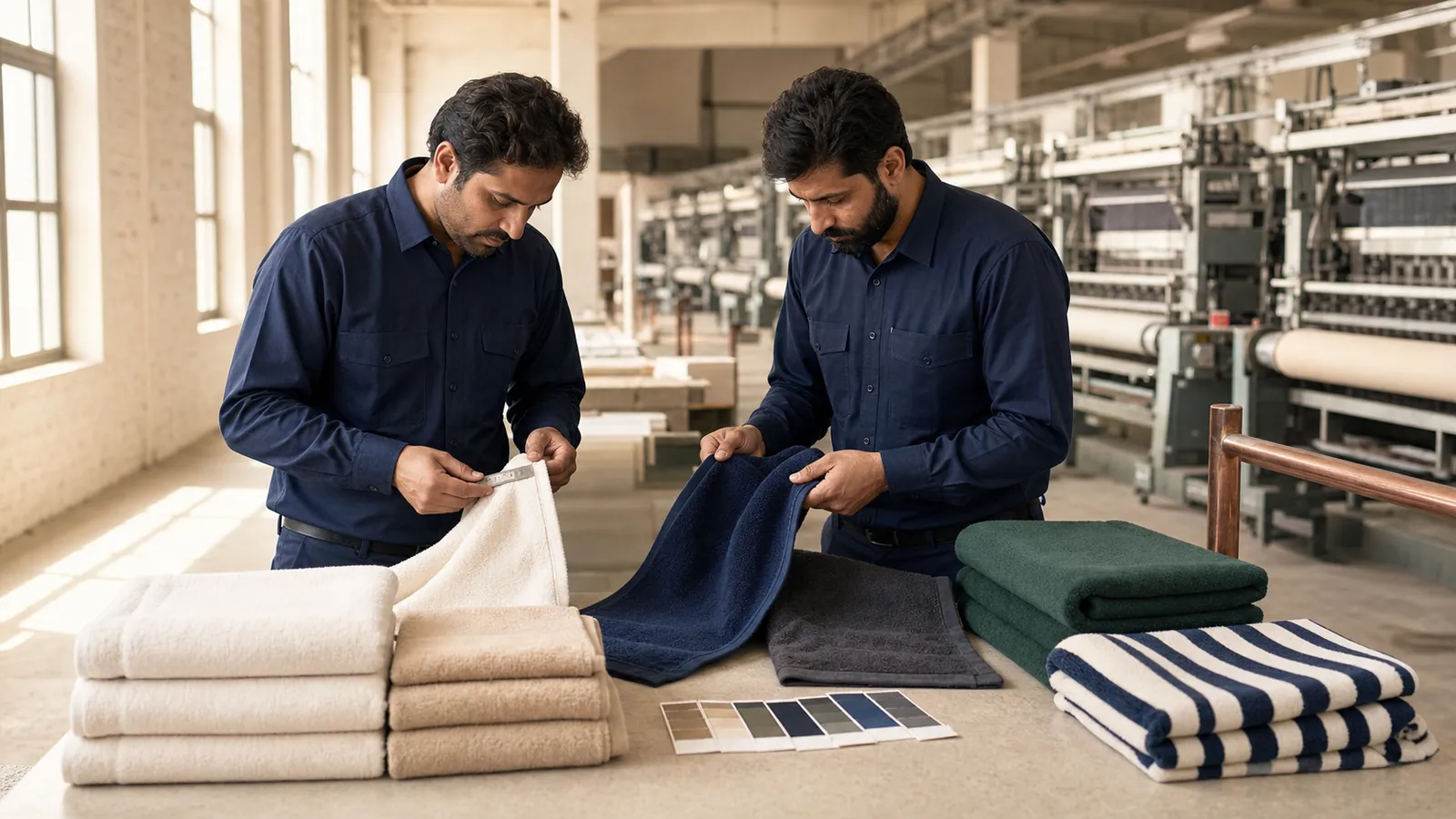
Choose a towel supplier by testing whether its claims can be converted into evidence: a written specification, a representative sample, current certificates with the correct scope, inspection records, clear shipping responsibilities, and a remedy if production misses the approved standard. Price matters, but an incomplete comparison can make the cheapest quote the most expensive order.
A polished catalogue tells you what a supplier wants to sell. It does not tell you whether the fifth reorder will match the first, who checks a batch before dispatch, or what happens when a carton count is wrong. Those answers come from the questions you ask and the documents you request.
Prepare the brief before comparing suppliers
A quote is only comparable when every supplier is pricing the same requirement. Start with intended use, towel type, dimensions, target GSM, fibre content, colour, border or pattern, branding, packing, order quantity, destination, and required delivery window. If one quote assumes a stock towel and another assumes a custom-dyed programme, their totals answer different questions.
For help defining weight and use case, begin with the Loft Weave towel GSM guide. Treat the brief as the first version of the production specification, then record every approved change in writing.
Ten questions to ask a wholesale towel supplier
1. What can you produce at my volume, and what is the realistic lead time?
Ask for capacity in the towel construction you need, not a factory-wide headline number. Loom availability, dyeing, embroidery, packaging, and raw-material scheduling can create different bottlenecks. A credible answer separates sampling, material booking, production, final inspection, and transit instead of offering one optimistic date.
2. Which recent orders are genuinely comparable with mine?
Segment experience matters because a hotel bath towel, gym hand towel, salon towel, and pool towel face different laundering, storage, colour, and service demands. Ask for anonymized examples that match your product type, construction, quantity range, and destination. Shipment history can be shown without exposing another buyer's pricing or brand.
3. How will the approved specification be measured?
Words such as "premium," "hotel quality," and "high absorbency" are not measurable. The specification should state target values and permitted tolerances. For GSM, ask how samples are conditioned, cut, weighed, and reported. For dimensions, confirm whether measurement occurs before or after laundering. Add shade, shrinkage, colourfastness, stitching, pile, and absorbency tests when they matter to the programme.
4. Is the approval sample representative of production?
A development sample can confirm size, colour direction, border, logo position, and general hand feel. It may not represent a bulk dye lot or a full production run. Ask what will change between the sample and production, then keep a sealed or signed approval sample. For a new construction, a pre-production or production-line sample provides better evidence than a showroom piece selected from stock.
5. Where are defects found, recorded, and corrected?
Final inspection alone is late. Ask how the supplier checks incoming yarn, weaving, dyeing, cutting, hemming, embroidery, finishing, and packing. The answer should identify who can stop or segregate a non-conforming batch. Photographs are useful, but a report should connect those photographs to an order, batch, quantity, result, and disposition.
6. Can every certification claim be verified?
Ask for the certificate number, legal entity, production site, scope, issuing body, status, and expiry date. Then verify it with the scheme owner or issuing body. OEKO-TEX provides a Label Check for product labels. GOTS maintains a certified-supplier database. ISO explains that organizations are certified by external certification bodies, not by ISO itself, and points buyers to IAF CertSearch for accredited management-system certificates.
A certificate may be genuine but irrelevant to your order if it covers a different company, site, process, product group, or period. Review the scope, not just the logo. Loft Weave's certifications page explains how these standards fit into commercial towel sourcing.
7. What does the social-audit evidence actually say?
Do not accept "Sedex certified" or "SMETA certified" as shorthand. Sedex states that it is not a certification scheme and that neither membership nor a SMETA audit produces a pass or fail. Ask which site was audited, when the audit occurred, who conducted it, which pillars were covered, what findings remain open, and whether corrective actions can be shared.
8. Who manages cargo security and customs handoffs?
For Pakistan-origin goods, be precise about CTPAT. CBP's foreign-manufacturer eligibility document limits that partner category to manufacturers in Mexico or Canada. A factory in Pakistan should not be presented as a CTPAT-certified foreign manufacturer. Instead, ask which eligible importer, carrier, consolidator, broker, or other supply-chain partners participate and how security requirements flow through the route.
CBP says CTPAT partners are considered lower risk and may receive benefits such as fewer examinations or front-of-line inspections, but participation does not guarantee that a particular shipment will avoid examination or clear by a fixed date.
9. Who prepares each shipping document, and who is the importer of record?
Commercial terms should identify responsibility for the commercial invoice, packing list, bill of lading, origin information, classification support, export documentation, insurance, customs entry, duties, and inland delivery. Confirm the Incoterm and named place in writing. An Incoterm does not replace a complete agreement, and it does not decide every compliance obligation.
10. What happens if production misses the approved standard?
Agree on the claims process before placing the order. Define the notice period, evidence required, inspection rights, and available remedies. Depending on the problem, a remedy might involve rework before dispatch, replacement, credit, or another written resolution. Reorder consistency should also be addressed: what records are retained, how long colour or construction references remain valid, and what changes require new approval?
A simple towel supplier scorecard
Score each supplier against evidence rather than presentation. A three-point scale keeps the comparison usable: 0 means no answer or unverifiable claim, 1 means a partial answer, and 2 means the requested evidence is current and relevant.
| Area | Evidence to review | Score |
|---|---|---|
| Capability | Comparable construction, volume range, milestone schedule | 0 / 1 / 2 |
| Specification | Targets, tolerances, methods, approved sample, change control | 0 / 1 / 2 |
| Quality | Inspection plan, batch records, defect handling, authority to stop work | 0 / 1 / 2 |
| Compliance | Verifiable certificates, correct scope, current audit evidence | 0 / 1 / 2 |
| Logistics | Named parties, documents, Incoterm, broker, importer of record | 0 / 1 / 2 |
| Accountability | Named contact, response times, claims process, reorder records | 0 / 1 / 2 |
A high score is not an automatic approval. It shows where the supplier has reduced uncertainty and where your contract or inspection plan still needs work.
Warning signs that deserve a closer look
- The supplier agrees to every requirement immediately but does not ask about end use, tolerance, or timing.
- Capacity and lead-time answers stay vague after the order details are known.
- The quote omits fibre content, construction, dimensions, GSM, packing, or delivery basis.
- A logo is offered instead of a certificate number, scope, issuing body, and current status.
- A showroom sample is treated as proof that every production batch will match.
- Inspection photos are not connected to a dated report, batch, quantity, or result.
- No one can explain who owns documentation, customs coordination, or a quality claim.
- The payment request arrives before the final specification and commercial terms are approved.
Frequently asked questions
What is the most important question to ask a towel supplier?
Ask how the approved specification will be measured and verified during production. This connects the sample, tolerances, inspection records, and remedy process. Without it, "same as sample" is open to interpretation.
Can a towel factory in Pakistan be CTPAT certified?
Not under CBP's CTPAT foreign-manufacturer category, whose published eligibility is limited to manufacturers in Mexico or Canada. Ask which eligible importer, carrier, broker, or other logistics partners participate in CTPAT and how their role relates to your shipment.
How do I verify an OEKO-TEX STANDARD 100 claim?
Request the label or certificate number and enter it in the official OEKO-TEX Label Check. Confirm the status and that the certified article or scope matches the towel you plan to buy.
Should I choose the supplier with the lowest unit price?
Compare landed cost, specification completeness, sampling, inspection, documentation, delivery basis, and remedy terms. A lower unit price can be outweighed by inconsistent production, rework, delays, or services excluded from the quote.
What sample should I approve before a bulk towel order?
Approve a sample identified by construction, fibre content, dimensions, GSM, colour, border, stitching, finish, and branding. For a new programme, ask whether a pre-production or production-line sample will be available and retain a sealed reference.
Turn the checklist into a controlled first order
Supplier selection should leave you with fewer assumptions and better records. Write the brief, compare evidence, approve a representative standard, and document who owns each step through delivery. Loft Weave's US-managed sourcing model is built around that handoff between buyer requirements, production oversight, and delivery coordination.
When you are ready to compare a real specification, share the application, quantities, target GSM, colours, branding, and timing through the wholesale pricing request.
Primary sources
- U.S. Customs and Border Protection: Customs Trade Partnership Against Terrorism
- CBP: CTPAT Foreign Manufacturer Eligibility Requirements
- OEKO-TEX: STANDARD 100 and Label Check guidance
- Global Organic Textile Standard: Certified Suppliers Database
- International Organization for Standardization: Certification and verification guidance
- Sedex: SMETA audits, membership, and certification clarification